Thank you for visiting SNEWPapers!
Sign up free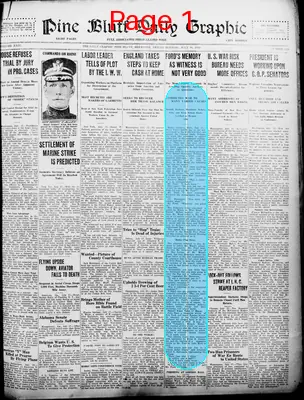
Pine Bluff Daily Graphic
Pine Bluff, Jefferson County, Arkansas
What is this article about?
Henry Ford testifies in his $1,000,000 libel suit against the Chicago Tribune in Mount Clemens, Mich., on July 17. He evades specific answers, denies a flag story from a speech, attributes World War I to bankers, munitions makers, alcohol, kings, and school books, and discusses a 1916 article about his lifestyle.
Clipping

OCR Quality
Full Text
Attributes War to Many Varied Causes
Alcohol, Bankers, Munitions Makers, King and Even School Books Ascribed as Responsible
Mount Clemens, Mich., July 17.—Henry Ford's fourth day on the witness stand in his $1,000,000 libel suit against the Chicago Daily Tribune, was much like yesterday in subject matter and in the prolonged multiplying of questions to obtain specific answers. This was true even of answers, which he returned yesterday but which apparently he had forgotten over night.
Today while he was being questioned by Elliott Stevenson, Tribune attorney, concerning a letter sent by Theodore Delavigne, who was his peace publicity man in 1916, to Henry A. Wise Wood, the following went into the record:
Mr. Ford: "I don't know anything about the letter. I know that he wrote it, sent it out."
Mr. Stevenson: "Do you think that he would have made that statement if it were not true?"
Attorney Murphy: "That is objected to as argumentative."
Mr. Ford: "I don't know."
The court: "He does not say he did not: he says he doesn't remember. What did you say Mr. Ford?"
Mr. Ford: "I don't remember. Whatever the stenographer has got there."
Mr. Stevenson: "You don't remember what?"
Mr. Ford: "Whatever you asked me."
The Delavigne letter concerned a speech by Henry A. Wise Wood in Detroit. Before making the address, Mr. Wood called on Mr. Ford, and in his speech quoted Mr. Ford as wishing to ignore all national boundaries and stating that after the war he would pull the Stars and Stripes from his factories and hoist a world brotherhood flag.
This speech was reported the next morning in the Detroit Free Press, and that evening, the Detroit Evening News had an editorial on it.
Denies Flag Story.
The editorial referred to was designed to refute Mr. Wood's preparedness arguments. Mr. Ford testified that Mr. Delavigne told him of the flag feature of Mr. Wood's speech, but that Delavigne wrote the Wood letter on his own responsibility.
He admitted that he had never asked the Free Press to deny the truth of any portion of the speech, although he said he had denied it often in other quarters.
"Apparently you now think that the statement that you were going to lower the flag was a reflection on you," suggested Mr. Stevenson.
"It was a detriment, yes sir."
"You have denied it since in the senatorial campaign?"
"I don't remember."
"Was it published in the senatorial campaign?"
"I didn't pay any attention to the senatorial campaign. They are liable to say anything in a campaign."
Scattered through his testimony, it appears Mr. Ford's ascribed the world war to variety of causes, including bankers, munition makers, alcoholic drink, kings and their henchmen, and school books.
Doesn't Know Value of House.
John Reed, a magazine writer of New York, and recent Russian bolshevik emissary to the United States disclosed the alleged facts in an article published in 1916. It was entitled "Industry's Miracle Maker."
The reading of this article cut severely into the time that Mr. Ford was on the stand and arguments on admissibility of evidence among counsel cut in much more.
The opening hours were consumed with testimony by Kirke B. Alexander, and the reading of a magazine article on Mr. Ford by John Reed in 1916.
"The article says you live in a million dollar house," said Attorney Elliott G. Stevenson, representing the Tribune.
"More than that, I think."
"A million and a half?"
"Well, I don't really know."
"Maybe you don't want to know."
"I told them not to tell me," said Mr. Ford, laughing.
What sub-type of article is it?
What themes does it cover?
What keywords are associated?
What entities or persons were involved?
Where did it happen?
Story Details
Key Persons
Location
Mount Clemens, Mich.
Event Date
July 17
Story Details
Henry Ford testifies in libel suit against Chicago Tribune, evades questions about a 1916 letter regarding a speech quoting him on flags and world brotherhood, denies involvement, attributes World War to bankers, munitions makers, alcohol, kings, and school books, and discusses his house value from a magazine article.