Thank you for visiting SNEWPapers!
Sign up free
The Lincoln Times
Lincolnton, Lincoln County, North Carolina
What is this article about?
The United States has secured a two-year supply of quinine for malaria combat through research in South America by University of Michigan botanist Dr. William C. Steere and USDA botanist Dr. F. R. Fosberg, who explored Cinchona trees in Colombia, Ecuador, and Peru since October 1942.
Clipping
OCR Quality
Full Text
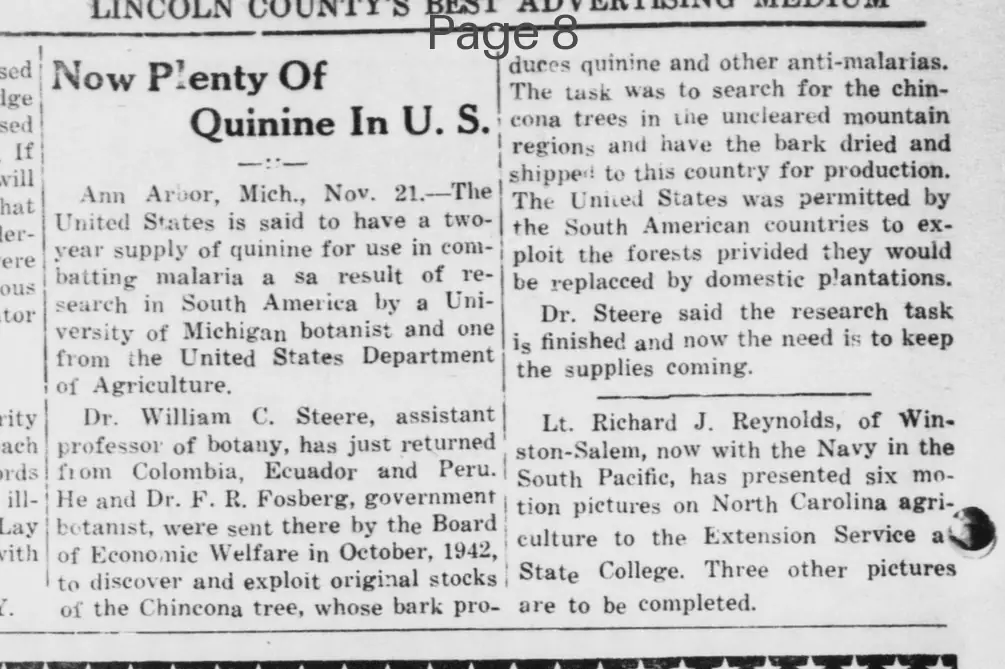
Ann Arbor, Mich., Nov. 21.-The United States is said to have a two-year supply of quinine for use in combating malaria as a result of research in South America by a University of Michigan botanist and one from the United States Department of Agriculture.
Dr. William C. Steere, assistant professor of botany, has just returned from Colombia, Ecuador and Peru. He and Dr. F. R. Fosberg, government botanist, were sent there by the Board of Economic Welfare in October, 1942, to discover and exploit original stocks of the Cinchona tree, whose bark produces quinine and other anti-malarials.
The task was to search for the cinchona trees in the uncleared mountain regions and have the bark dried and shipped to this country for production. The United States was permitted by the South American countries to exploit the forests provided they would be replaced by domestic plantations.
Dr. Steere said the research task is finished and now the need is to keep the supplies coming.
What sub-type of article is it?
What keywords are associated?
What entities or persons were involved?
Where did it happen?
Domestic News Details
Primary Location
Ann Arbor, Mich.
Event Date
Nov. 21
Key Persons
Outcome
two-year supply of quinine secured; research task finished; need to maintain supplies
Event Details
Research in South America by University of Michigan and USDA botanists discovered and exploited Cinchona tree stocks for quinine production to combat malaria; sent by Board of Economic Welfare in October 1942 to Colombia, Ecuador, and Peru; bark dried and shipped to US; forests to be replaced by domestic plantations.