Thank you for visiting SNEWPapers!
Sign up free
The Kentucky Gazette
Lexington, Fayette County, Kentucky
What is this article about?
H. H. Brackenridge defends the U.S. war against hostile Indian tribes, arguing their inherent savagery necessitates decisive military subjugation rather than lenient treaties or agents. He criticizes romanticized views, British support for Indians, and urges garrisoning Presqu'ile for strategic control and future trade.
Merged-components note: These components form a continuous essay by H.H. Brackenridge on the Indian War, spanning pages 1 and 2.
Clippings
1 of 2
OCR Quality
Full Text
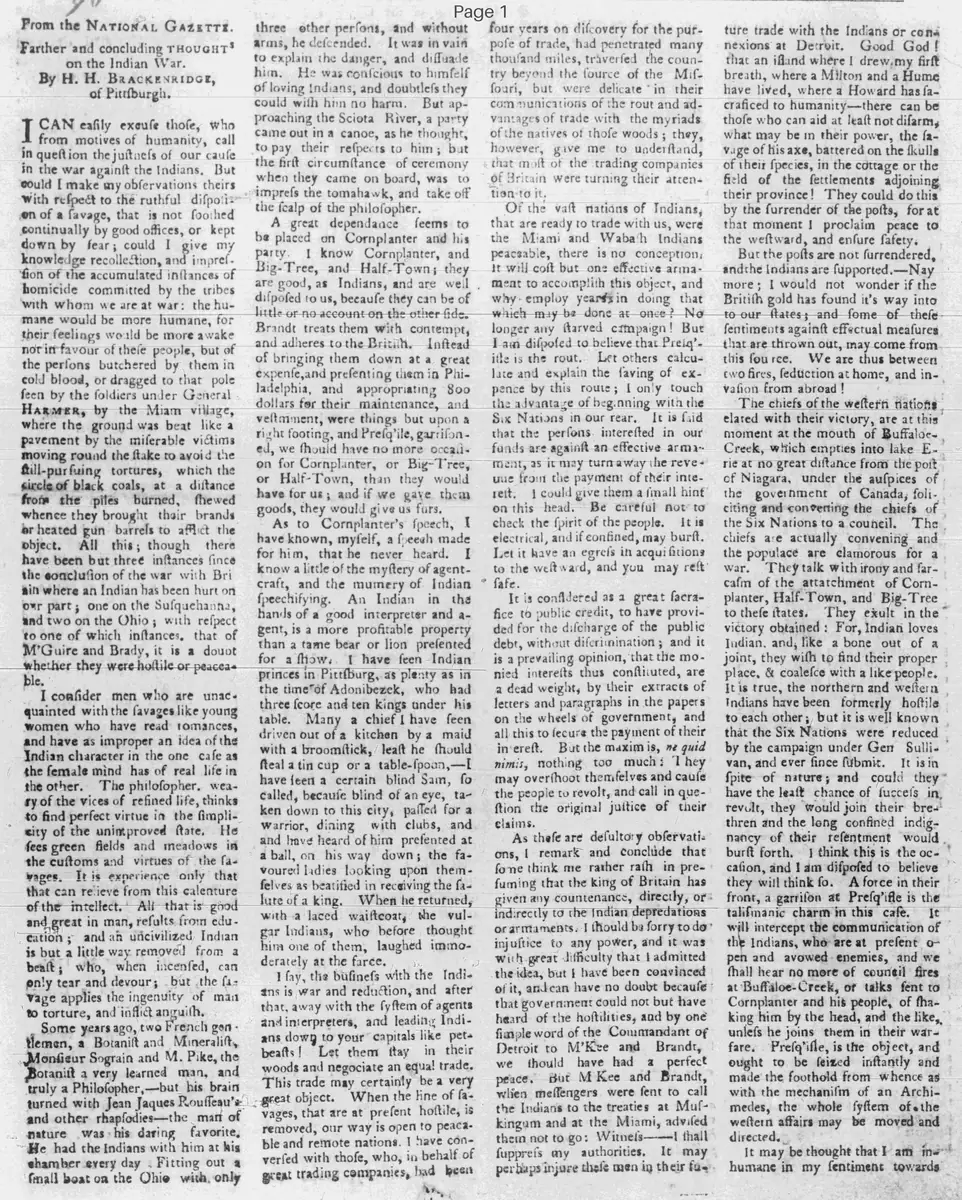
Farther and concluding Thoughts
on the Indian War.
By H. H. Brackenridge,
of Pittsburgh.
I CAN easily excuse those, who
from motives of humanity, call
in question the justice of our cause
in the war against the Indians. But
could I make my observations theirs
with respect to the ruthlessness policy of a savage, that is not soothed
continually by good offices, or kept
down by fear; could I give my
knowledge recollection, and impression of the accumulated instances of
homicide committed by the tribes
with whom we are at war: the hu-
mane would be more humane, for
their feelings would be more awake
not in favour of these people, but of
the persons butchered by them in
cold blood, or dragged to that pole
seen by the soldiers under General
HARMAR. by the Miam village,
where the ground was beat like a
pavement by the miserable victims
moving round the stake to avoid the
still-pursuing tortures, which the
circle of black coals, at a distance
from the piles burned, shewed
whence they brought their brands
or heated gun barrels to affect the
object. All this; though there
have been but three instances since
the conclusion of the war with Bri- ain where an Indian has been hurt on
our part: one on the Susquehanna,
and two on the Ohio; with respect
to one of which instances. that of
M'Guire and Brady, it is a doubt
whether they were hostile or peaceable.
I consider men who are unac-
quainted with the savages like young
women who have read romances,
and have as improper an idea of the
Indian character in the one case as
the female mind has of real life in
the other. The philosopher. wea-
ry of the vices of refined life, thinks
to find perfect virtue in the impli-
city of the unimproved state. He
Sees green fields and meadows in
the customs and virtues of the a-
vages. It is experience only that
that can relieve from this calenture
of the intellect. All that is good
and great in man, results from edu-
cation; and an uncivilized Indian
is but a little way removed from a
beast: who, when incensed, can
only tear and devour; but the fi-
vage applies the ingenuity of man
to torture, and inflict anguish.
Some years ago, two French gon-
tlemen, a Botanist and Mineralist,
Monsieur Sograin and M. Pike, the
Botanist a very learned man, and
truly a Philosopher,-but his brain
turned with Jean Jacques Rousseau's
and other rhapsodies--the mass of
nature Was his daring favorite.
He had the Indians with him at his
chamber every day Fitting out a
small boat on the Ohio with, only
three other persons, and without
arms, he descended. It was in vain
to explain the danger, and dissuade
him. He was conscious to himself
of loving Indians, and doubtless they
could with him no harm. But ap-
proaching the Sciota River, a party
came out in a canoe, as he thought,
to pay their respects to him; but
the first circumstance of ceremony
when they came on board, was to
impress the tomahawk, and take off
the scalp of the philosopher.
A great dependence seems to
be placed on Cornplanter and his
party. I know Cornplanter, and
Big-Tree, and Half-Town; they
are good, as Indians. and are well
disposed to us, because they can be of
little or no account on the other side.
Brandt treats them with contempt,
and adheres to the British. Instead
of bringing them down at a great
expense,and presenting them in Phi-
ladelphia, and appropriating 800
dollars for their maintenance, and
vestment, were things but upon a
right footing. and Presqu'ile, garrison-
ed, we should have no more occasion
for Cornplanter, or Big-Tree,
or Half-Town, than they would
have for us: and if we gave them
goods, they would give us furs.
As to Cornplanter's speech, I
have known, myself. a speech made
for him, that he never heard. I
know a little of the mystery of agent-
craft, and the mummery of Indian
speechifying. An Indian in the
hands of a good interpreter and a-
gent, is a more profitable property
than a tame bear or lion presented
for a show. I have seen-Indian
princes in Pittsburgh, as plenty as in
the time of Adonibezek. who had
three score and ten kings under his
table. Many a chief I have seen
driven out of a kitchen by a maid
with a broomstick./lest he should
steal a tin cup or a table-spoon.=
I
have seen a certain blind Sam, so
called. because blind of an eye, ta-
ken down to this city, passed for a
warrior, dining with clubs, and
and I have heard of him presented at
a ball, on his way down; the fa-
voured ladies looking upon them-
themselves/ as beatified in receiving the sa-
lute of a king. When he returned.
with a laced waistcoat. the vul-
gar Indians, who before thought
him one of them. laughed immo-
derately at the farce.
I say, the business with the Indi-
ans is war and reduction. and after
that, away with the system of agents
and interpreters, and leading Indi-
ans down to your capitals like pet-
beasts! Let them stay in their
woods and negotiate an equal trade.
This trade may certainly be a very
great object. When the line of sa-
vages, that are at present hostile, is
removed, our way is open to peaca-
ble and remote nations. I have con-
versed with those, who. in behalf of
great trading companies, had been
four years on discovery for the pur-
pse of trade, had penetrated many
thousand miles, traversed the coun-
try beyond the source of the Mis-
souri, but were delicate in their
com nunications of the rout and ad-
vantages of trade with the myriads
of the natives of those woods ; they,
however, give me to understand,
that most of the trading companies
of Britain were turning their atten-
tion-to it.
Of the vast nations of Indians.
that are ready to trade with us, were
the Miami and Wabash Indians
peaceable, there is no conception.
It will cost but one effective arma-
ment to accomplish this object, and
why-employ years in doing that
which may be done at once ? No
longer any starved campaign! But
I am disposed to believe that Presq'.
ile is the rout. Let others calcu-
lite and explain the saving of ex-
pesce by this route; I only touch
the advantage of beginning with the
Six Nations in our rear. It is said
that the persons interested in our
funds are against an effective armi-
ment, as it may turn away the reve-
ues from the payment of their inte-
rest. I could give them a small hint
on this head. Be careful not to
check the spirit of the people. It is
electrical, and if confined, may burst.
Let it have an egress in acquisitions
to the westward, and you may rest
safe.
It is considered as a great sacra-
fice to public credit, to have provi-
ded for the discharge of the public
debt, without discrimination; and it
is a prevailing opinion, that the mo-
ied interests thus constituted, are
a dead weight, by their extracts of
letters and paragraphs in the papers
on the wheels of government, and
all this to secure the payment of their
interest. But the maxim is, ne quid
nimis, nothing too much : they
may overshoot themselves and cause
the people to revolt, and call in que-
stion the original justice of their
claims.
As these are desultory observa-
tions, I remark and conclude that
some think me rather rash in pre-
suming that the king of Britain has
given any countenance, directly, or
indirectly to the Indian depredations
or armaments. I should be sorry to do
injustice to any power, and it was
with great difficulty that I admitted
the idea, but I have been convinced
of it, and can have no doubt because
that government could not but have
heard of the hostilities, and by one
simple word of the Commandant of
Detroit to M'Kee and Brandt,
we should have had a perfect
peace. But M'Kee and Brandt.
when messengers were sent to call
the Indians to the treaties at Mus-
kingum and at the Miami, advised
them not to go: Witness--I shall
suppress my authorities. It may
perhaps injure these men in their fu-
ture trade with the Indians or con-
nexions at Detroit.Good God !
that an island where I drew,my first
breath. where a Milton and a Hume
have lived, where a Howard has sa-
crificed to humanity--there can be
those who can aid at least not disarm,
what may be in their power. the sa-
vage of his axe, battered on the skulls
of their species, in the cottage or the
field of the settlements adjoining
their province! They could do this
by the surrender of the posts, for at
that moment I proclaim peace to
the westward, and ensure safety.
But the posts are not surrendered.
and the Indians are supported.-Nay
more; I would not wonder if the
British gold has found it's way into
our states: and some of these
sentiments against effectual measures
that are thrown out, may come from
this source. We are thus between
two fires, seduction at home, and in-
vation from abroad!
The chiefs of the western nations
elated with their victory, are at this
moment at the mouth of Buffalo-
Creek. which empties into lake E.
rie at no great distance from this post
of Niagara, under the auspices of
the government of Canada, soli-
citing and converting the chiefs of
the Six Nations to a council. The
chiefs are actually convening and
the populace are clamorous for a
War.
They talk with irony and sar-
casm of the attachment of Corn-
planter, Half-Town, and Big-Tree
to these states. They exult in the
victory obtained : For, Indian loves
Indian, and, like a bone out of a
joint, they wish to find their proper
place, & coalesce with a like people.
It is true, the northern and western
Indians have been formerly hostile
to each other;, but it is well known
that the Six Nations were reduced
by the campaign under Gen Sulli-
van, and ever since submit. It is in
spite of nature; and could they
have the least chance of success in
revolt, they would join their bre-
thren and the long confined indig-
nancy of their resentment would
burst forth. I think this is the oc-
casion, and I am disposed to believe
they will think so. A force in their
front, a garrison at Presq'ile is the
talismanic charm in this case.
It
will intercept the communication of
the Indians, who are at present o-
pen and avowed-enemies, and we
shall hear no more of council fires
at Buffalo-Creek. or talks sent to
Cornplanter and his people, of sha-
king him by the head, and the like,
unless he joins them in their war-
fare. Presq'ile, is the object, and
ought to be seized instantly and
made the foothold from whence as
with the mechanism of an Archi-
medes, the whole system of the
western affairs may be moved and
directed.
It may be thought that I am in
humane in my sentiment towards
the savages: It is a mistake. I am inhumane to no man or men; but in order to be humane, let me have it in my power. Let myself first be safe, and then I can shew what humanity dictates. The question is, Whether we shall submit ourselves to the savages, or they to us? I say, let us conquer because we cannot depend upon them: for the weaker ever distrusts the mightier, and the unenlightened man, the sensible; but when we shall have it in our power, let us dispense treaties on principles of reciprocity (to use the term of the diplomatists) and let them know that we are not about to purchase a treaty, but to make one and preserve it. These principles, founded in nature and truth, will strike the mind of the savage, that we ask no more than he ought to give or, that we give more than he has a right to ask. By the immortal Gods! (a Roman oath, but sworn with christian devotion) if this principle could be made the basis of our negotiations, we should govern not only these people, but all the world with whom we have to do. When I say govern I mean command of them all that is our right on principles of the laws of nations or of nature. But in our affairs with the western Indians, we have for a series of years pursued a sickly tampering system of half peace, half war, from which nothing could result but half success. A bold and decisive act of effective hostility at the conclusion of the war with Britain, would have compelled these Indians and preserved in existence the countless numbers that have fallen victims to torture or death on the borders of the wilderness. It was therefore inhumane not to have adopted this system, which would have been effectual. But I saw, and lamented the circumstance of the Congress being besieged with candidates for agencies and commissions, and messengers, and runners, to negotiate with these tribes. There was not a thing that had ever seen a squaw: or a half king, or a chief, or had heard the guttural sound of a Kickapoo, or a Delaware, but would have it that he understood fifty Indian languages, and could interpret, and could draw all the tribes after him, just as a boy would whistle pigeons. Hence, treaty and not war. It is not to be supposed that men at the helm know every thing; they are just as ignorant, with respect to affairs beyond their reach, as other people. It is the man on the extremity of any government as I have been who sees the most absurdities. I shall say no more at present; for I wish all things conducted well; and would rather help forward what ought to be done than blame what has been transacted.
Philad. Feb. 4.
What sub-type of article is it?
What keywords are associated?
What entities or persons were involved?
Editorial Details
Primary Topic
Advocacy For Decisive War Against Hostile Indians And Strategic Garrisoning
Stance / Tone
Strongly Pro Conquest And Critical Of Appeasement Policies
Key Figures
Key Arguments