Thank you for visiting SNEWPapers!
Sign up free
Story
August 29, 1894
The Ohio Democrat
Logan, Hocking County, Ohio
What is this article about?
George M. Pullman testifies before Chicago labor commission on wage reductions to secure work amid competition, company profits of $6.8M dividends despite manufacturing losses, and refusal to arbitrate the strike. Witnesses confirm employee satisfaction and minimal distress.
Clipping
OCR Quality
95%
Excellent
Full Text
Commission.
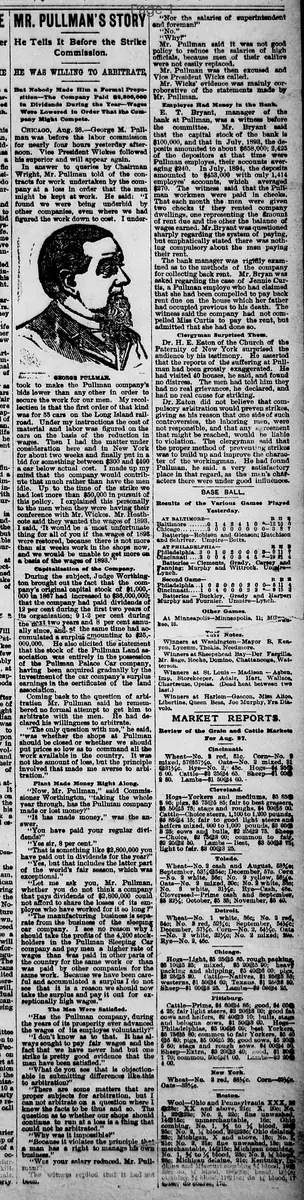
But Nobody Made Him a Formal Proposition—The Company Paid $6,800,000 In Dividends During the Year—Wages Lowered in Order That the Company Might Compete.
CHICAGO, Aug. 28.—George M. Pullman was before the labor commission for nearly four hours yesterday afternoon. Vice President Wickes followed his superior and will appear again.
In answer to queries by Chairman Wright, Mr. Pullman told of the contracts for work undertaken by the company.
"We found we were being underbid by other companies, even where we had figured the work down to cost," he said. "I undertook to make the Pullman company's bids lower than any other in order to secure the work for our men. My recollection is that the first order of that kind was for 55 cars on the Long Island railroad. Under my instructions the cost of material and labor was figured on the cars on the basis of the reduction in wages. Then I had the matter under consideration here and in New York for about two weeks and finally put in a bid for something between $300 and $400 a car below actual cost. I made up my mind that the company would contribute that much rather than have the men idle. Up to the time of the strike we had lost more than $50,000 in pursuit of this policy. I explained this personally to the men when they were having their conference with Mr. Wickes. Mr. Heathcote said they wanted the wages of 1893. I said, 'It would be a most unfortunate thing for all of you if the wages of 1893 were restored, because there is not more than six weeks work in the shops now, and we would be unable to get more on a basis of the wages of 1893.'"
Capitalization of the Company.
During the subject, Judge Worthington brought out the fact that the company's original capital stock of $1,000,000 in 1867 had increased to $36,000,000; that the company had paid dividends of 12 per cent during the first two years of its organization; 9 1-2 per cent during the next two years and 8 per cent annually since, and, at the same time had accumulated a surplus amounting to $25,000,000. He also elicited the statement that the stock of the Pullman Land association was entirely in the possession of the Pullman Palace Car company, having been acquired gradually by the investment of the car company's surplus earnings in the certificates of the land association.
Coming back to the question of arbitration Mr. Pullman said he remembered no formal attempt to get him to arbitrate with the men. He had declared his willingness to arbitrate.
"The only question with me," he said, "was whether the shops at Pullman should be closed or whether we should put prices so low as to command all the work available in the country. It was not the amount of loss, but the principle involved that made me averse to arbitration."
Plant Made Money Right Along.
"Now, Mr. Pullman," said Commissioner Worthington, "taking the whole year through, has the Pullman company made or lost money?"
"It has made money," was the answer.
"You have paid your regular dividends?"
"Yes sir, 8 per cent."
"That is something like $2,800,000 you have paid out in dividends for the year?"
"Yes, but that includes the latter part of the world's fair season, which was exceptional."
"Let me ask you, Mr. Pullman, whether you do not think a company that pays dividends of $2,800,000 could not afford to share the losses of its employes who have worked for it so long?"
"The manufacturing business is separate from the business of the sleeping car company. I see no reason why I should take the profits of the 4,200 stockholders in the Pullman Sleeping Car company and pay men a higher rate of wages than was paid in other parts of the country for the same work or than was paid by other companies for the same work. Because we have been careful and accumulated a surplus I do not see that it is a reason we should now take the surplus and pay it out for exceptionally high wages."
The Men Were Satisfied.
"Has the Pullman company, during the years of its prosperity ever advanced the wages of its employes voluntarily?"
"I don't know as to that. It has always sought to pay fair wages and the fact that we have never had but one strike is pretty good evidence that the men have been satisfied."
"What do you see that is objectionable in submitting differences like this to arbitration?"
"There are some matters that are proper subjects for arbitration, but I can not arbitrate on a question where I know the facts to be thus and so. The question as to whether our shops should continue to run at a loss is a thing that could not be arbitrated."
"Why was it impossible?"
"Because it violates the principle that a man has a right to manage his own business."
"Was your salary reduced, Mr. Pullman?"
The witness replied that it had not been.
"Nor the salaries of superintendents and foremen?"
"No."
"Why?"
Mr. Pullman said it was not good policy to reduce the salaries of high officials, because men of their calibre were not easily replaced.
Mr. Pullman was then excused and Vice President Wickes called.
Mr. Wickes' evidence was mainly corroborative of the statements made by Mr. Pullman.
Employes Had Money in the Bank.
E. T. Bryant, manager of the bank at Pullman, was a witness before the committee. Mr. Bryant said that the capital stock of the bank is $100,000, and that in July, 1893, the deposits amounted to about $658,000; 2,425 of the depositors at that time were Pullman employes, their accounts averaging $240. In July, 1894, the deposits amounted to $453,000 with only 1,414 employes' accounts, which averaged $270. The witness said that the Pullman workmen were paid in checks. That each month the men were given two checks if they rented company dwellings, one representing the amount of rent due and the other the balance of wages earned. Mr. Bryant was questioned sharply regarding the system of paying, but emphatically stated there was nothing compulsory about the men paying their rent.
The bank manager was rigorously examined as to the methods of the company for collecting back rent. Mr. Bryant was asked regarding the case of Jennie Curtis, a Pullman employe who had claimed that she had been compelled to pay back rent due on the house which her father had occupied previous to his death. The witness said the company had not compelled Miss Curtis to pay the rent, but admitted that she had done so.
Clergyman Surprised Them.
Dr. H. E. Eaton of the Church of the Paternity of New York surprised the audience by his testimony. He asserted that the reports of the suffering at Pullman had been grossly exaggerated. He had visited 40 houses, he said, and found no distress. The men had told him they had no real grievances, he declared, and had no real cause for striking.
Dr. Eaton did not believe that compulsory arbitration would prevent strikes, giving as his reason that one side of such controversies, the laboring men, were not responsible, and that any agreement that might be reached would be liable to violation. The clergyman said that the proper method of preventing strikes was to build up and improve the character of the workingman. He had found Pullman, he said, a very satisfactory place in that regard, as the men's characters there were under good influences.
But Nobody Made Him a Formal Proposition—The Company Paid $6,800,000 In Dividends During the Year—Wages Lowered in Order That the Company Might Compete.
CHICAGO, Aug. 28.—George M. Pullman was before the labor commission for nearly four hours yesterday afternoon. Vice President Wickes followed his superior and will appear again.
In answer to queries by Chairman Wright, Mr. Pullman told of the contracts for work undertaken by the company.
"We found we were being underbid by other companies, even where we had figured the work down to cost," he said. "I undertook to make the Pullman company's bids lower than any other in order to secure the work for our men. My recollection is that the first order of that kind was for 55 cars on the Long Island railroad. Under my instructions the cost of material and labor was figured on the cars on the basis of the reduction in wages. Then I had the matter under consideration here and in New York for about two weeks and finally put in a bid for something between $300 and $400 a car below actual cost. I made up my mind that the company would contribute that much rather than have the men idle. Up to the time of the strike we had lost more than $50,000 in pursuit of this policy. I explained this personally to the men when they were having their conference with Mr. Wickes. Mr. Heathcote said they wanted the wages of 1893. I said, 'It would be a most unfortunate thing for all of you if the wages of 1893 were restored, because there is not more than six weeks work in the shops now, and we would be unable to get more on a basis of the wages of 1893.'"
Capitalization of the Company.
During the subject, Judge Worthington brought out the fact that the company's original capital stock of $1,000,000 in 1867 had increased to $36,000,000; that the company had paid dividends of 12 per cent during the first two years of its organization; 9 1-2 per cent during the next two years and 8 per cent annually since, and, at the same time had accumulated a surplus amounting to $25,000,000. He also elicited the statement that the stock of the Pullman Land association was entirely in the possession of the Pullman Palace Car company, having been acquired gradually by the investment of the car company's surplus earnings in the certificates of the land association.
Coming back to the question of arbitration Mr. Pullman said he remembered no formal attempt to get him to arbitrate with the men. He had declared his willingness to arbitrate.
"The only question with me," he said, "was whether the shops at Pullman should be closed or whether we should put prices so low as to command all the work available in the country. It was not the amount of loss, but the principle involved that made me averse to arbitration."
Plant Made Money Right Along.
"Now, Mr. Pullman," said Commissioner Worthington, "taking the whole year through, has the Pullman company made or lost money?"
"It has made money," was the answer.
"You have paid your regular dividends?"
"Yes sir, 8 per cent."
"That is something like $2,800,000 you have paid out in dividends for the year?"
"Yes, but that includes the latter part of the world's fair season, which was exceptional."
"Let me ask you, Mr. Pullman, whether you do not think a company that pays dividends of $2,800,000 could not afford to share the losses of its employes who have worked for it so long?"
"The manufacturing business is separate from the business of the sleeping car company. I see no reason why I should take the profits of the 4,200 stockholders in the Pullman Sleeping Car company and pay men a higher rate of wages than was paid in other parts of the country for the same work or than was paid by other companies for the same work. Because we have been careful and accumulated a surplus I do not see that it is a reason we should now take the surplus and pay it out for exceptionally high wages."
The Men Were Satisfied.
"Has the Pullman company, during the years of its prosperity ever advanced the wages of its employes voluntarily?"
"I don't know as to that. It has always sought to pay fair wages and the fact that we have never had but one strike is pretty good evidence that the men have been satisfied."
"What do you see that is objectionable in submitting differences like this to arbitration?"
"There are some matters that are proper subjects for arbitration, but I can not arbitrate on a question where I know the facts to be thus and so. The question as to whether our shops should continue to run at a loss is a thing that could not be arbitrated."
"Why was it impossible?"
"Because it violates the principle that a man has a right to manage his own business."
"Was your salary reduced, Mr. Pullman?"
The witness replied that it had not been.
"Nor the salaries of superintendents and foremen?"
"No."
"Why?"
Mr. Pullman said it was not good policy to reduce the salaries of high officials, because men of their calibre were not easily replaced.
Mr. Pullman was then excused and Vice President Wickes called.
Mr. Wickes' evidence was mainly corroborative of the statements made by Mr. Pullman.
Employes Had Money in the Bank.
E. T. Bryant, manager of the bank at Pullman, was a witness before the committee. Mr. Bryant said that the capital stock of the bank is $100,000, and that in July, 1893, the deposits amounted to about $658,000; 2,425 of the depositors at that time were Pullman employes, their accounts averaging $240. In July, 1894, the deposits amounted to $453,000 with only 1,414 employes' accounts, which averaged $270. The witness said that the Pullman workmen were paid in checks. That each month the men were given two checks if they rented company dwellings, one representing the amount of rent due and the other the balance of wages earned. Mr. Bryant was questioned sharply regarding the system of paying, but emphatically stated there was nothing compulsory about the men paying their rent.
The bank manager was rigorously examined as to the methods of the company for collecting back rent. Mr. Bryant was asked regarding the case of Jennie Curtis, a Pullman employe who had claimed that she had been compelled to pay back rent due on the house which her father had occupied previous to his death. The witness said the company had not compelled Miss Curtis to pay the rent, but admitted that she had done so.
Clergyman Surprised Them.
Dr. H. E. Eaton of the Church of the Paternity of New York surprised the audience by his testimony. He asserted that the reports of the suffering at Pullman had been grossly exaggerated. He had visited 40 houses, he said, and found no distress. The men had told him they had no real grievances, he declared, and had no real cause for striking.
Dr. Eaton did not believe that compulsory arbitration would prevent strikes, giving as his reason that one side of such controversies, the laboring men, were not responsible, and that any agreement that might be reached would be liable to violation. The clergyman said that the proper method of preventing strikes was to build up and improve the character of the workingman. He had found Pullman, he said, a very satisfactory place in that regard, as the men's characters there were under good influences.
What sub-type of article is it?
Historical Event
What themes does it cover?
Justice
Misfortune
What keywords are associated?
Pullman Strike
Labor Commission
Wage Reduction
Arbitration Refusal
Company Dividends
Employee Testimony
What entities or persons were involved?
George M. Pullman
Vice President Wickes
Chairman Wright
Judge Worthington
Commissioner Worthington
E. T. Bryant
Dr. H. E. Eaton
Mr. Heathcote
Jennie Curtis
Where did it happen?
Chicago, Pullman
Story Details
Key Persons
George M. Pullman
Vice President Wickes
Chairman Wright
Judge Worthington
Commissioner Worthington
E. T. Bryant
Dr. H. E. Eaton
Mr. Heathcote
Jennie Curtis
Location
Chicago, Pullman
Event Date
Aug. 28
Story Details
George M. Pullman testifies on wage reductions to compete for contracts, company profitability with $6.8M dividends, refusal to arbitrate due to business principles, and employee satisfaction; witnesses corroborate minimal distress and fair practices.