Thank you for visiting SNEWPapers!
Sign up free
Henderson Daily Dispatch
Henderson, Vance County, North Carolina
What is this article about?
Charles M. Johnson, director of North Carolina's Local Government Commission, opposes counties' requests to postpone tax property sales from June, arguing it violates law, removes payment incentives, hinders borrowing and refinancing during economic crisis, and smells of politics ahead of primaries.
Merged-components note: Continuation of tax sales story across pages; relabeled second part from editorial to story as content is primarily reporting on policy and statements.
Clippings
1 of 2
OCR Quality
Full Text
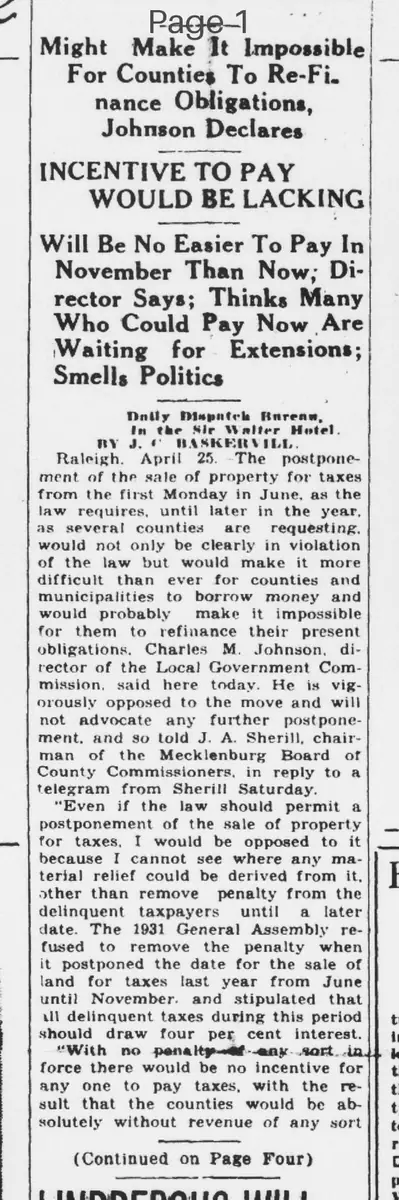
INCENTIVE TO PAY WOULD BE LACKING
Will Be No Easier To Pay In November Than Now; Director Says; Thinks Many Who Could Pay Now Are Waiting for Extensions; Smells Politics
Daily Dispatch Bureau,
In the Sir Walter Hotel.
BY J. C. BASKERVILL.
Raleigh, April 25. The postponement of the sale of property for taxes from the first Monday in June, as the law requires, until later in the year as several counties are requesting, would not only be clearly in violation of the law but would make it more difficult than ever for counties and municipalities to borrow money and would probably make it impossible for them to refinance their present obligations, Charles M. Johnson, director of the Local Government Commission, said here today. He is vigorously opposed to the move and will not advocate any further postponement, and so told J. A. Sherrill, chairman of the Mecklenburg Board of County Commissioners, in reply to a telegram from Sherrill Saturday.
"Even if the law should permit a postponement of the sale of property for taxes, I would be opposed to it because I cannot see where any material relief could be derived from it, other than remove penalty from the delinquent taxpayers until a later date. The 1931 General Assembly refused to remove the penalty when it postponed the date for the sale of land for taxes last year from June until November, and stipulated that all delinquent taxes during this period should draw four per cent interest.
"With no penalty—enforce there would be no incentive for any one to pay taxes, with the result that the counties would be absolutely without revenue of any sort
(Continued on Page Four)
TAX SALES
Delay in the sale of property for taxes may serve as a convenience to a few property owners, but it is doubtful if any very great beneficial results would come from a postponement. Charles M. Johnson, secretary of the Local Government Commission, is on record against such delays this year as were permitted last year, and he puts up an argument that seems at least in some measure logical.
One of the worst features of a postponement, that official says, is that it would make it harder for counties and municipalities to borrow money, and it would force them to wait for tax revenue at a time when the money is sorely needed and when it can not be had elsewhere. Embarrassment would result. Moreover, if property were not sold and if no penalty were imposed, the incentive to pay would be removed, and there would be no way to force collections. It is further probable that those who owe tax money now will be in no better position to pay in November or December than now, especially when it is remembered that another year's taxes will then be due, and two years' obligations will be owed at the same time.
A sale now does not mean that the owner loses his property now. It is pointed out that sixteen months will elapse before there can be a foreclosure, which would give ample time for recovery, if such were possible at all.
as Mr. Johnson says, to fall in line with the agitation for postponement. Undoubtedly the burden is heavy and hard to bear, but delays will hardly make it easier. There is a possibility, too, that political considerations may be an influence in agitation that is being heard.
We should be the last to insist, or even to suggest, a procedure that would work a hardship or do an injustice to any tax-payer, or to any one else. But one has only to refer back to conditions in Vance county last year. There was delay after delay, but in the end very little more tax money came in as the result of the postponements that were granted.
this is the people's country and their government. If they demand this additional consideration, they will face the possible embarrassment.
But it is easy to over-emphasize the benefits of long postponements of the evil day.
(Continued from Page One.)
during the period of postponement.
This fact, together with the likelihood that they would not be able to borrow any money, would not help them any, as I see it. It is also probable that the delinquent taxpayers would not be in any better position to pay their taxes in November or December than they are now."
If there was any immediate danger that those whose property is to be sold for taxes in June, would lose that property then, Johnson said he would urge a special session of the General Assembly at once to authorize a postponement. But no foreclosure suits can be brought on the tax sale certificates until after 16 months have expired from the date of sale, so that the owner of property sold for taxes in June, 1932, has until October, 1933, before any foreclosure suit can be brought. He really has until June, 1934, in which to redeem his property, since the law does not compel foreclosure suits to be brought until after the expiration of 24 months.
"If a taxpayer cannot raise the money to pay his taxes within two years after the tax sale, the property either is not worth much or there is little chance that he could raise the money within ten years," Johnson said.
Political Bait.
It was strongly intimated by Johnson that in his opinion those who are advocating the postponement of these tax sales at this time are merely doing so for political purposes because of the approaching primary.
"I know that the popular thing for me to do would be to agree with them and tell them to go ahead and violate the law and postpone the tax sales," Johnson said. "But I am not going to advise any one to violate the law and to do something that would leave the counties in infinitely worse shape than they are now in."
In his letter to Chairman Sherrill of the Mecklenburg County Board of Commissioners, Johnson said:
"You are familiar with the fact that local banks in North Carolina have been lending practically no money. It has been necessary, therefore, for local units (counties, cities and towns) to go on a cash basis at probably the worst time in the history of the country. Not collecting any taxes and being unable to borrow money, I do not see how they can operate (under a postponement of tax sales and serious financial difficulties are bound to be the result."
While admitting that there are many taxpayers who actually cannot pay their taxes at this time, Johnson also maintains that there are many who can pay but who are waiting to see what is going to be done, and who will not pay if they can get a five months extension without any penalty.
What sub-type of article is it?
What themes does it cover?
What keywords are associated?
What entities or persons were involved?
Where did it happen?
Story Details
Key Persons
Location
Raleigh, North Carolina
Event Date
April 25, 1932
Story Details
Charles M. Johnson opposes postponing tax property sales, stating it would violate law, eliminate payment incentives, prevent county revenue collection, hinder borrowing and refinancing, and likely stem from political motives ahead of primaries, with no real relief for taxpayers as foreclosures take years.