Thank you for visiting SNEWPapers!
Sign up free
The Enquirer
Richmond, Henrico County, Virginia
What is this article about?
This editorial, part II, argues against a large U.S. navy for protecting commerce due to expense and risks to civil institutions. It proposes alternative legislative measures like tariffs, duties on imports, promotion of domestic manufactures, and internal trade to safeguard agriculture, shipping, and economic interests against foreign interference, especially from Britain.
Merged-components note: Continuation of the editorial on naval power and commerce protection; text flows directly from one to the next.
Clippings
1 of 2
OCR Quality
Full Text
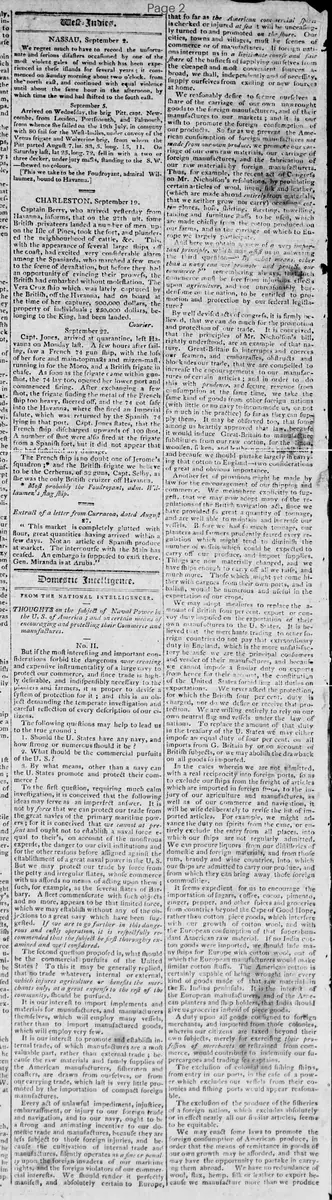
FROM THE NATIONAL INTELLIGENCER.
THOUGHTS on the subject of Naval Power in the U.S. of America; and on certain means of encouraging and protecting their Commerce and manufactures.
No. II.
But if the most interesting and important considerations forbid the dangerous war-creating and expensive instrumentality of a large navy to protect our commerce, and since trade is highly desirable, and indispensibly necessary to the planters and farmers, it is proper to devise a system of protection for it; and this is an object demanding the temperate investigation and careful reflection of every description of our citizens.
The following questions may help to lead us to the true ground:
1. Should the U. States have any navy, and how strong or numerous should it be?
2. What should be the commercial pursuits of the U. S.?
3. By what means, other than a navy can the U. States promote and protect their commerce?
To the first question, requiring much calm investigation, it is conceived that the following ideas may serve as an imperfect answer. It is not by force that we can protect our trade from the great navies of the primary maritime powers; for it is conceived that we cannot at present and ought not to establish a naval force equal to theirs, on account of the monstrous expense, the danger to our civil institutions and for the other reasons before assigned against the establishment of a great naval power in the U. S. But we may protect our trade by force from the petty and irregular states, whose commerce with us affords no means of acting upon them; such, for example, as the several states of Barbary. A fleet commensurate with such objects and no more, appears to be that limited force, which we may establish without any of the objections to a great navy which have been suggested. If we are to go further in this dangerous and costly operation, it is respectfully recommended that the subject be first thoroughly examined and well considered.
The second question proposed is, what should be the commercial pursuits of the United States? To this it may be generally replied, that no trade whatever, internal or external, which injures agriculture or benefits the merchants only, at a great expense to the rest of the community, should be pursued.
It is our interest to import implements and materials for manufactures, and manufacturers themselves, which will employ many vessels, rather than to import manufactured goods, which will employ very few.
It is our interest to promote and establish internal trade, of which manufactures are a most valuable part, rather than external trade: because the raw materials and family supplies of the American manufacturers, fishermen and coasters, are drawn from ourselves, or from our carrying trade, which last is very little promoted by the importation of compact foreign manufactures.
Every act of unlawful impediment, injustice, embarrassment, or injury to our foreign trade and navigation, and to our navy, ought to be a strong and animating incentive to our domestic trade and manufactures, because they are less subject to those foreign injuries, and because the cultivation of internal trade and manufactures, silently operates as a fine or penalty upon the foreign invaders of our maritime rights, and the foreign violators of our commercial interests. We should render it perfectly manifest, and absolutely certain to Europe that so far as the American commercial plan is checked or injured at sea it will be unceasingly turned to and promoted on the shore. Our cities, towns and villages, must be scenes of commerce or of manufactures. If foreign nations interrupt us in a legitimate course and fair share of the business of supplying ourselves from the cheapest and most convenient sources abroad, we shall, independently and of necessity, supply ourselves from existing or new sources at home.
We reasonably desire to secure ourselves a share of the carriage of our own unwrought goods to the foreign manufacturers, and of their manufactures to our markets; and it is our wish to promote the foreign consumption of our products. So far as we prevent the American consumption of foreign manufactures not made from our own produce, we promote our carriage of our own raw materials, our carriage of foreign manufactures, and the fabrication of our raw materials by foreign manufacturers. Thus, for example, the recent act of Congress on Mr. Nicholson's resolutions, by prohibiting certain articles of wool, linen, silk and leather, (which are made abroad entirely from materials, that we neither grow nor carry) occasions cotton gloves, hose, shirting, sheeting, towelling, taping and furniture staffs to be used, which are made chiefly from the cotton produced on our farms, and in the carriage of which to Europe we largely participate.
And here we obtain a view of a very important principle, which may assist us in answering the third question--"By what means, other than a navy can we promote and protect our commerce?" remembering always, that such commerce must be free from injurious effects upon agriculture, and not unreasonably burdensome on the nation, to be entitled to promotion and protection by our federal legislature?
By well devised acts of congress, it is firmly believed, that we can do much for the promotion and protection of our trade. It is conceived, that the principles of Mr. Nicholson's bill, rightly understood, are an example of that nature. Great-Britain so interrupts and coerces our seamen, and embarrasses, obstructs and blockades our trade, that we are compelled to increase the encouragements to our manufactures of certain articles; and in order to do this with prudence, and secure revenue from consumption at the same time, we take the same kind of goods from other foreign nations (with little or no navy to incommode us, or not so much in the practice) so far as they can supply them. It may be observed too, that some among us heartily approved that law, because it would induce Great-Britain to manufacture substitutes from our raw cotton, for the linen, woollen, silken, and leathern goods. and because we should partake largely in carrying that cotton to England--two considerations of great and obvious importance.
Another set of provisions might be made by law for the encouragement of our shipping and commerce. We mean here explicitly to suggest, that we may now adopt many of the regulations of the British navigation act, since we have provided so great a quantity of tonnage, and are well able to maintain and increase our vessels. Before we had so much tonnage, our planters and farmers prudently feared every regulation which might tend to diminish the number of vessels which could be expected to carry off our produce, and import supplies. Things are now materially changed, and we have ships enough to carry off all we raise, and much more. Those which might yet come hither with cargoes from their own ports, and in ballast, would be numerous and useful in the exportation of our crops.
We may adopt measures to replace the amount of British four per cent. export or convoy duty imposed on the exportation of their own manufactures to the U. States. It is believed that the merchants trading to other foreign countries do not pay that extraordinary duty in England, which is the more unsatisfactory because we are the principal consumers and venders of their manufactures, and because we cannot impose a similar duty on exports from hence for their account, the constitution of the United States forbidding all duties on exportations. We never asked the protection, for which the British four per cent. duty is charged, nor do we desire or receive that protection. We are willing entirely to rely on our own neutral flag and vessels under the law of nations. To replace the amount of that duty in the treasury of the U. States we may either impose an equal duty of four per cent. on all imports from G. Britain by or on account of British subjects, or we may abolish the drawback on all goods so imported.
In the cases wherein we are not admitted, with a real reciprocity into foreign ports, so as to exclude our ships from the freight of articles which are imported in foreign froes, to the injury of our agriculture and manufactures, as well as of our commerce and navigation, it will be wise deliberately to revise the list of imported articles. For example, we might advance the duty on spirits from the cane, or entirely exclude the entry from all places, into which our ships are not regularly admitted. We can procure liquors from our distilleries of domestic and foreign materials, and from those rum, brandy and wine countries, into which our ships are admitted to carry our produce, and from which they can bring away those foreign commodities.
It seems expedient for us to encourage the importation of sugars, coffee, cocoa, pimento, ginger, pepper, and other spices and groceries from countries beyond the Cape of Good Hope, rather than cotton piece goods, which interfere with our growth of cotton wool, and with the European consumption of that superabundant American raw material. If no India cotton goods were imported, we should lade many ships for Europe with cotton wool, out of which the European manufacturers would make similar cotton stuffs. The American cotton is certainly capable of being wrought into every kind of goods made of that raw material in the E. Indies peninsula. It is the interest of the European manufacturers, and of the American planters and ship holders, that India should give us groceries instead of piece goods.
A duty upon all goods consigned to foreign merchants, and imported from those colonies, wherein our citizens are taxed beyond their own subjects, merely for exercising their profession of merchants or restrained from commerce, would contribute to indemnify our supercargoes and trading sea captains.
The exclusion of colonial and fishing ships, from entry in our ports, in the case of a power which excludes our vessels from their colonies and fishing ports would appear reasonable.
The exclusion of the produce of the fisheries of a foreign nation, which excludes absolutely or in effect nearly all our similar articles, seems to be equitable.
We may enact some laws to promote the foreign consumption of American produce, in order that the means of remittance in goods of our own growth may be afforded, and that we may have the opportunity to partake in carrying them abroad." We have no redundance of wool, flax, hemp, silk or leather to export because we manufacture more than we produce
and all we can import. Let us suppose, therefore, that our duties ad valorem upon all goods made of those raw materials were (for mere example) at 25 percent. at a medium. We now grow forty or fifty millions of pounds of cotton wool, and can easily produce much more. Let us suppose, therefore, our duties, ad valorem upon all goods made of that raw material from Europe were fixed (for example also) at 15 per cent. The difference of 10 per cent. would operate as a premium for the consumption of piece goods made abroad of our own cotton in most instances in preference to goods made in Europe of foreign wool. flax, hemp, silk and leather-articles which we never produce for sale abroad. The duty of 25 per cent. upon foreign linens and woollens would be in favor of our own manufactures of flax, hemp and wool.
One more example will be offered cautiously promising that it is perfectly novel, and for that and other reasons should be carefully examined.
It is proposed for consideration, that every future injury either in person or property, unlawfully done to any American citizen by any foreign power, officer or agent shall be a subject of investigation and decision before a standing board of commissioners to be created by law, and sitting in foro conscientiae ; that every such future injury shall be estimated in the form of an indemnification in money to the suffering citizen or his representatives : that evidences of the sums due therefor shall be issued bearing interest from their respective dates; that the claim for which they shall be respectively issued shall be assigned to the government of the United States, than an application for just compensation shall be made by our government, thus placed in the situation of the sufferer, to the government of the injurer; that if the demands of this nature ascertained in any half year, shall not be satisfied within one year, the president of the United States shall be authorized to direct the collection of any additional duty upon the produce and manufactures of the injuring country, to cover the same, and he shall be requested to cause the same to be reported to the legislature, and that a like process shall be pursued half yearly, in order to indemnify the injured citizens of the U.S. out of the industry of the violator.
These remedies for the various commercial injuries we sustain, are cautiously suggested for timely consideration. They are merely intended to exemplify the nature of the principles on which we may proceed in consequence. If no such injuries were in existence or in contemplation, we need not thus ask for the indemnification and protection of our citizens, not to secure our just share in the commerce of our country and of the world. We probably should not think of adopting these or any other measures to force manufactures but for such weighty reasons as the necessary support of our agriculture, and the employment of the injured merchants mariners and sea port artizans and laborers. The U. S. for a long time omitted to use the best defence of navigation, commerce and manufactures--well provisioned tars.
The great object of this limited sketch is openly to submit to the country a respectful suggestion, that the whole circle of our commercial rights and interests, internal and external can be more cheaply, more safely, and more effectually defended by wholesome statutes, than by a dangerous and costly establishment of naval power.
Including our seafaring citizens of course, and with a particular eye to their interesting case.
It is respectfully conceived that the case of SEAMEN might be immediately put upon this footing in cluding all under contracts, made as prescribed by our national laws.
What sub-type of article is it?
What keywords are associated?
What entities or persons were involved?
Editorial Details
Primary Topic
Protecting U.S. Commerce And Manufactures Without A Large Navy
Stance / Tone
Advocacy For Legislative Protections Over Naval Expansion
Key Figures
Key Arguments