Thank you for visiting SNEWPapers!
Sign up free
Story
April 25, 1817
Daily National Intelligencer
Washington, District Of Columbia
What is this article about?
Curious manuscripts from M. T. Townshend detail Revolutionary War incidents: David Hume urges opposition to British policies; ministry disputes follow Cornwallis's surrender, leading to Lord George Germaine's removal and Sir Henry Clinton's recall.
Clipping
OCR Quality
98%
Excellent
Full Text
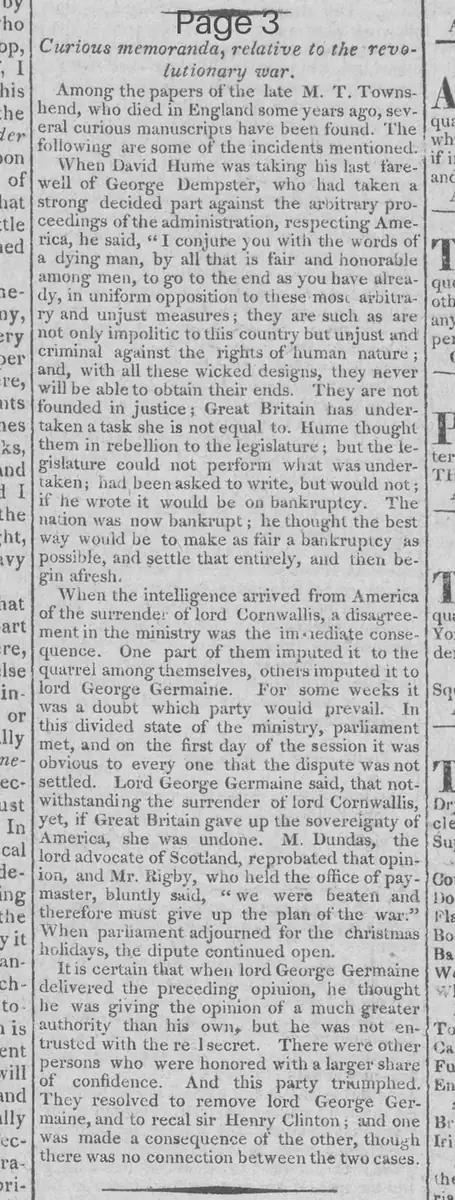
Curious memoranda, relative to the revolutionary war.
Among the papers of the late M. T. Townshend, who died in England some years ago, several curious manuscripts have been found. The following are some of the incidents mentioned.
When David Hume was taking his last farewell of George Dempster, who had taken a strong decided part against the arbitrary proceedings of the administration, respecting America, he said, "I conjure you with the words of a dying man, by all that is fair and honorable among men, to go to the end as you have already, in uniform opposition to these most arbitrary and unjust measures; they are such as are not only impolitic to this country but unjust and criminal against the rights of human nature; and, with all these wicked designs, they never will be able to obtain their ends. They are not founded in justice: Great Britain has undertaken a task she is not equal to." Hume thought them in rebellion to the legislature; but the legislature could not perform what was undertaken; had been asked to write, but would not: if he wrote it would be on bankruptcy. The nation was now bankrupt; he thought the best way would be to make as fair a bankruptcy as possible, and settle that entirely, and then begin afresh.
When the intelligence arrived from America of the surrender of lord Cornwallis, a disagreement in the ministry was the immediate consequence. One part of them imputed it to the quarrel among themselves, others imputed it to lord George Germaine. For some weeks it was a doubt which party would prevail. In this divided state of the ministry, parliament met, and on the first day of the session it was obvious to every one that the dispute was not settled. Lord George Germaine said, that notwithstanding the surrender of lord Cornwallis yet, if Great Britain gave up the sovereignty of America, she was undone. M. Dundas, the lord advocate of Scotland, reprobated that opinion, and Mr. Rigby, who held the office of paymaster, bluntly said, "we were beaten and therefore must give up the plan of the war."
When parliament adjourned for the christmas holidays, the dispute continued open.
It is certain that when lord George Germaine delivered the preceding opinion, he thought he was giving the opinion of a much greater authority than his own, but he was not entrusted with the secret. There were other persons who were honored with a larger share of confidence. And this party triumphed. They resolved to remove lord George Germaine, and to recal sir Henry Clinton; and one was made a consequence of the other, though there was no connection between the two cases.
Among the papers of the late M. T. Townshend, who died in England some years ago, several curious manuscripts have been found. The following are some of the incidents mentioned.
When David Hume was taking his last farewell of George Dempster, who had taken a strong decided part against the arbitrary proceedings of the administration, respecting America, he said, "I conjure you with the words of a dying man, by all that is fair and honorable among men, to go to the end as you have already, in uniform opposition to these most arbitrary and unjust measures; they are such as are not only impolitic to this country but unjust and criminal against the rights of human nature; and, with all these wicked designs, they never will be able to obtain their ends. They are not founded in justice: Great Britain has undertaken a task she is not equal to." Hume thought them in rebellion to the legislature; but the legislature could not perform what was undertaken; had been asked to write, but would not: if he wrote it would be on bankruptcy. The nation was now bankrupt; he thought the best way would be to make as fair a bankruptcy as possible, and settle that entirely, and then begin afresh.
When the intelligence arrived from America of the surrender of lord Cornwallis, a disagreement in the ministry was the immediate consequence. One part of them imputed it to the quarrel among themselves, others imputed it to lord George Germaine. For some weeks it was a doubt which party would prevail. In this divided state of the ministry, parliament met, and on the first day of the session it was obvious to every one that the dispute was not settled. Lord George Germaine said, that notwithstanding the surrender of lord Cornwallis yet, if Great Britain gave up the sovereignty of America, she was undone. M. Dundas, the lord advocate of Scotland, reprobated that opinion, and Mr. Rigby, who held the office of paymaster, bluntly said, "we were beaten and therefore must give up the plan of the war."
When parliament adjourned for the christmas holidays, the dispute continued open.
It is certain that when lord George Germaine delivered the preceding opinion, he thought he was giving the opinion of a much greater authority than his own, but he was not entrusted with the secret. There were other persons who were honored with a larger share of confidence. And this party triumphed. They resolved to remove lord George Germaine, and to recal sir Henry Clinton; and one was made a consequence of the other, though there was no connection between the two cases.
What sub-type of article is it?
Historical Event
Biography
What themes does it cover?
Misfortune
Fortune Reversal
What keywords are associated?
Revolutionary War
David Hume
Cornwallis Surrender
British Ministry
Lord George Germaine
American Independence
What entities or persons were involved?
M. T. Townshend
David Hume
George Dempster
Lord Cornwallis
Lord George Germaine
M. Dundas
Mr. Rigby
Sir Henry Clinton
Where did it happen?
England
Story Details
Key Persons
M. T. Townshend
David Hume
George Dempster
Lord Cornwallis
Lord George Germaine
M. Dundas
Mr. Rigby
Sir Henry Clinton
Location
England
Event Date
American Revolutionary War Period
Story Details
Manuscripts from M. T. Townshend recount Hume's dying opposition to British policies toward America, predicting failure; post-Cornwallis surrender, ministry divides, parliament debates continuance, leading to Germaine's removal and Clinton's recall.