Thank you for visiting SNEWPapers!
Sign up free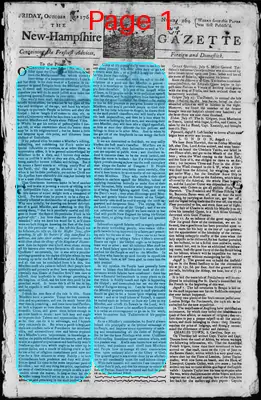
Letter to Editor
October 23, 1761
The New Hampshire Gazette
Portsmouth, Rockingham County, New Hampshire
What is this article about?
A layman critiques an essay in Paper No. 261 from Massachusetts Bay on ministers' characters, arguing that pastoral visits are not biblically mandated as essential but discretionary based on circumstances. He defends ministers against prejudices, supports salaries, and warns of the dangers of contempt for the Gospel in New England.
Clipping
OCR Quality
98%
Excellent
Full Text
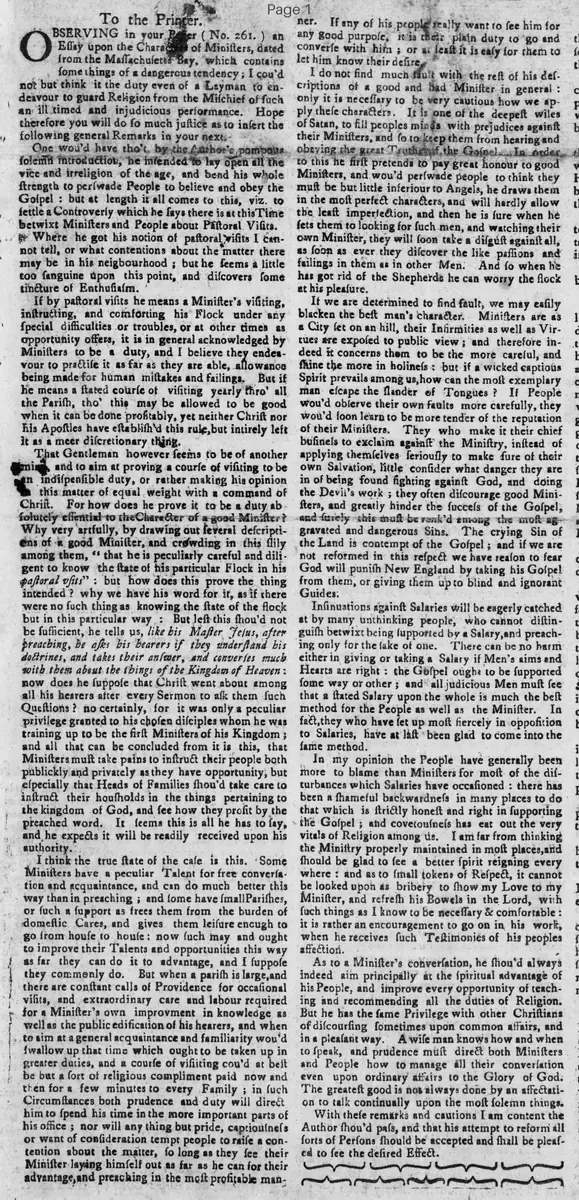
OBSERVING in your Paper (No. 261.) an Essay upon the Character of Ministers, dated from the Massachusetts Bay, which contains some things of a dangerous tendency; I could not but think it the duty even of a Layman to endeavour to guard Religion from the Mischief of such an ill timed and injudicious performance. Hope therefore you will do so much justice as to insert the following general Remarks in your next.-
One would have thought, by the Author's pompous solemn introduction, he intended to lay open all the vice and irreligion of the age, and bend his whole strength to persuade People to believe and obey the Gospel: but at length it all comes to this, viz. to settle a Controversy which he says there is at this Time betwixt Ministers and People about Pastoral Visits.
* Where he got his notion of pastoral visits I cannot tell, or what contentions about the matter there may be in his neighbourhood; but he seems a little too sanguine upon this point, and discovers some tincture of Enthusiasm.
If by pastoral visits he means a Minister's visiting, instructing, and comforting his Flock under any special difficulties or troubles, or at other times as opportunity offers, it is in general acknowledged by Ministers to be a duty, and I believe they endeavour to practice it as far as they are able, allowance being made for human mistakes and failings. But if he means a stated course of visiting yearly thro' all the Parish, tho' this may be allowed to be good when it can be done profitably, yet neither Christ nor his Apostles have established this rule, but entirely left it as a meer discretionary thing.
That Gentleman however seems to be of another mind, and to aim at proving a course of visiting to be an indispensible duty, or rather making his opinion in this matter of equal weight with a command of Christ. For how does he prove it to be a duty absolutely essential to the Character of a good Minister? Why very artfully, by drawing out several descriptions of a good Minister, and crowding in this slyly among them, "that he is peculiarly careful and diligent to know the state of his particular Flock in his pastoral visits": but how does this prove the thing intended? why we have his word for it, as if there were no such thing as knowing the state of the flock but in this particular way. But let this should not be sufficient, he tells us, like his Master Jesus, after preaching, he asks his bearers if they understand his doctrines, and takes their answer, and converses much with them about the things of the Kingdom of Heaven: now does he suppose that Christ went about among all his hearers after every Sermon to ask them such Questions? no certainly, for it was only a peculiar privilege granted to his chosen disciples whom he was training up to be the first Ministers of his Kingdom; and all that can be concluded from it is this, that Ministers must take pains to instruct their people both publickly and privately as they have opportunity, but especially that Heads of Families should take care to instruct their housholds in the things pertaining to the kingdom of God, and see how they profit by the preached word. It seems this is all he has to say, and he expects it will be readily received upon his authority.
I think the true state of the case is this. Some Ministers have a peculiar Talent for free conversation and acquaintance, and can do much better this way than in preaching; and some have small Parishes, or such a support as frees them from the burden of domestic Cares, and gives them leisure enough to go from house to house: now such may and ought to improve their Talents and opportunities this way as far they can do it to advantage, and I suppose they commonly do. But when a parish is large, and there are constant calls of Providence for occasional visits, and extraordinary care and labour required for a Minister's own improvement in knowledge as well as the public edification of his hearers, and when to aim at a general acquaintance and familiarity would swallow up that time which ought to be taken up in greater duties, and a course of visiting could at best be but a sort of religious compliment paid now and then for a few minutes to every Family; in such Circumstances both prudence and duty will direct him to spend his time in the more important parts of his office; nor will any thing but pride, captiousness or want of consideration tempt people to raise a contention about the matter, so long as they see their Minister laying himself out as far as he can for their advantage and preaching in the most profitable manner.
If any of his people really want to see him for any good purpose, it is their plain duty to go and converse with him; or at least it is easy for them to let him know their desire.
I do not find much fault with the rest of his descriptions of a good and bad Minister in general: only it is necessary to be very cautious how we apply these characters. It is one of the deepest wiles of Satan, to fill peoples minds with prejudices against their Ministers, and so to keep them from hearing and observing the great Truths of the Gospel. In order to this he first pretends to pay great honour to good Ministers, and would persuade people to think they must be but little inferiour to Angels, he draws them in the most perfect characters, and will hardly allow the least imperfection, and then he is sure when he sets them to looking for such men, and watching their own Minister, they will soon take a disgust against all, as soon as ever they discover the like passions and failings in them as in other Men. And so when he has got rid of the Shepherds he can worry the flock at his pleasure.
If we are determined to find fault, we may easily blacken the best man's character. Ministers are as a City set on an hill. their Infirmities as well as Virtues are exposed to public view; and therefore indeed it concerns them to be the more careful, and shine the more in holiness: but if a wicked captious Spirit prevails among us, how can the most exemplary man escape the slander of Tongues? If People would observe their own faults more carefully, they would soon learn to be more tender of the reputation of their Ministers. They who make it their chief business to exclaim against the Ministry, instead of applying themselves seriously to make sure of their own Salvation, little consider what danger they are in of being found fighting against God, and doing the Devil's work; they often discourage good Ministers, and greatly hinder the success of the Gospel, and surely this must be ranked among the most aggravated and dangerous Sins. The crying Sin of the Land is contempt of the Gospel: and if we are not reformed in this respect we have reason to fear God will punish New England by taking his Gospel from them, or giving them up to blind and ignorant Guides.
Insinuations against Salaries will be eagerly catched at by many unthinking people, who cannot distinguish betwixt being supported by a Salary, and preaching only for the sake of one. There can be no harm either in giving or taking a Salary if Men's aims and Hearts are right: the Gospel ought to be supported some way or other; and all judicious Men must see that a stated Salary upon the whole is much the best method for the People as well as the Minister. In fact, they who have set up most fiercely in opposition to Salaries, have at last been glad to come into the same method.
In my opinion the People have generally been more to blame than Ministers for most of the disturbances which Salaries have occasioned: there has been a shameful backwardness in many places to do that which is strictly honest and right in supporting the Gospel: and covetousness has eat out the very vitals of Religion among us. I am far from thinking the Ministry properly maintained in most places, and should be glad to see a better spirit reigning every where: and as to small tokens of Respect, it cannot be looked upon as bribery to show my Love to my Minister, and refresh his Bowels in the Lord, with such things as I know to be necessary & comfortable: it is rather an encouragement to go on in his work, when he receives such Testimonies of his peoples affection.
As to a Minister's conversation, he should always indeed aim principally at the spiritual advantage of his People, and improve every opportunity of teaching and recommending all the duties of Religion. But he has the same Privilege with other Christians of discoursing sometimes upon common affairs, and in a pleasant way. A wise man knows how and when to speak, and prudence must direct both Ministers and People how to manage all their conversation even upon ordinary affairs to the Glory of God. The greatest good is not always done by an affectation to talk continually upon the most solemn things.
With these remarks and cautions I am content the Author should pass, and that his attempt to reform all sorts of Persons should be accepted and shall be pleased to see the desired Effect.
One would have thought, by the Author's pompous solemn introduction, he intended to lay open all the vice and irreligion of the age, and bend his whole strength to persuade People to believe and obey the Gospel: but at length it all comes to this, viz. to settle a Controversy which he says there is at this Time betwixt Ministers and People about Pastoral Visits.
* Where he got his notion of pastoral visits I cannot tell, or what contentions about the matter there may be in his neighbourhood; but he seems a little too sanguine upon this point, and discovers some tincture of Enthusiasm.
If by pastoral visits he means a Minister's visiting, instructing, and comforting his Flock under any special difficulties or troubles, or at other times as opportunity offers, it is in general acknowledged by Ministers to be a duty, and I believe they endeavour to practice it as far as they are able, allowance being made for human mistakes and failings. But if he means a stated course of visiting yearly thro' all the Parish, tho' this may be allowed to be good when it can be done profitably, yet neither Christ nor his Apostles have established this rule, but entirely left it as a meer discretionary thing.
That Gentleman however seems to be of another mind, and to aim at proving a course of visiting to be an indispensible duty, or rather making his opinion in this matter of equal weight with a command of Christ. For how does he prove it to be a duty absolutely essential to the Character of a good Minister? Why very artfully, by drawing out several descriptions of a good Minister, and crowding in this slyly among them, "that he is peculiarly careful and diligent to know the state of his particular Flock in his pastoral visits": but how does this prove the thing intended? why we have his word for it, as if there were no such thing as knowing the state of the flock but in this particular way. But let this should not be sufficient, he tells us, like his Master Jesus, after preaching, he asks his bearers if they understand his doctrines, and takes their answer, and converses much with them about the things of the Kingdom of Heaven: now does he suppose that Christ went about among all his hearers after every Sermon to ask them such Questions? no certainly, for it was only a peculiar privilege granted to his chosen disciples whom he was training up to be the first Ministers of his Kingdom; and all that can be concluded from it is this, that Ministers must take pains to instruct their people both publickly and privately as they have opportunity, but especially that Heads of Families should take care to instruct their housholds in the things pertaining to the kingdom of God, and see how they profit by the preached word. It seems this is all he has to say, and he expects it will be readily received upon his authority.
I think the true state of the case is this. Some Ministers have a peculiar Talent for free conversation and acquaintance, and can do much better this way than in preaching; and some have small Parishes, or such a support as frees them from the burden of domestic Cares, and gives them leisure enough to go from house to house: now such may and ought to improve their Talents and opportunities this way as far they can do it to advantage, and I suppose they commonly do. But when a parish is large, and there are constant calls of Providence for occasional visits, and extraordinary care and labour required for a Minister's own improvement in knowledge as well as the public edification of his hearers, and when to aim at a general acquaintance and familiarity would swallow up that time which ought to be taken up in greater duties, and a course of visiting could at best be but a sort of religious compliment paid now and then for a few minutes to every Family; in such Circumstances both prudence and duty will direct him to spend his time in the more important parts of his office; nor will any thing but pride, captiousness or want of consideration tempt people to raise a contention about the matter, so long as they see their Minister laying himself out as far as he can for their advantage and preaching in the most profitable manner.
If any of his people really want to see him for any good purpose, it is their plain duty to go and converse with him; or at least it is easy for them to let him know their desire.
I do not find much fault with the rest of his descriptions of a good and bad Minister in general: only it is necessary to be very cautious how we apply these characters. It is one of the deepest wiles of Satan, to fill peoples minds with prejudices against their Ministers, and so to keep them from hearing and observing the great Truths of the Gospel. In order to this he first pretends to pay great honour to good Ministers, and would persuade people to think they must be but little inferiour to Angels, he draws them in the most perfect characters, and will hardly allow the least imperfection, and then he is sure when he sets them to looking for such men, and watching their own Minister, they will soon take a disgust against all, as soon as ever they discover the like passions and failings in them as in other Men. And so when he has got rid of the Shepherds he can worry the flock at his pleasure.
If we are determined to find fault, we may easily blacken the best man's character. Ministers are as a City set on an hill. their Infirmities as well as Virtues are exposed to public view; and therefore indeed it concerns them to be the more careful, and shine the more in holiness: but if a wicked captious Spirit prevails among us, how can the most exemplary man escape the slander of Tongues? If People would observe their own faults more carefully, they would soon learn to be more tender of the reputation of their Ministers. They who make it their chief business to exclaim against the Ministry, instead of applying themselves seriously to make sure of their own Salvation, little consider what danger they are in of being found fighting against God, and doing the Devil's work; they often discourage good Ministers, and greatly hinder the success of the Gospel, and surely this must be ranked among the most aggravated and dangerous Sins. The crying Sin of the Land is contempt of the Gospel: and if we are not reformed in this respect we have reason to fear God will punish New England by taking his Gospel from them, or giving them up to blind and ignorant Guides.
Insinuations against Salaries will be eagerly catched at by many unthinking people, who cannot distinguish betwixt being supported by a Salary, and preaching only for the sake of one. There can be no harm either in giving or taking a Salary if Men's aims and Hearts are right: the Gospel ought to be supported some way or other; and all judicious Men must see that a stated Salary upon the whole is much the best method for the People as well as the Minister. In fact, they who have set up most fiercely in opposition to Salaries, have at last been glad to come into the same method.
In my opinion the People have generally been more to blame than Ministers for most of the disturbances which Salaries have occasioned: there has been a shameful backwardness in many places to do that which is strictly honest and right in supporting the Gospel: and covetousness has eat out the very vitals of Religion among us. I am far from thinking the Ministry properly maintained in most places, and should be glad to see a better spirit reigning every where: and as to small tokens of Respect, it cannot be looked upon as bribery to show my Love to my Minister, and refresh his Bowels in the Lord, with such things as I know to be necessary & comfortable: it is rather an encouragement to go on in his work, when he receives such Testimonies of his peoples affection.
As to a Minister's conversation, he should always indeed aim principally at the spiritual advantage of his People, and improve every opportunity of teaching and recommending all the duties of Religion. But he has the same Privilege with other Christians of discoursing sometimes upon common affairs, and in a pleasant way. A wise man knows how and when to speak, and prudence must direct both Ministers and People how to manage all their conversation even upon ordinary affairs to the Glory of God. The greatest good is not always done by an affectation to talk continually upon the most solemn things.
With these remarks and cautions I am content the Author should pass, and that his attempt to reform all sorts of Persons should be accepted and shall be pleased to see the desired Effect.
What sub-type of article is it?
Persuasive
Religious
Reflective
What themes does it cover?
Religion
Morality
What keywords are associated?
Pastoral Visits
Ministers Duties
Religion
Gospel Contempt
Ministerial Salaries
New England
Prejudices Against Clergy
What entities or persons were involved?
The Printer
Letter to Editor Details
Recipient
The Printer
Main Argument
the letter critiques an essay promoting pastoral visits as an indispensable duty for ministers, arguing it is discretionary and not biblically required, cautions against prejudices that undermine ministers and the gospel, and defends the necessity of ministerial salaries.
Notable Details
Critiques Essay From Paper No. 261 Dated From Massachusetts Bay
References Christ And Apostles On Ministerial Duties
Warns Of Satan's Wiles In Fostering Prejudices Against Ministers
Defends Salaries And Support For The Gospel In New England