Thank you for visiting SNEWPapers!
Sign up free
Morning Republican
Little Rock, Pulaski County, Arkansas
What is this article about?
A letter from Little Rock, Arkansas, dated Nov. 15, details the 1870 state election amid Republican Party splits into 'Minstrels' and 'Brindle-tails' factions, election irregularities like illegal polls, and refutes rumors of Gov. Clayton selling out to Democrats, noting Republican legislative gains despite chaos.
Merged-components note: Continuation of the article on the Arkansas election; text flows sequentially across columns.
Clipping
OCR Quality
Full Text
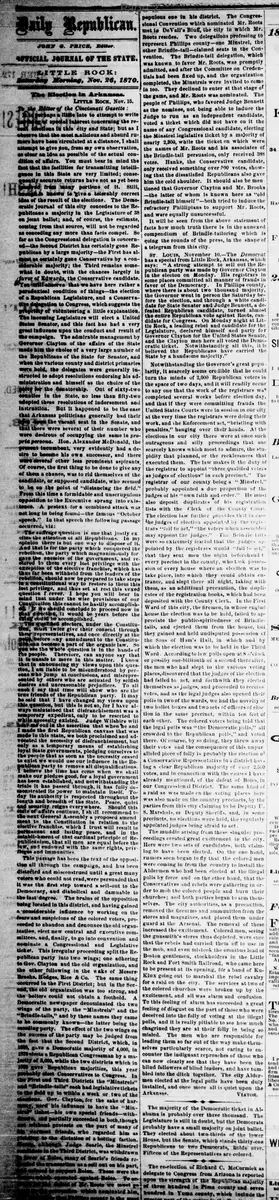
LITTLE ROCK, Nov. 15.
To the Editor of the Cincinnati Gazette:
Perhaps a little late to attempt to write concerning elections in this city and State; but as I learn that the most malicious and absurd rumors have been circulated at a distance, I shall attempt to give you, from my own observation, as clear an idea as possible of the actual condition of affairs. You must bear in mind the fact that the facilities for transmitting intelligence in this State are very limited; consequently returns have not yet been received from many portions of it. Still, we have a pretty good idea of the result of the election, and the Democratic journal of this city concedes the Republicans 8 on joint ballot; add, of course, the Legislature. You will not be surprised to learn that the Governor's friends claim more than facts compel. You will see that the Republican Legislature, and a majority in Congress, is the result of instruction. But it happened to poor Desmond to become his own successor, and several others less fortunate, viz:
The suffrage question is one that justly excites favor. I hope you will bear in mind, it would be years before suffrage could be accomplished. Before the whole people it is to move in this matter. The does who are the true friends of the Republican party. It may be while necessity existed, Judge Whittaker will not out in the assertion that when he and I made the first Republican canvass that was ever in this state, we both proclaimed and advised the people that as soon as the necessity ceased to exist we would use our influence in the Republican party to remove all disqualifications. I believe the time has come when we shall take our stand. The Republican party has been established, and notwithstanding the trials it has passed through, it has fully demonstrated its power to maintain itself. Today its authority is respected throughout the length and breadth of the State. Peace, quiet and security reigns everywhere. Should this state of affairs continue, I shall recommend to the next General Assembly a proposed amendment to the Constitution in relation to the elective franchise, which I trust will result in restoring peace, and in the establishment of that cardinal principle of Republicanism, that all men are equal before the law, and endowed with the same rights, privileges and immunities.
This passage has been the text of the opposition all through the campaign, and has been distorted and misconstrued until a great many voters who could not read, were persuaded that it was the first step toward a sell-out to the Democracy, and diabolical and damnable to the last degree. The brains of the opposition being located in this district, and having gained a considerable influence by working on the fears and suspicions of the colored voters, proceeded to abandon and denounce the old organization, elect new central and executive committees, and, finally, to go into convention and nominate a Congressional and Legislative ticket. This irregular proceeding split the Republican party into two wings; one adhering to Gov. Clayton and the old organization, and the other following in the wake of Messrs. Brooke, Hodges, Rice & Co. The same thing occurred in the First District; but in the Second the old organization was too strong, and the bolters could not obtain a foothold. A Democratic newspaper denominated the two wings of the party, the "Minstrels" and the "Brindle-tails," and by these names they came to be commonly known—the latter being the seceding party. The effect of the two wings on the success of the party may be judged from the fact that the Second District, which, in 1868, gave a Democratic majority of 4,000, in 1870 elected a Republican Congressman by a majority of 4,000, while the two districts which in 1868 gave Republican majorities, this year elected Conservatives to Congress. In the First and Third Districts the "Minstrels" and "Brindle-tails" each had legislative tickets in the field up to within a week or two of the election. Gov. Clayton, for the sake of harmony, used his influence to have the "Minstrels" ticket withdrawn in his own special friends—with considerable success in both, though not without protest on the part of many of his truest friends, who regarded him as truckling to the dictation of a bolting faction. In the Third District, Judge Searls, the Minstrel candidate for Congress, was withdrawn by order of his party, which so incensed many of Searls' friends regarded it as a sell out on his part, etc. These were the letters—Test.
must go
Populous one in his district. The Congressional Convention which nominated Mr. Roots met in DeVall's Bluff, the city in which Mr. Roots resides. Two delegations professing to represent Phillips county—one Minstrel, the other Brindle-tail—claimed seats in the Convention. The Brindle-tail delegation, which was known to favor Mr. Roots, was promptly admitted, and after the Committee on Credentials had been fixed up, and the organization completed, the Minstrels were invited to come in too. They declined to enter at that stage of the game, and Mr. Roots was nominated. The people of Phillips, who favored Judge Bennett as the nominee, not being able to induce the Judge to run as an independent candidate, voted a ticket which did not have on it the name of any Congressional candidate, electing the Minstrel legislative ticket by a majority of nearly 2,800, while the ticket on which were the names of Mr. Roots and his associates of the Brindle-tail persuasion, only received 833 votes. Hanker, the Conservative candidate, only received something over 400 votes, showing that the dissatisfied Republicans also gave him the cold shoulder. It should also be mentioned that Governor Clayton and Mr. Brooks—the latter of whom is known here as "old Brindle-tail himself"—both tried to induce the refractory Phillipsians to support Mr. Roots, and were equally unsuccessful.
It will be seen from the above statement of facts how much truth there is in the annexed compendium of Brindle-tailory which is going the rounds of the press, in the shape of a telegram from this city.
St. Louis, November 10.—The Democrat has a special from Little Rock, Arkansas, which says: "A strong attempt to sell out the Republican party was made by Governor Clayton in the election on Monday. His registrars in some places committed all manner of frauds in favor of the Democracy. In Phillips county, where there is about two thousand majority, the Governor went in person the Saturday before the election, and through a white candidate for State Senator and Judge Bennett, a defeated Republican candidate, turned almost the entire Republican vote against Roots, candidate for Congress. On Monday night at Little Rock, a leading rebel and candidate for the Legislature, declared himself and party for Governor Clayton for the United States Senate, and the Clayton men here all voted the Democratic ticket. Notwithstanding all this, it is believed the Republicans have carried the State by a handsome majority."
Notwithstanding the Governor's great popularity, it scarcely seems credible that he could turn the minds of 2,000 Republican voters in the space of two days, and it will readily occur to any one that the work of the registrars was completed several weeks before election day, and that if they were committing frauds the United States Courts were in session in our city at the very time the registrars were doing their work, and the Enforcement act, "bristling with penalties," hanging over their heads. At the elections in our city there were at once such outrageous and silly proceedings that one scarcely knows which most to admire, the stupidity that planned, or the recklessness that executed them. The law makes it the duty of the registrar to appoint "three qualified voters as judges of elections" in each precinct. The registrar of our county being a "Minstrel," probably appointed a due proportion of the judges of his "own faith and order." He must also deposit duplicates of his registration lists with the Clerk of the County Court. The election law further provides that in case the judges of election appointed by the registrars "fail to act," the voters when assembled may appoint the judges. The Brindle-tails were so extremely fearful that the judges appointed by the registrars would "fail to act," that they sent men the night beforehand to every precinct in the county, who took possession of every house where an election was to take place, into which they could obtain entrance, and slept there all night, taking with them, as an additional precaution, the duplicates of the registration books, which had been deposited with the County Clerk. In the First Ward of this city, the firemen, in whose engine house the election was to be held, failed to appreciate the public-spiritedness of Brindle-tails, and ejected them from the house, but they gained and held undisputed possession of the Sons of Ham's Hall, in which and by which the election was to be held in the Third Ward. According to law polls open at 8 o'clock or possibly one-billionth of a second thereafter. The men who had slept in the various voting places, discovered that the judges of the election had failed to act, and forthwith they elected themselves as judges, and proceeded to receive votes, and as the legal judges also opened their polls in two of the wards, we had the novelty of two ballot boxes and two sets of officers of election in the same precinct, within ten feet of each other. The colored voters being told that the legal polls was "the Democratic polls," all crowded to the Republican polls, and voted there. Of course, by so doing, they threw away their votes and the consequence of this unparalleled piece of folly is probably the election of a Conservative Representative in a district having a clear Republican majority of over 2,000 votes, and in connection with the causes I have already mentioned, of the defeat of Boles, in our Congressional District. The same kind of a raid as was made on the voting places here was also made on the country precincts, by the parties from this city claiming to be Deputy U. S. Marshals, or Deputy Sheriffs, and, in some precincts, no elections were held, the regularly appointed judges being afraid to act.
The muddle arising from these singular proceedings created great excitement in the city. Here were two sets of candidates, both claiming to have been elected. On the one hand, rumors soon began to fly that the colored men were coming in from the country to install the Aldermen who had been elected at the illegal polls by force and on the other hand, that the Conservatives and rebels were gathering in order to mob the colored people and burn their churches; and both parties began to arm themselves. The city authorities, as a precaution, removed the firearms and ammunition from the stores and magazines, and placed them under guard at the Arsenal. The removal of these increased the excitement. Colored men, seeing the gunsmith's stores thus depleted, were sure that the rebels had carried them off to use in the mob, and even mistook the omnibus load of Boston gentlemen, stockholders in the Little Rock and Fort Smith Railroad, who came here to be present at its opening, for a band of Ku-Klux going out to marshal the rebel cavalry for a raid on the city. The services at two of the colored churches were broken up by the excitement, and all was alarm and confusion.
To this feeling of alarm has succeeded a great feeling of disgust on the part of those who were deceived into the folly of voting at the illegal polls, and it is really pitiable to see how much chagrined they are at their folly in being so misled. The men who are responsible for leading them so far out of the way make themselves particularly scarce, not caring to encounter the indignant reproaches of those who can now clearly see that they have been the blind followers of blind leaders, and have tumbled into the ditch together. The city Aldermen elected at the legal polls have been duly installed, and once more all is quiet upon the Arkansas.
VIATOR,
What sub-type of article is it?
What themes does it cover?
What keywords are associated?
What entities or persons were involved?
Where did it happen?
Story Details
Key Persons
Location
Little Rock, Arkansas
Event Date
November 1870
Story Details
Letter refuting rumors of Republican sell-out in Arkansas election; details party split into Minstrels and Brindle-tails, suffrage debates, convention disputes in Phillips County, illegal polling stations leading to vote invalidation, post-election excitement, and Republican legislative success despite chaos.