Thank you for visiting SNEWPapers!
Sign up free
New Hampshire Statesman
Concord, Merrimack County, New Hampshire
What is this article about?
Letter from American Consul J. Augustus Johnson in Beyrout, Syria, dated June 28, 1860, details Druse massacres of Christians in Mount Lebanon, aided by Turkish soldiers. Estimates 10,500 Christian deaths, 1,200 Druse; widespread destruction of villages, churches, and crops; 60,000 homeless. Calls for U.S. humanitarian aid.
Clipping
OCR Quality
Full Text
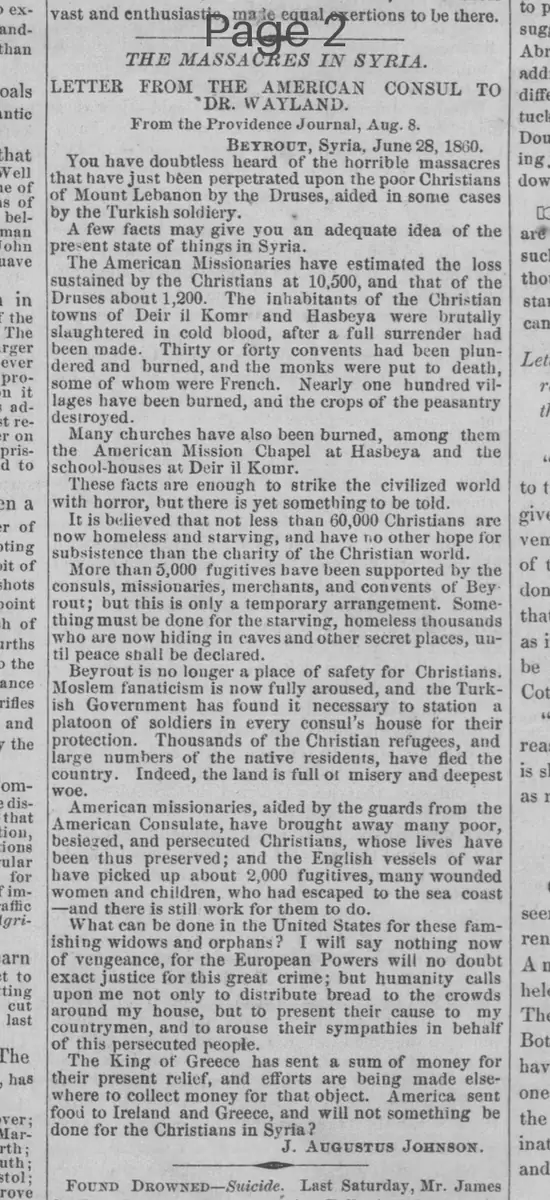
LETTER FROM THE AMERICAN CONSUL. TO DR. WAYLAND.
From the Providence Journal, Aug. 8.
BEYROUT, Syria, June 28, 1860.
You have doubtless heard of the horrible massacres that have just been perpetrated upon the poor Christians of Mount Lebanon by the Druses, aided in some cases by the Turkish soldiery.
A few facts may give you an adequate idea of the present state of things in Syria.
The American Missionaries have estimated the loss sustained by the Christians at 10,500, and that of the Druses about 1,200. The inhabitants of the Christian towns of Deir il Komr and Hasbeya were brutally slaughtered in cold blood, after a full surrender had been made. Thirty or forty convents had been plundered and burned, and the monks were put to death, some of whom were French. Nearly one hundred villages have been burned, and the crops of the peasantry destroyed.
Many churches have also been burned, among them the American Mission Chapel at Hasbeya and the school-houses at Deir il Komr.
These facts are enough to strike the civilized world with horror, but there is yet something to be told.
It is believed that not less than 60,000 Christians are now homeless and starving, and have no other hope for subsistence than the charity of the Christian world. More than 5,000 fugitives have been supported by the consuls, missionaries, merchants, and convents of Beyrout; but this is only a temporary arrangement. Something must be done for the starving, homeless thousands who are now hiding in caves and other secret places, until peace shall be declared.
Beyrout is no longer a place of safety for Christians. Moslem fanaticism is now fully aroused, and the Turkish Government has found it necessary to station a platoon of soldiers in every consul's house for their protection. Thousands of the Christian refugees, and large numbers of the native residents, have fled the country. Indeed, the land is full of misery and deepest woe.
American missionaries, aided by the guards from the American Consulate, have brought away many poor, besieged, and persecuted Christians, whose lives have been thus preserved: and the English vessels of war have picked up about 2,000 fugitives, many wounded women and children, who had escaped to the sea coast—and there is still work for them to do.
What can be done in the United States for these famishing widows and orphans? I will say nothing now of vengeance, for the European Powers will no doubt exact justice for this great crime; but humanity calls upon me not only to distribute bread to the crowds around my house, but to present their cause to my countrymen, and to arouse their sympathies in behalf of this persecuted people.
The King of Greece has sent a sum of money for their present relief, and efforts are being made elsewhere to collect money for that object. America sent food to Ireland and Greece, and will not something be done for the Christians in Syria?
J. AUGUSTUS JOHNSON.
What sub-type of article is it?
What keywords are associated?
What entities or persons were involved?
Where did it happen?
Foreign News Details
Primary Location
Syria
Event Date
June 28, 1860
Key Persons
Outcome
christians: 10,500 killed, 60,000 homeless and starving; druses: about 1,200 killed. nearly 100 villages burned, 30-40 convents plundered and burned with monks killed, many churches destroyed, crops ruined. 5,000+ fugitives supported in beyrout; thousands fled; european powers expected to exact justice.
Event Details
Druses, aided by Turkish soldiery in some cases, perpetrated massacres on Christians in Mount Lebanon. Inhabitants of Deir il Komr and Hasbeya slaughtered after surrender. Convents, churches including American Mission Chapel at Hasbeya and school-houses at Deir il Komr burned. Moslem fanaticism aroused; Turkish government stations soldiers at consuls' houses for protection. American missionaries and consulate guards rescued many; English warships saved 2,000 fugitives. Beyrout unsafe for Christians; land full of misery. Call for U.S. aid similar to aid sent to Ireland and Greece; King of Greece sent money.