Thank you for visiting SNEWPapers!
Sign up free
Roanoke Rapids Herald
Roanoke Rapids, Halifax County, North Carolina
What is this article about?
Post-WWII Europe: Elmore N. McKee reports home gardens in Germany, France, and Western Europe have prevented mass starvation amid 1,200-calorie rations. 1948 seed scarcity threatens plots; U.S. seed shipments recommended via ASTA assortment to aid families.
Clipping
OCR Quality
Full Text
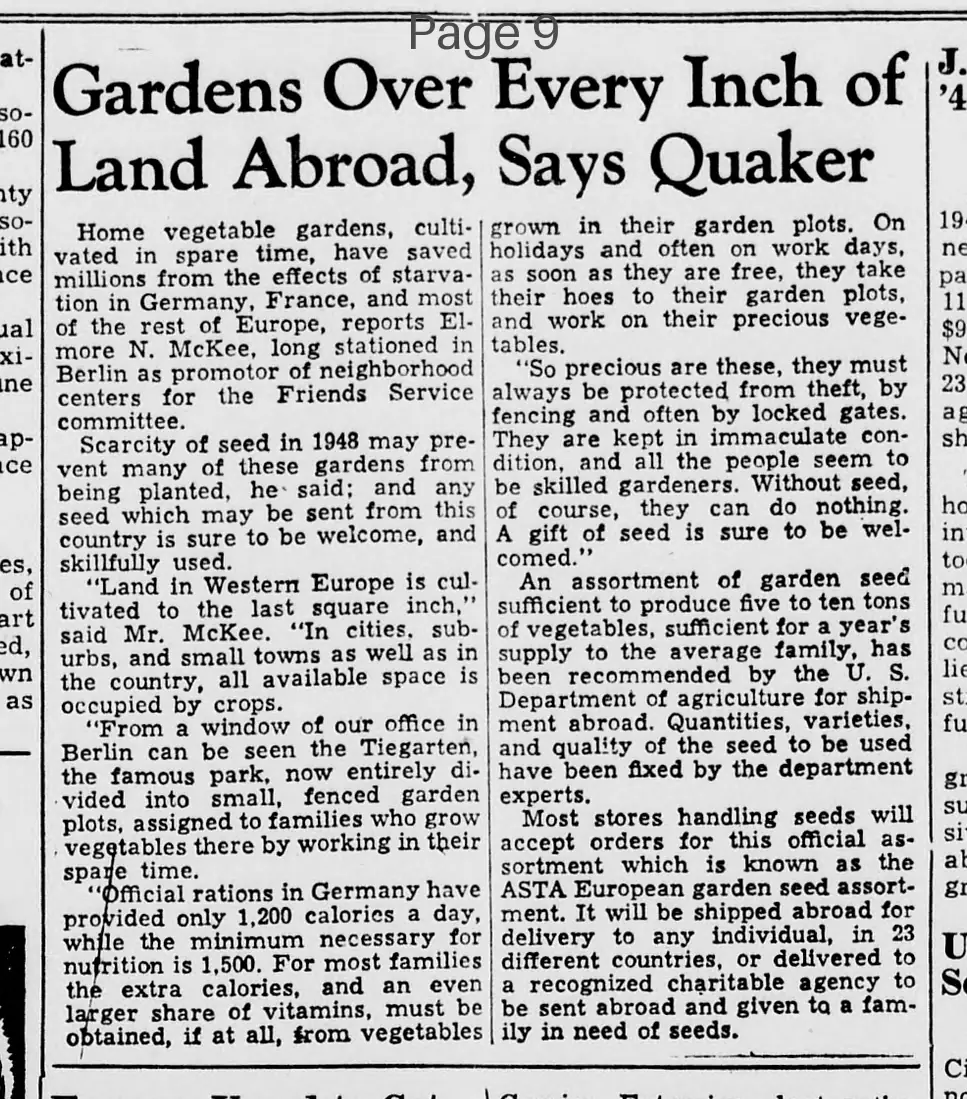
Home vegetable gardens, cultivated in spare time, have saved millions from the effects of starvation in Germany, France, and most of the rest of Europe, reports Elmore N. McKee, long stationed in Berlin as promotor of neighborhood centers for the Friends Service committee.
Scarcity of seed in 1948 may prevent many of these gardens from being planted, he said; and any seed which may be sent from this country is sure to be welcome, and skillfully used.
"Land in Western Europe is cultivated to the last square inch," said Mr. McKee. "In cities, suburbs, and small towns as well as in the country, all available space is occupied by crops.
"From a window of our office in Berlin can be seen the Tiegarten, the famous park, now entirely divided into small, fenced garden plots, assigned to families who grow vegetables there by working in their spare time.
"Official rations in Germany have provided only 1,200 calories a day, while the minimum necessary for nutrition is 1,500. For most families the extra calories, and an even larger share of vitamins, must be obtained, if at all, from vegetables grown in their garden plots. On holidays and often on work days, as soon as they are free, they take their hoes to their garden plots, and work on their precious vegetables.
"So precious are these, they must always be protected from theft, by fencing and often by locked gates. They are kept in immaculate condition, and all the people seem to be skilled gardeners. Without seed, of course, they can do nothing.
A gift of seed is sure to be welcomed."
An assortment of garden seed sufficient to produce five to ten tons of vegetables, sufficient for a year's supply to the average family, has been recommended by the U. S. Department of Agriculture for shipment abroad. Quantities, varieties, and quality of the seed to be used have been fixed by the department experts.
Most stores handling seeds will accept orders for this official assortment which is known as the ASTA European garden seed assortment. It will be shipped abroad for delivery to any individual, in 23 different countries, or delivered to a recognized charitable agency to be sent abroad and given to a family in need of seeds.
What sub-type of article is it?
What keywords are associated?
What entities or persons were involved?
Where did it happen?
Foreign News Details
Primary Location
Western Europe
Event Date
1948
Key Persons
Outcome
home vegetable gardens have saved millions from starvation effects; official rations provide only 1,200 calories per day versus minimum 1,500 needed; extra calories and vitamins from gardens
Event Details
Home vegetable gardens cultivated in spare time have saved millions from starvation in Germany, France, and most of Western Europe, according to Elmore N. McKee of the Friends Service Committee. Land is cultivated to the last square inch, including parks like the Tiergarten in Berlin divided into family plots. Scarcity of seed in 1948 may prevent planting; seeds from the U.S. would be welcome. U.S. Department of Agriculture recommends ASTA European garden seed assortment for shipment to 23 countries or charitable agencies.