Thank you for visiting SNEWPapers!
Sign up free
Alexandria Gazette & Daily Advertiser
Alexandria, Virginia
What is this article about?
Detailed account from Cadiz merchant Samuel Larned of a military revolt by the expeditionary army against the Spanish government, aiming to restore the 1812 Constitution. Troops arrested commanders and attempted to seize Cadiz but faced resistance; the city remains loyal to the regime amid confusion.
Clipping
OCR Quality
Full Text
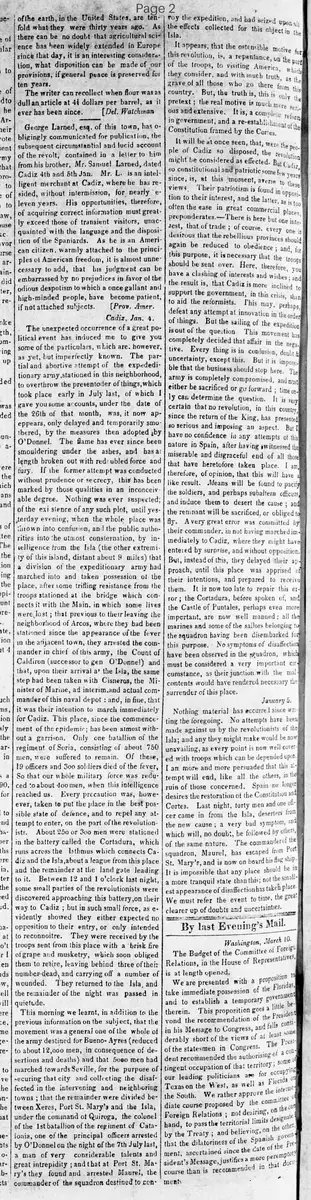
George Larned, esq. of this town, has obligingly communicated for publication, the subsequent circumstantial and lucid account of the revolt, contained in a letter to him from his brother, Mr. Samuel Larned, dated Cadiz 4th and 5th Jan. Mr. L. is an intelligent merchant at Cadiz, where he has resided, without intermission, for nearly eleven years. His opportunities, therefore, of acquiring correct information must greatly exceed those of transient visitors, unacquainted with the language and the disposition of the Spaniards. As he is an American citizen, warmly attached to the principles of American freedom, it is almost unnecessary to add, that his judgment can be embarrassed by no prejudices in favor of the odious despotism to which a once gallant and high-minded people, have become patient, if not attached subjects.
[Prov. Amer.
Cadiz, Jan. 4.
The unexpected occurrence of a great political event has induced me to give you some of the particulars, which are, however, as yet, but imperfectly known. The partial and abortive attempt of the expeditionary army, stationed in this neighborhood, to overthrow the present order of things, which took place early in July last, of which I gave you some accounts, under the date of the 26th of that month, was, it now appears, only delayed and temporarily smothered, by the measures then adopted by O'Donnel. The flame has ever since been smouldering under the ashes, and has at length broken out with redoubled force and fury. If the former attempt was conducted without prudence or secrecy, this has been marked by those qualities in an inconceivable degree. Nothing was ever suspected of the existence of any such plot, until yesterday evening, when the whole place was thrown into confusion, and the public authorities into the utmost consternation, by intelligence from the Isla (the other extremity of this island, distant about 9 miles) that a division of the expeditionary army had marched into and taken possession of the place, after some trifling resistance from the troops stationed at the bridge which connects it with the Main, in which some lives were lost; that previous to their leaving the neighborhood of Arcos, where they had been stationed since the appearance of the fever in the adjacent town, they arrested the commander in chief of this army, the Count of Caldiron (successor to gen O'Donnel) and that, upon their arrival at the Isla, the same step had been taken with Cisneros, the Minister of Marine, ad interim, and actual commander of this naval depot: and, in fine, that it was their intention to march immediately for Cadiz. This place, since the commencement of the epidemic, has been almost without a garrison. Only one battalion of the regiment of Soria, consisting of about 750 men, were suffered to remain. Of these, 19 officers and 300 soldiers died of the fever. So that our whole military force was reduced to about 400 men, when this intelligence reached us. Every precaution was, however, taken to put the place in the best possible state of defence, and to repel any attempt to enter, on the part of the revolutionists. About 250 or 300 men were stationed in the battery called the Cortadura, which runs across the Isthmus which connects Cadiz and the Isla, about a league from this place and the remainder at the land gate leading to it. Between 12 and 1 o'clock last night, some small parties of the revolutionists were discovered approaching this battery, on their way to Cadiz; but in such small force, as evidently showed they either expected no opposition to their entry, or only intended to reconnoitre. They were received by the troops sent from this place with a brisk fire of grape and musketry, which soon obliged them to retire, leaving behind three of their number dead and carrying off a number of wounded. They returned to the Isla, and the remainder of the night was passed in quietude.
This morning we learnt, in addition to the previous information on the subject, that the movement was a general one of the whole of the army destined for Bueno-Ayres (reduced to about 12,000 men, in consequence of desertions and deaths) and that 5000 men had marched towards Seville, for the purpose of securing that city and collecting the disaffected in the intervening and neighboring towns; that the remainder were divided between Xeres, Port St. Mary's and the Isla, under the command of Quiroga, the colonel of the 1st battalion of the regiment of Catalonia, one of the principal officers arrested by O'Donnel on the night of the 7th July last, a man of very considerable talents and great intrepidity; and that at Port St. Mary's they found and arrested Maurel, the commander of the squadron destined to convoy the expedition, and had seized upon all the effects collected for this object in the Isla.
It appears, that the ostensible motive for this revolution, is, a repentance, on the part of the troops, to visiting America, which they consider, and with much truth, as the grave of all those who go there from this country. But, the truth is, this is only the pretext; the real motive is much more serious and extensive. It is, a complete reform in government, and a re-establishment of the Constitution framed by the Cortes.
It will be at once seen, that, were the people of Cadiz so disposed, the revolution might be considered as effected. But Cadiz so constitutional and patriotic some few years since, is, at this moment, averse to these views. Their patriotism is found in opposition to their interest, and the latter, as is too often the case in great commercial places, preponderates.—There is here but one interest, that of trade; of course, every one is desirous that the rebellious provinces should again be reduced to obedience; and, for this purpose, it is necessary that the troops should be sent over. Here, therefore, you have a clashing of interests and wishes; and the result is, that Cadiz is more inclined to support the government, in this crisis, than to aid the reformists. This may, perhaps, defeat any attempt at innovation in the order of things. But the sailing of the expedition is out of the question This movement has completely decided that affair in the negative. Every thing is in confusion, doubt & uncertainty, except this. But it is impossible that the business should stop here. The army is completely compromised, and must either be sacrificed or go forward; time only can determine the question. It is very certain that no revolution, in this country since the return of the King, has presented so serious and imposing an aspect. But I have no confidence in any attempts of this nature in Spain, after having witnessed the miserable and disgraceful end of all those that have heretofore taken place. I am, therefore, of opinion, that this will have a like result. Means will be found to pacify the soldiers, and perhaps subaltern officers and induce them to desert the cause; and the remnant will be sacrificed, or obliged to fly. A very great error was committed by their commander, in not having marched immediately to Cadiz, where they might have entered by surprise, and without opposition. But, instead of this, they delayed their approach, until this place was apprised of their intentions, and prepared to receive them. It is now too late to repair this error; the Cortadura, before spoken of, and the Castle of Puntales, perhaps even more important, are now well manned; all the marines and some of the sailors belonging to the squadron having been disembarked for this purpose. No symptoms of disaffection have been observed in the squadron, which must be considered a very important circumstance, as their junction with the malcontents would have rendered necessary the surrender of this place.
January 5.
Nothing material has occurred since writing the foregoing. No attempts have been made against us by the revolutionists of the Isla; and any they might make would be now unavailing, as every point is now well covered with troops which can be depended upon. I am more and more persuaded that this attempt will end, like all the others, in the ruin of those concerned. Spain no longer desires the restoration of the Constitution and Cortes. Last night, forty men and one officer came in from the Isla, deserters from the new cause; a very bad symptom, and which will, no doubt, be followed by others, of the same nature. The commander of the squadron, Maurel, has escaped from Port St. Mary's, and is now on board his flag ship. It is impossible that any place should be in a more tranquil state than this; not the smallest appearance of disaffection has taken place. We must refer the event to time, the great clearer up of doubts and uncertainties.
What sub-type of article is it?
What keywords are associated?
What entities or persons were involved?
Where did it happen?
Foreign News Details
Primary Location
Cadiz
Event Date
Jan. 4 And 5
Key Persons
Outcome
some lives lost at the bridge; three revolutionaries killed and wounded in skirmish at cortadura battery; 40 men and one officer deserted the revolt; maurel escaped; revolt likely to fail with cadiz resisting and army compromised.
Event Details
The expeditionary army, reduced to 12,000 men, revolted against the government, arresting commanders Count of Caldiron and Cisneros, and seizing the Isla de Leon. Led by Quiroga, they aimed to restore the Constitution of the Cortes, using reluctance to sail to Buenos Aires as pretext. They arrested Maurel at Port St. Mary's and split forces, with 5,000 marching to Seville. Cadiz, weakened by fever (only 400 troops left), fortified defenses and repelled a reconnaissance party at Cortadura. The city supports the government due to trade interests; no naval disaffection; further desertions occurred by January 5.