Thank you for visiting SNEWPapers!
Sign up free
Literary
February 24, 1917
The Dickinson Press
Dickinson, Stark County, North Dakota
What is this article about?
Jean Black's eighth-grade prize essay on 'Folk Song' discusses the origins of folk music from dances and communities, its characteristics like simplicity and oral tradition, examples from various countries, and influences by composers such as Robert Burns, Thomas Moore, Chopin, and Stephen Foster, noting their decline and hope for renewed interest.
Clipping
OCR Quality
98%
Excellent
Full Text
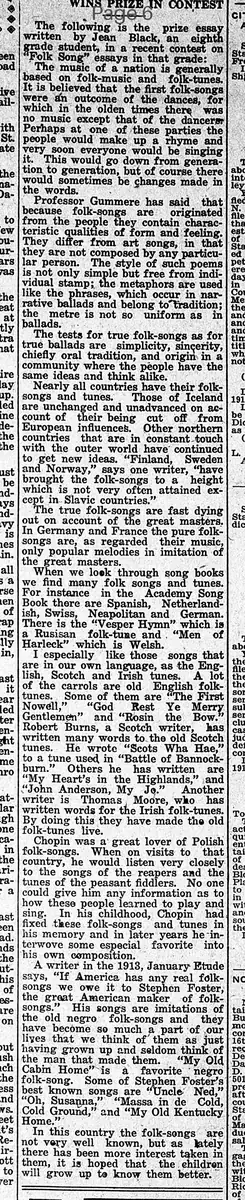
The following is the prize essay written by Jean Black, an eighth grade student, in a recent contest on "Folk Song" essays in that grade:
The music of a nation is generally based on folk-music and folk-tunes. It is believed that the first folk-songs were an outcome of the dances, for which in the olden times there was no music except that of the dancer. Perhaps at one of these parties the people would make up a rhyme and very soon everyone would be singing it. This would go down from generation to generation, but of course there would sometimes be changes made in the words.
Professor Gummere has said that because folk-songs are originated from the people they contain characteristic qualities of form and feeling. They differ from art songs, in that they are not composed by any particular person. The style of such poems is not only simple but free from individual stamp; the metaphors are used like the phrases which occur in narrative ballads and belong to tradition; the metre is not so uniform as in ballads.
The tests for true folk-songs as for true ballads are simplicity, sincerity, chiefly oral tradition, and origin in a community where the people have the same ideas and think alike.
Nearly all countries have their folk-songs and tunes. Those of Iceland are unchanged and unadvanced on account of their being cut off from European influences. Other northern countries that are in constant touch with the outer world have continued to get new ideas. "Finland, Sweden and Norway," says one writer, "have brought the folk-songs to a height which is not very often attained except in Slavic countries."
The true folk-songs are fast dying out on account of the great masters. In Germany and France the pure folk-songs are, as regarded their music, only popular melodies in imitation of the great masters.
When we look through song books we find many folk songs and tunes. For instance in the Academy Song Book there are Spanish, Netherlands, Swiss, Neapolitan and German. There is the "Vesper Hymn" which is a Russian folk-tune and "Men of Harlech" which is Welsh.
I especially like those songs that are in our own language, as the English, Scotch and Irish tunes. A lot of the carols are old English folk-tunes. Some of them are "The First Nowell," "God Rest Ye Merry Gentlemen" and "Rosin the Bow."
Robert Burns, a Scotch writer, has written many words to the old Scotch tunes. He wrote "Scots Wha Hae" to a tune used in "Battle of Bannockburn." Others he has written are "My Heart's in the Highlands," and "John Anderson, My Jo." Another writer is Thomas Moore, who has written words for the Irish folk-tunes. By doing this they have made the old folk-tunes live.
Chopin was a great lover of Polish folk-songs. When on visits to that country, he would listen very closely to the songs of the reapers and the tunes of the peasant fiddlers. No one could give him any information as to how these people learned to play and sing. In his childhood, Chopin had fixed these folk-songs and tunes in his memory and in later years he interwove some especial favorite into his own composition.
A writer in the 1913 January Etude says, "If America has any real folk-songs we owe it to Stephen Foster, the great American maker of folk-songs." His songs are imitations of the old negro folk-songs and they have become so much a part of our lives that we think of them as just having grown up and seldom think of the man that made them. "My Old Cabin Home" is a favorite negro folk-song. Some of Stephen Foster's best known songs are "Uncle Ned," "Oh, Susanna," "Massa in de Cold, Cold Ground," and "My Old Kentucky Home."
In this country the folk-songs are not very well known, but as lately there has been more interest taken in them, it is hoped that the children will grow up to know them better.
The music of a nation is generally based on folk-music and folk-tunes. It is believed that the first folk-songs were an outcome of the dances, for which in the olden times there was no music except that of the dancer. Perhaps at one of these parties the people would make up a rhyme and very soon everyone would be singing it. This would go down from generation to generation, but of course there would sometimes be changes made in the words.
Professor Gummere has said that because folk-songs are originated from the people they contain characteristic qualities of form and feeling. They differ from art songs, in that they are not composed by any particular person. The style of such poems is not only simple but free from individual stamp; the metaphors are used like the phrases which occur in narrative ballads and belong to tradition; the metre is not so uniform as in ballads.
The tests for true folk-songs as for true ballads are simplicity, sincerity, chiefly oral tradition, and origin in a community where the people have the same ideas and think alike.
Nearly all countries have their folk-songs and tunes. Those of Iceland are unchanged and unadvanced on account of their being cut off from European influences. Other northern countries that are in constant touch with the outer world have continued to get new ideas. "Finland, Sweden and Norway," says one writer, "have brought the folk-songs to a height which is not very often attained except in Slavic countries."
The true folk-songs are fast dying out on account of the great masters. In Germany and France the pure folk-songs are, as regarded their music, only popular melodies in imitation of the great masters.
When we look through song books we find many folk songs and tunes. For instance in the Academy Song Book there are Spanish, Netherlands, Swiss, Neapolitan and German. There is the "Vesper Hymn" which is a Russian folk-tune and "Men of Harlech" which is Welsh.
I especially like those songs that are in our own language, as the English, Scotch and Irish tunes. A lot of the carols are old English folk-tunes. Some of them are "The First Nowell," "God Rest Ye Merry Gentlemen" and "Rosin the Bow."
Robert Burns, a Scotch writer, has written many words to the old Scotch tunes. He wrote "Scots Wha Hae" to a tune used in "Battle of Bannockburn." Others he has written are "My Heart's in the Highlands," and "John Anderson, My Jo." Another writer is Thomas Moore, who has written words for the Irish folk-tunes. By doing this they have made the old folk-tunes live.
Chopin was a great lover of Polish folk-songs. When on visits to that country, he would listen very closely to the songs of the reapers and the tunes of the peasant fiddlers. No one could give him any information as to how these people learned to play and sing. In his childhood, Chopin had fixed these folk-songs and tunes in his memory and in later years he interwove some especial favorite into his own composition.
A writer in the 1913 January Etude says, "If America has any real folk-songs we owe it to Stephen Foster, the great American maker of folk-songs." His songs are imitations of the old negro folk-songs and they have become so much a part of our lives that we think of them as just having grown up and seldom think of the man that made them. "My Old Cabin Home" is a favorite negro folk-song. Some of Stephen Foster's best known songs are "Uncle Ned," "Oh, Susanna," "Massa in de Cold, Cold Ground," and "My Old Kentucky Home."
In this country the folk-songs are not very well known, but as lately there has been more interest taken in them, it is hoped that the children will grow up to know them better.
What sub-type of article is it?
Essay
What keywords are associated?
Folk Songs
Ballads
Oral Tradition
Robert Burns
Thomas Moore
Chopin
Stephen Foster
National Music
What entities or persons were involved?
Jean Black, An Eighth Grade Student
Literary Details
Title
Folk Song
Author
Jean Black, An Eighth Grade Student
Subject
Prize Essay In A Recent Contest On "Folk Song" Essays In That Grade