Thank you for visiting SNEWPapers!
Sign up free
Story
February 1, 1843
Morning Star
Limerick, York County, Maine
What is this article about?
An account of murderer Colt's religious views denying eternal punishment, expressed in his final days, letters, and to Dr. Anthon, portraying them as influencing his murder and planned suicide before execution.
Clipping
OCR Quality
95%
Excellent
Full Text
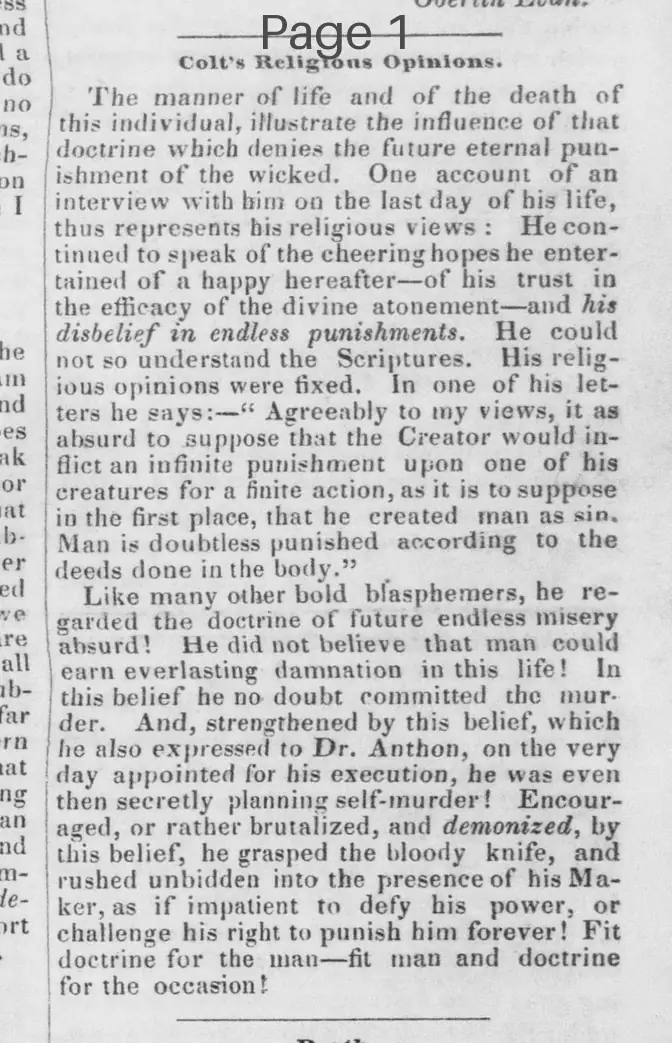
Colt's Religious Opinions.
The manner of life and of the death of this individual illustrate the influence of that doctrine which denies the future eternal punishment of the wicked. One account of an interview with him on the last day of his life thus represents his religious views: He continued to speak of the cheering hopes he entertained of a happy hereafter—of his trust in the efficacy of the divine atonement—and his disbelief in endless punishments. He could not so understand the Scriptures. His religious opinions were fixed. In one of his letters he says:-
"Agreeably to my views, it as absurd to suppose that the Creator would inflict an infinite punishment upon one of his creatures for a finite action, as it is to suppose in the first place, that he created man as sin. Man is doubtless punished according to the deeds done in the body."
Like many other bold blasphemers, he regarded the doctrine of future endless misery absurd! He did not believe that man could earn everlasting damnation in this life! In this belief he no doubt committed the murder. And, strengthened by this belief, which he also expressed to Dr. Anthon, on the very day appointed for his execution, he was even then secretly planning self-murder! Encouraged, or rather brutalized, and demonized, by this belief, he grasped the bloody knife, and rushed unbidden into the presence of his Maker, as if impatient to defy his power, or challenge his right to punish him forever! Fit doctrine for the man—fit man and doctrine for the occasion!
The manner of life and of the death of this individual illustrate the influence of that doctrine which denies the future eternal punishment of the wicked. One account of an interview with him on the last day of his life thus represents his religious views: He continued to speak of the cheering hopes he entertained of a happy hereafter—of his trust in the efficacy of the divine atonement—and his disbelief in endless punishments. He could not so understand the Scriptures. His religious opinions were fixed. In one of his letters he says:-
"Agreeably to my views, it as absurd to suppose that the Creator would inflict an infinite punishment upon one of his creatures for a finite action, as it is to suppose in the first place, that he created man as sin. Man is doubtless punished according to the deeds done in the body."
Like many other bold blasphemers, he regarded the doctrine of future endless misery absurd! He did not believe that man could earn everlasting damnation in this life! In this belief he no doubt committed the murder. And, strengthened by this belief, which he also expressed to Dr. Anthon, on the very day appointed for his execution, he was even then secretly planning self-murder! Encouraged, or rather brutalized, and demonized, by this belief, he grasped the bloody knife, and rushed unbidden into the presence of his Maker, as if impatient to defy his power, or challenge his right to punish him forever! Fit doctrine for the man—fit man and doctrine for the occasion!
What sub-type of article is it?
Biography
Crime Story
Tragedy
What themes does it cover?
Crime Punishment
Moral Virtue
Tragedy
What keywords are associated?
Colt Murder
Religious Opinions
Eternal Punishment
Self Murder
Divine Atonement
What entities or persons were involved?
Colt
Dr. Anthon
Story Details
Key Persons
Colt
Dr. Anthon
Story Details
Colt, facing execution for murder, expressed disbelief in eternal punishment, viewing it as absurd for finite sins, trusting in divine atonement for a happy hereafter; this belief allegedly enabled his crime and led to his suicide on execution day.