Thank you for visiting SNEWPapers!
Sign up free
The Weekly Minnesotian
Saint Paul, Ramsey County, Minnesota
What is this article about?
A correspondent from Sauk Rapids, Minnesota, promotes a beautiful, fertile tract of land west of the Mississippi River for farming and settlement, describing its soil, water, and timber. Mentions local developments including land breaking by Lowry and Gilman, planned warehouse and dwelling by Lowry and Hanley, county jail construction, and prospective Land Office in Benton County. Dated August 14, 1852.
Clipping
OCR Quality
Full Text
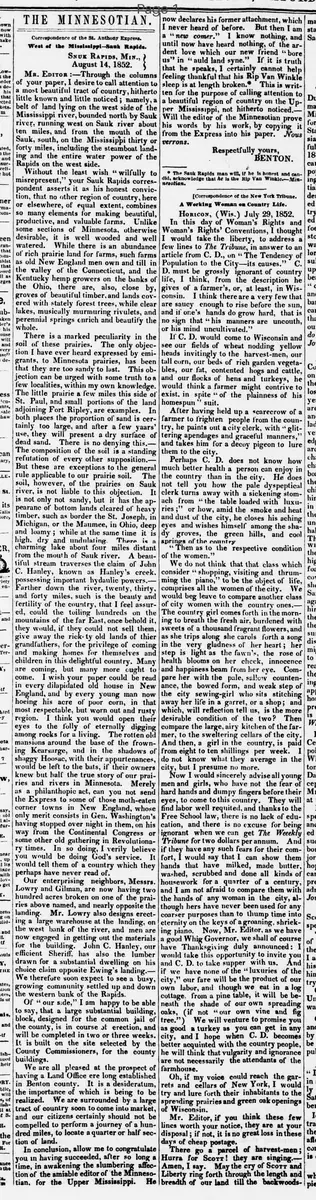
Correspondence of the St. Anthony Express.
West of the Mississippi--Sauk Rapids.
Sauk Rapids, Min.,
August 14, 1852.
Mr. Editor:--Through the columns of your paper, I desire to call attention to a most beautiful tract of country, hitherto little known and little noticed; namely, a belt of land lying on the west side of the Mississippi river, bounded north by Sauk river, running west on Sauk river about ten miles, and from the mouth of the Sauk, south, on the Mississippi thirty or forty miles, including the steamboat landing and the entire water power of the Rapids on the west side.
Without the least wish "wilfully to misrepresent," your Sauk Rapids correspondent asserts it as his honest conviction, that no other region of country, here or elsewhere, of equal extent, combines so many elements for making beautiful, productive, and valuable farms. Unlike some sections of Minnesota, otherwise desirable, it is well wooded and well watered. While there is an abundance of rich prairie land for farms, such farms as old New England men own and till in the valley of the Connecticut, and the Kentucky hemp growers on the banks of the Ohio, there are, also, close by, groves of beautiful timber, and lands covered with stately forest trees, while clear lakes, musically murmuring rivulets, and perennial springs enrich and beautify the whole.
There is a marked peculiarity in the soil of these prairies. The only objection I have ever heard expressed by emigrants, to Minnesota prairies, has been that they are too sandy to last. This objection can be urged with some truth to a few localities, within my own knowledge. The little prairie a few miles this side of St. Paul, and small portions of the land adjoining Fort Ripley, are examples. In both places the proportion of sand is certainly too large, and after a few years' use, they will present a dry surface of dead sand. There is no denying this. The composition of the soil is a standing refutation of every other supposition. But these are exceptions to the general rule applicable to our prairie soil. The soil, however, of the prairies on Sauk river, is not liable to this objection. It is not only not sandy, but it has the appearance of bottom lands cleared of heavy timber, such as border the St. Joseph, in Michigan, or the Maumee, in Ohio, deep and loamy; while at the same time it is high, dry and undulating.
There is a charming lake about four miles distant from the mouth of Sauk river. A beautiful stream traverses the claim of John C. Hanley, known as Hanley's creek, possessing important hydraulic powers. Farther down the river, twenty, thirty, and forty miles, such is the beauty and fertility of the country, that I feel assured, could the toiling hundreds on the mountains of the far East, once behold it, they would, if they could not sell them, give away the rickety old lands of their grandfathers, for the privilege of coming and making homes for themselves and children in this delightful country. Many are coming, but many more ought to come. I wish your paper could be read in every dilapidated old house in New England, and by every young man now hoeing his acre of poor corn, in that most respectable, but worn out and rusty region. I think you would open their eyes to the folly of eternally digging among rocks for a living. The rotten old mansions around the base of the frowning Kearsarge, and in the shadows of shaggy Hoosac, with their appurtenances, would be left to the bats, if their owners knew but half the true story of our prairies and rivers in Minnesota. Merely as a philanthropic act, can you not send the Express to some of those moth-eaten corner towns in New England, whose only merit consists in Gen. Washington's having stopped over night in them, on his way from the Continental Congress or some other old gathering in Revolutionary times. In so doing, I verily believe you would be doing God's service. It would tell them of a country which they perhaps have never read of.
Our enterprising neighbors, Messrs. Lowry and Gilman, are now having two hundred acres broken on one of the prairies above named, and nearly opposite the landing. Mr. Lowry also designs erecting a large warehouse at the landing, on the west bank of the river, and men are now engaged in getting out the materials for the building. John C. Hanley, our efficient Sheriff, has also the lumber drawn for a substantial dwelling on his choice claim opposite Ewing's landing. We therefore soon expect to see a busy, growing community settled up and down the western bank of the Rapids.
Of "our side," I am happy to be able to say, that a large substantial building, block, designed for the common jail of the county, is in course of erection, and will be completed in two or three weeks. It is built on the site selected by the County Commissioners, for the county buildings.
We are all pleased at the prospect of having a Land Office ere long established in Benton county. It is a desideratum, the importance of which is being to be realized. We are surrounded by a large tract of country soon to come into market, and our citizens certainly should not be compelled to perform a journey of a hundred miles, to locate a quarter or half section of land.
In conclusion, allow me to congratulate you in having succeeded, after so long a time, in awakening the slumbering affection of the amiable editor of the Minnesotian, for the Upper Mississippi. He now declares his former attachment, which I never heard of before. But then I am a "new comer." I know nothing, and until now have heard nothing, of the ardent love which our new friend "bore us" in "auld lang syne." If it is truth that he speaks, I certainly cannot help feeling thankful that his Rip Van Winkle sleep is at length broken. This is written for the purpose of calling attention to a beautiful region of country on the Upper Mississippi, not hitherto noticed.
Will the editor of the Minnesotian prove his words by his work, by copying it from the Express into his paper. Nous verrons.
Respectfully yours,
BENTON.
*The Sauk Rapids man will, if he is honest and candid, acknowledge that he is the Rip Van Winkle.--Minnesotian.
What sub-type of article is it?
What keywords are associated?
What entities or persons were involved?
Where did it happen?
Domestic News Details
Primary Location
Sauk Rapids, Min.
Event Date
August 14, 1852
Key Persons
Outcome
local developments include 200 acres broken by lowry and gilman, planned warehouse by lowry, dwelling by hanley, county jail under construction to complete in 2-3 weeks, and prospect of land office in benton county.
Event Details
Correspondent BENTON describes a beautiful, fertile tract west of Mississippi River, bounded by Sauk River, promoting it for settlement and farming due to rich prairie soil, timber, water sources, and hydraulic power. Encourages Eastern emigrants to move. Notes local improvements and growing community.