Thank you for visiting SNEWPapers!
Sign up free
New York Daily Tribune
New York, New York County, New York
What is this article about?
Coroner inquest into the murder of Augustus T. Van Liew, found dead in Mercer St., NYC, July 27, 1857. Witnesses report seeing him before death and suspicious pickpockets nearby, including John Hurley, but no evidence clears the mystery; jury finds death by violence from unknowns.
Clipping
OCR Quality
Full Text
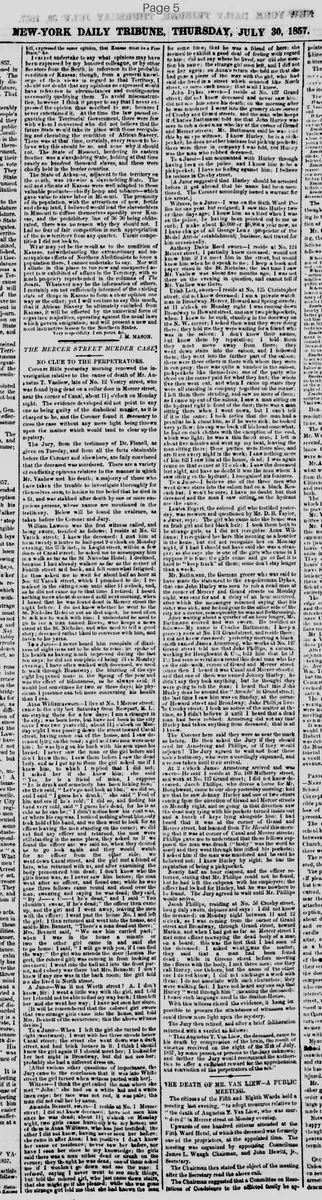
NO CLUE TO THE PERPETRATORS.
Coroner Hills yesterday morning renewed the investigation relative to the cause of death of Mr. Augustus T. Van Liew, late of No. 12 Vestry street, who was found lying dead on a cellar door in Mercer street, near the corner of Canal, about 11½ o'clock on Monday night. The evidence developed did not point to any one as being guilty of the diabolical murder, as it is charged to be, and the Coroner found it necessary to close the case without any more light being thrown upon the matter which would tend to clear up the mystery.
The Jury, from the testimony of Dr. Finnell, as given on Tuesday, and from all the facts obtainable before the Coroner and elsewhere, are fully convinced that the deceased was murdered. There are a variety of conflicting opinions relative to the manner in which Mr. Van Liew met his death; a majority of those who have taken the trouble to investigate thoroughly for themselves seem to incline to the belief that he died in a fit, and was stabbed after death by one or more suspicious persons, whose names are mentioned in the testimony. Below will be found the evidence, as taken before the Coroner and Jury.
William Lawson was the first witness called, and being sworn, testified as follows: I reside at No. 62 Varick street; I knew the deceased; I met him at four twenty minutes to half-past 9 o'clock on Monday evening, the 27th inst., in Laight street, within a few doors of Canal street; he asked me to accompany him in a walk as far as the St. Nicholas Hotel; I declined, because I had already walked as far as the corner of Fourth street and back, and felt somewhat fatigued; he then asked me to wait for about half an hour at No. 62 Varick street, which I promised to do; I remained in the sitting-room until after 11 o'clock, and, as he did not come up to that time I retired; I heard nothing more about deceased until next morning, when I heard that he was found dead in Mercer street the night before; I do not know whether he went to the St. Nicholas Hotel or not on that night; he used often to ask me to walk with him; I understand he used to go to see a man named Reeve, who keeps a news stand at the St. Nicholas, and who used to tell a good story; deceased rather liked to converse with him, and listen to his yarns.
To a Juror—I never heard him complain of dizziness of sight so as not to be able to read; he spoke of his health as having much improved during the last ten days; he did not complain of being ill on Monday evening; I have often walked with deceased, we used to walk through Broadway; the blurring of the eye sight happened more in the Spring of the year and was the effect of biliousness, so he always said; it would last sometimes for two or three days; his physician I presume can tell more concerning his health than I can.
Anna Williams sworn—I live at No. 1 Mercer street; I came to the city last Saturday from Newport, R. I.; staying there for a few days; I am a stranger in the city; was born here, but have not been in the city since I was two years old; about 11½ o'clock on Monday night I was passing down the street toward Canal street, having come out of the house, and I saw deceased lying on the road; a girl and two men were near him; he was lying on his back with his arm upon his breast; I never saw the man or the girl before and don't know them; I saw them before I saw the dead body, and as I got up to them the girl asked me if I knew him, to which I replied that I did not; I asked her if she knew him; she said "Yes, he is a friend of mine, I suppose he is drunk and somebody has been licking him;" she then said, "Let's go and look at him;" we did so, and I said "I guess he's drunk;" she said "Feel of him, and see if he's cold;" I did so, and finding his hand very cold, said "I guess he's dead, for he is as cold as he can be;" I didn't notice how his coat was, or where his cap was, I noticed nothing about him, only took hold of his hand, and we then went to look for an officer leaving the men standing on the corner; we did not find any officer and returned, the men were still standing in the same place, they asked us if we found the officer and we said no, when they desired us to go look again and they would watch for an officer from the other side; we went down Canal street, and the girl met a friend of hers, who returned with us, and after examining the body pronounced him dead; I don't know who the girl's friend was, as I never saw him before; the man went after an officer, and found one; while he was gone three fellows came round and stood over the man, swearing and saying he was dead; they said, "By J— C—t he's dead," and I said "You shouldn't swear, if he's dead;" the officer then came up, and the girl and I went away, leaving the men with the officer; I went past the house No. 1 and left the girl; I then returned and went into the house, and Mrs. Bennett said, "We saw him carried past;" when I was in the house a minute or two the other girl came in and said she wanted to go home: I said, "I will go with you, if I can find the way;" the girl who attends the door (Louisa Bogert, the colored girl) was coming in from looking at deceased; I went into the hall and into the front parlor, and nobody was there but Mrs. Bennett; I don't know if any one was in the back room; the girl told me she lived in North street,
A Juror—Was it not Worth street? A. I don't know, Sir; I went a little way with the girl, and told her I should not be able to find my way back; I then left her and she went her way: I have not seen her since.
[It will be remembered that the colored girl swore that two strange girls came into the house, and told Mrs. Bennett of the occurrence; this the above witness denies.]
To a Juror—When I left the girl she turned to the right (westward); I went with her three streets below Canal street; the street she went down was a dark street, and had brick houses in it; I think I should know the girl again if I should meet her; I looked for her last night in Broadway, but did not see her; probably she had a different dress on.
[After various other questions of importance, the Jury came to the conclusion that it was into White street the girl turned when witness parted with her).
Witness—I think the girl called the man whom she met "John;" she had on a white hat and a white lined cape; her face was not red, it was pale; the man did not call her by name.
Amanda Bennett, sworn—I reside at No. 1 Mercer street; I did not know deceased: have not seen him since he was dead; about 11 o'clock on Monday night two girls came in, one of them is Anna Williams, who has just testified: the other did not know having the came in after Anna; I am positive I do not know her name or residence; never saw her before, nor have I seen her since to my knowledge; the girls said there was a man either dead or drunk on the corner; they thought he was dead; one of them asked me if I wouldn't go down and see the man; I refused, saying I never went to see such things, but told the colored girl who just that she might go if she pleased; while she was gone the strange girl told me that she had known the man for some time; that he was a friend of hers; she seemed to exhibit a good deal of feeling with regard to him; did not say where he lived, nor did she mention his name; the strange girl soon left, and I did not see her again; on Anna's return she told me that she had gone a piece of the way with the girl, who had raid be lived street wbneh sounded like North street, or some such name; that is all I know.
John Dykes, sworn—I reside at No. Grand street; did not know deceased and never saw him. did not see him since his death; on the morning after he was murdered I went into the grocery store corner of Crosby and Grand streets and the man who keeps it (Charles Bathmann) told me that John Hurley was seen to rob a dead man who lay at the corner of Grand and Mercer streets this by an eye witness; I know Hurley. he is a pick-pocker; he does no other business but picking pockets; there were three in company I was told, cut Hurley was the man who robbed deceased.
To a Juror—I am acquainted with Hurley through bavirg been on the police and know him to pick pocket; I have no feeling against him; I believe he resides in Crosby street.
[A Juror suggested that Hurley should be arrested before it got abroad that his name had been men- tioned. The Coroner accordingly issued a warrant for hie arrest.]
Witness, to a Juror—I was on the Sixth Ward Po- lice for one year. but resigned; I saw this Hurley two or three days ago; I knew him as a thief when I was on the police, be having been pointed out to me as euch nake about 000 or 900 year now as I have cbage of all George Lea's (proprietor of the Model Arti-te establishment) business, and travel for him occasionally.
Anthony Davis Reed sworn—I reside at No. 124 Mercer street partially knew deceazed wouid not know him if I'd meet him in the street, but would know him when he d ppeak to me; I kseep a book and paper stand ibere on the evening in question, and cannot tell if Mr. Vauliew was there.
Uriah Loft, sworn—I reside at No. 125 Christopher street; did not klow deceased; I am a private watch- man Brondway Mercer Howard and Spring streets at 11 o'clock on Monday night I was coming down Broadway to Howard street, and saw two pickpockets, whom I knew to be such, standing in the doorway on the N. W. corner; I asked them: what they were doing there; they told me they were waiting for a friend who was in the saloon; I don't know their names, but know them by reputation; I told them they murt move away from there; they went down stairs into the saloon, and I followed them; they went into the further part of the saloon: there were three others in there with whom they were in cou pany; there was quite a number in the saloon, pickpockets like themselves one of the party who stood on the corner paid for what they had; the whole five then went out, ard when I came up stairs they were all standing in company together on the corner; I left them there standing, and saw no more of them; as I came up out of the saloon, I saw a man sitting on the hydrant right in front of the door; there was a man sitting there when I went down, but I can't tell if it is the same; I took notice that the man had a peculiar lo ok about him, as if he were sick: he looked very yellow; his cap was back off his head somewhat; he bad on dark clothes with the exception of the vest, which war light; be was a thin faced man; I left in about five minutes and went up my beat, leaving the man sitting there; these parties were there also, and are there every night in the week; I saw nothing more of him till I saw him at the house, dead; I was again round on that corner at 12 o'clock, I saw the deceased last night, and have no doubt it was the man whom I saw sitting on the hydrant; I recognized his features.
To a Juror—I believe one of the three men who went down stairs into the saloon had on a black Kossuth hat; I won't be sure; I have no doubt but that deceased and the man I saw sitting on the hydrant are the same.
Louisa Bogert, the colored girl who testified yester- day, was resworn and questioned by Mr. D. B. Taylor, a Juror, pays: The gird who came into the house was an Irish girl and had black hair: I took them both to be strange girls, as I did not recognize Anna Wil- lians; I recognized her here this morning as a boarder in the house, but did not recognize her on Monday night, if I had I should not have said she was a stran- ger; as she says she is one of the girls who came in I suppose it is true; the girls come and go so fast it is haid to "keep tiack" of them; some don't stay longer than a week.
Mr. Bathmann, the German grocer who was said to have made the statement to the ex-policeman Dykes, that one John Hurley was seen to rob a dead man at tbe corner of Mercer and Grand streets on Monday night, was sent for and a delay of an hour occurred, afier wbich the messenger returned saying that his sister was sick, and be bad gone to tbe other side of the city for a coctor, consequently he was not forthcoming. Atter waiting about a quarter of an hour longer, Mr. Bathmann arrived and was sworn. He testified as follow s—My name is Charles Bathmann; I keep a gioceiy siore at No 13l Grand street, and reside there; I did not keow deceased; yesterday morning a black suith naned James Armetrong, who works at No. 127 Gravd stieet told me that Jake Phillips, a carman workivg for Houghwaut & C, told hiin that be (J I.) had seen peveral men round this dead man who lay on the side-walk, corver of Gravd and Mercer street (since then I beard it was Canal and Mercer streets) ard that one of them was named Johnny Hurley; he didu't say tbey took anything, but he thoughi they were goivg to rob the man; I heard that this John Huley doee be aroupd the " Arcade" in Grand strect; tbe last time I saw him was on Sunday, at the corner of Howard street and Broadway; Jake Pbillios lives In Crosby street; I took no notice of the mnatter at th tine, as I didn't believe it until I heard that a dead man had been robbed; Arnstrong did not eay that Hurley had taken anything from deceased; that is all 1 know.
The Coroner here said they were as near the mark as before. He then asked the Jury if they should send for Arnstrong and Phillips, or if they would adjourn? The Jury agreed to wait and hear these men's testimony, who were accordingly supenæd, and a recees taken until their arrival.
At 2 o'clock James Armstrong arrived and was worn—He said I reside at No. 169 Mulberry street, ard work at No. 127 Grand street; I did not know de- ceased; Jacob Phillips, who drives a horee for Mr. Hougbwaut, cane to our shop yesterday mnorning: told me that be saw Johnny Hurley and one or two others coming from the airection of Grand and Mercer streets on Monaay night, and on going in that direction saw the dead may lying with bis pockets turned inside out and a bubch of keye lying alongside him; I bad heard that it was at the corner of Grand and Mereer street. but learped from The Herald this morn: in'g tbat it was at corner of Canal and Mercer streets; Phillipe gave me to understand that these fellows sup posed tbe man was drunk ("lusby" was the word he ured and they went through bim (rifled his pockets); I asked bin: if the wan was murdered and he eaid he beheved not: I know Hurley by sight; he bas the reputation of being a pickpocket.
Nearly half an hour elapsed, and the officer re- turned, stating that Mr. Phillips could not be fouod. but be bad l.t the rubpena with his employers; the officer bad lor ked for Hurley, but he was nowhere to be found. The Jury agreed to wait until Mr. Phillips would anive.
Jacob Phillips, reeiding at No. 56 Crosby street, beng duly sworn, deposes and says: I did not know the deceased; on Monday nigbt between 11 and 12 o'cicck, as I was coming from the corner of Grand street and Broadway, through Grand street, toward Marion, and when I bad got as far as Mercer street I met some cfficer couveying the dead body of a man. on a board; this was the first thet I had soen of the deceased; I asked what was the matter; they said that a man Ead been found dead: while in Greene street before meeting the flicers with the body, I met three men; one they call Hur.ey, one Osborn, but the name of tae other one I do not know: I did nct exchange a word with thew; I do not associate with such characters; they were walking fart: I have not beard any one say thst Hurley "went through him" (weaning the deceased); 1 heard such lapguage used in the Station-Houge.
With this witness closed tho evidence, it being in porrible to procure the atbexdance of witzesses who could throw more light upon the mystery.
The Jury tben retired, and after a brief deliberation returned with a verdict as followe:
" Tha: Augustus T. Van Liew, the deceased, came to his deah by compression the brain the reault vio,ence received on the pight of the Zzth of July, 1857 by some person or persons to the Jury unknown and further the Jury would recommend the authori- ties to offer a suficient reward for the apprehension and conviction of the perpetrators of the act.'
What sub-type of article is it?
What themes does it cover?
What keywords are associated?
What entities or persons were involved?
Where did it happen?
Story Details
Key Persons
Location
Mercer Street, Near Canal, New York City
Event Date
July 27, 1857
Story Details
Coroner Hills investigates the death of Augustus T. Van Liew, found dead on a cellar door in Mercer Street. Witnesses testify to seeing him alive earlier and suspicious persons, including pickpockets like John Hurley, near the body. Conflicting opinions on whether he died in a fit or was murdered; jury concludes murder by violence from unknown persons.