Thank you for visiting SNEWPapers!
Sign up free
The Massachusetts Spy, And Worcester County Advertiser
Worcester, Worcester County, Massachusetts
What is this article about?
A letter to the Massachusetts Spy critiques the U.S. Constitution's slave representation clause, arguing it grants unequal rights to non-slaveholding states, harms northern industry and defense, and effectively makes northerners 'slaves of slaves.' Signed by Liber Homo.
Clipping
OCR Quality
Full Text
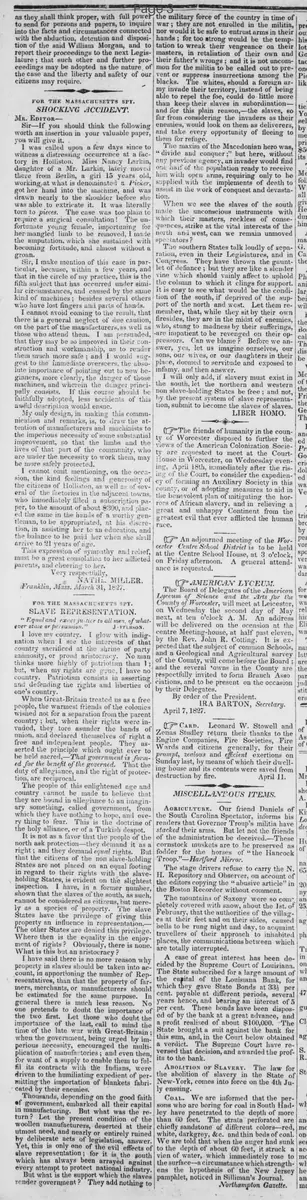
SLAVE REPRESENTATION.
"Equal and exact justice to all men, of whatever state or persuasion."
JEFFERSON.
I love my country. I glow with indignation when I see the interests of that country sacrificed at the shrine of party animosity, or proud aristocracy. No man thinks more highly of patriotism than I; but, when my rights are gone, I have no country. Patriotism consists in asserting and defending the rights and liberties of one's country.
When Great-Britain treated us as a free people, the warmest friends of the colonies wished not for a separation from the parent country; but, when their rights were invaded, they tore asunder the bands of union, and declared themselves of right a free and independent people. They asserted the principle which ought ever to be held sacred, That government is formed for the benefit of the governed. That the duty of allegiance, and the right of protection, are reciprocal.
The people of this enlightened age and country cannot be made to believe that they are bound in allegiance to an imaginary something, called government, from which they have nothing to hope, and everything to fear. This is the doctrine of the holy alliance, or of a Turkish despot.
It is not as a favor that the people of the north ask protection—they demand it as a right; and they demand equal rights. But that the citizens of the non slave-holding States are not placed on an equal footing in regard to their rights with the slave-holding States, is evident on the slightest inspection. I have, in a former number, shown that the slaves of the south, as such, cannot be considered as citizens, but merely as a species of property. The slave States have the privilege of giving this property an influence in representation.—The other States are denied this privilege.
Where then is the equality in the enjoyment of rights? Obviously, there is none. What is this but an aristocracy?
I have said there is no more reason why property in slaves should be taken into account, in apportioning the number of Representatives, than that the property of farmers, merchants, or manufacturers should be estimated for the same purpose. In general there is much less reason. No one pretends to doubt the importance of the two first. Let those who doubt the importance of the last, call to mind the time of the late war with Great-Britain; when the government, being urged by imperious necessity, encouraged the multiplication of manufactories; and even then, for want of a supply to enable them to fulfil its contracts with the Indians, were driven to the humiliating expedient of permitting the importation of blankets fabricated by their enemies.
Thousands, depending on the good faith of government, embarked all their capital in manufacturing. But what was the return? Let the present condition of the woollen manufacturers, deserted at their utmost need, and nearly or entirely ruined by deliberate acts of legislation, answer.
Yet, this is only one of the evil effects of slave representation; for it is the south which has always been arrayed against every attempt to protect national industry.
But what is the support which the slaves render government? "They add nothing to the military force of the country in time of war; they are not enrolled in the militia, nor would it be safe to entrust arms in their hands; for too strong would be the temptation to wreak their vengeance on their masters, in retaliation of their own and their father's wrongs; and it is not uncommon for the militia to be called out to prevent or suppress insurrections among the blacks. The whites, should a foreign army invade their territory, instead of being able to repel the foe, could do little more than keep their slaves in subordination—and for this plain reason,—the slaves, so far from considering the invaders as their enemies, would look on them as deliverers, and take every opportunity of fleeing to them for refuge."
The maxim of the Macedonian hero was, "divide and conquer;" but here, without any previous agency, an invader would find one half of the population ready to receive him with open arms, requiring only to be supplied with the implements of death to assist in the work of conquest and devastation.
When we see the slaves of the south made the unconscious instruments with which their masters, reckless of consequences, strike at the vital interests of the north and west, can we remain unmoved spectators?
The southern States talk loudly of separation, even in their Legislatures, and in Congress. They have thrown the gauntlet of defiance: but they are like a slender vine which should vainly affect to uphold the column to which it clings for support.
It is easy to see what would be the condition of the south, if deprived of the support of the north and west. Let them remember, that, while they sit by their own firesides, they are in the midst of enemies, who, stung to madness by their sufferings, are impatient to be revenged on their oppressors. Can we blame? Before we answer, yes, let us imagine ourselves, our sons, our wives, or our daughters in their place, doomed to servitude and exposed to infamy, and then answer.
I will only add, if slavery must exist in the south, let the northern and western non slave-holding States be free; and not, by the present system of slave representation, submit to become the slaves of slaves.
LIBER HOMO.
What sub-type of article is it?
What themes does it cover?
What keywords are associated?
What entities or persons were involved?
Letter to Editor Details
Author
Liber Homo
Recipient
For The Massachusetts Spy
Main Argument
the system of slave representation in the u.s. constitution creates inequality by allowing slaveholding states to count enslaved people as property for representation while denying equivalent benefits to non-slave states, harming northern industry and defense, and effectively subjugating free northerners to southern interests.
Notable Details