Thank you for visiting SNEWPapers!
Sign up free
The Potters Herald
East Liverpool, Columbiana County, Ohio
What is this article about?
Research directors from 33 AFL and CIO unions praise the unemployment insurance program's role in post-WWII reconversion but call for improvements to address inadequate benefits, narrow coverage, short duration, and restrictive disqualifications. They highlight inequities across states and risks of discriminatory practices.
Clipping
OCR Quality
Full Text
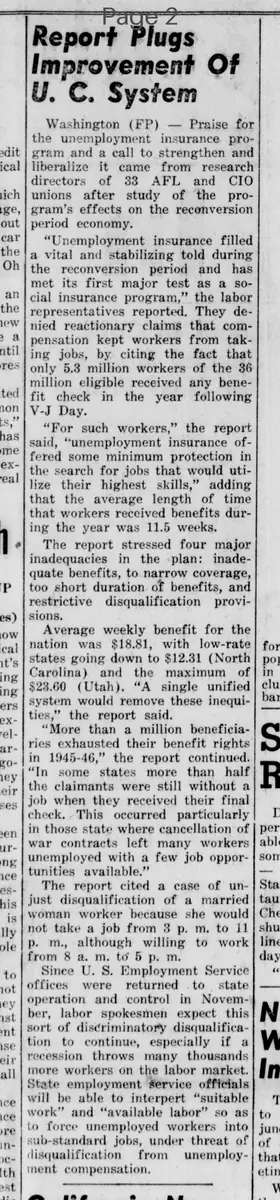
Washington (FP) - Praise for the unemployment insurance program and a call to strengthen and liberalize it came from research directors of 33 AFL and CIO unions after study of the program's effects on the reconversion period economy.
"Unemployment insurance filled a vital and stabilizing role during the reconversion period and has met its first major test as a social insurance program," the labor representatives reported. They denied reactionary claims that compensation kept workers from taking jobs, by citing the fact that only 5.3 million workers of the 36 million eligible received any benefit check in the year following V-J Day.
"For such workers," the report said, "unemployment insurance offered some minimum protection in the search for jobs that would utilize their highest skills," adding that the average length of time that workers received benefits during the year was 11.5 weeks.
The report stressed four major inadequacies in the plan: inadequate benefits, too narrow coverage, too short duration of benefits, and restrictive disqualification provisions.
Average weekly benefit for the nation was $18.81, with low-rate states going down to $12.31 (North Carolina) and the maximum of $23.60 (Utah). "A single unified system would remove these inequities," the report said.
"More than a million beneficiaries exhausted their benefit rights in 1945-46," the report continued. "In some states more than half the claimants were still without a job when they received their final check. This occurred particularly in those state where cancellation of war contracts left many workers unemployed with a few job opportunities available."
The report cited a case of unjust disqualification of a married woman worker because she would not take a job from 3 p. m. to 11 p. m., although willing to work from 8 a. m. to 5 p. m.
Since U. S. Employment Service offices were returned to state operation and control in November, labor spokesmen expect this sort of discriminatory disqualification to continue, especially if a recession throws many thousands more workers on the labor market.
State employment service officials will be able to interpret "suitable work" and "available labor" so as to force unemployed workers into sub-standard jobs, under threat of disqualification from unemployment compensation.
What sub-type of article is it?
What themes does it cover?
What keywords are associated?
Where did it happen?
Story Details
Location
Washington
Event Date
Year Following V J Day
Story Details
Labor unions' report praises unemployment insurance for stabilizing post-war economy but identifies inadequacies like low benefits, narrow coverage, short duration, and unfair disqualifications, urging a unified national system to address inequities and prevent forcing workers into substandard jobs.