Thank you for visiting SNEWPapers!
Sign up free
Editorial
April 20, 1959
The Augusta Courier
Augusta, Richmond County, Georgia
What is this article about?
Editorial criticizes the U.S. Supreme Court's recent opinions for overreaching constitutional authority, arguing it acts as a 'runaway court' influenced by 'legal realism.' It traces the court's expanded power to Chief Justice Marshall, echoes Jefferson's warnings, and urges Congress to limit its jurisdiction to restore constitutional supremacy.
Clipping
OCR Quality
98%
Excellent
Full Text
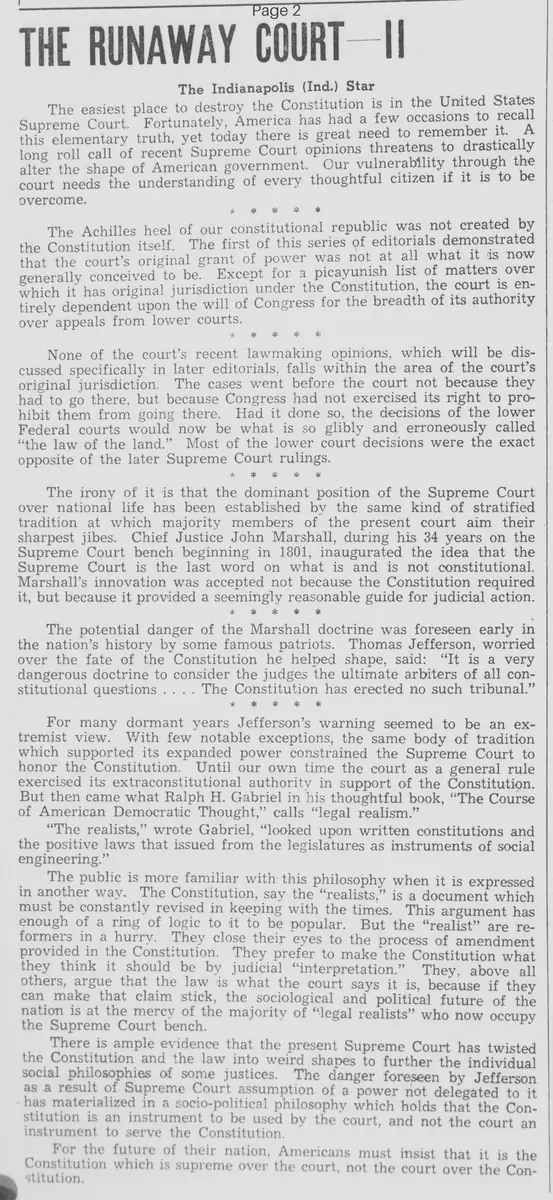
THE RUNAWAY COURT
The Indianapolis (Ind.) Star
Supreme Court.
Fortunately, America has had a few occasions to recall this elementary truth, yet today there is great need to remember it. A long roll call of recent Supreme Court opinions threatens to drastically alter the shape of American government. Our vulnerability through the court needs the understanding of every thoughtful citizen if it is to be overcome.
The Achilles heel of our constitutional republic was not created by the Constitution itself. The first of this series of editorials demonstrated that the court's original grant of power was not at all what it is now generally conceived to be. Except for a picayunish list of matters over which it has original jurisdiction under the Constitution, the court is entirely dependent upon the will of Congress for the breadth of its authority over appeals from lower courts.
None of the court's recent lawmaking opinions, which will be discussed specifically in later editorials, falls within the area of the court's original jurisdiction. The cases went before the court not because they had to go there, but because Congress had not exercised its right to prohibit them from going there. Had it done so, the decisions of the lower Federal courts would now be what is so glibly and erroneously called "the law of the land." Most of the lower court decisions were the exact opposite of the later Supreme Court rulings.
The irony of it is that the dominant position of the Supreme Court over national life has been established by the same kind of stratified tradition at which majority members of the present court aim their sharpest jibes. Chief Justice John Marshall, during his 34 years on the Supreme Court bench beginning in 1801, inaugurated the idea that the Supreme Court is the last word on what is and is not constitutional.
Marshall's innovation was accepted not because the Constitution required it, but because it provided a seemingly reasonable guide for judicial action.
The potential danger of the Marshall doctrine was foreseen early in the nation's history by some famous patriots. Thomas Jefferson, worried over the fate of the Constitution he helped shape, said: "It is a very dangerous doctrine to consider the judges the ultimate arbiters of all constitutional questions . . . . The Constitution has erected no such tribunal."
For many dormant years Jefferson's warning seemed to be an extremist view. With few notable exceptions, the same body of tradition which supported its expanded power constrained the Supreme Court to honor the Constitution. Until our own time the court as a general rule exercised its extraconstitutional authority in support of the Constitution.
But then came what Ralph H. Gabriel in his thoughtful book, "The Course of American Democratic Thought," calls "legal realism."
"The realists," wrote Gabriel, "looked upon written constitutions and the positive laws that issued from the legislatures as instruments of social engineering."
The public is more familiar with this philosophy when it is expressed in another way. The Constitution, say the "realists," is a document which must be constantly revised in keeping with the times. This argument has enough of a ring of logic to it to be popular. But the "realist" are reformers in a hurry. They close their eyes to the process of amendment provided in the Constitution. They prefer to make the Constitution what they think it should be by judicial "interpretation." They, above all others, argue that the law is what the court says it is, because if they can make that claim stick, the sociological and political future of the nation is at the mercy of the majority of "legal realists" who now occupy the Supreme Court bench.
There is ample evidence that the present Supreme Court has twisted the Constitution and the law into weird shapes to further the individual social philosophies of some justices. The danger foreseen by Jefferson as a result of Supreme Court assumption of a power not delegated to it has materialized in a socio-political philosophy which holds that the Constitution is an instrument to be used by the court, and not the court an instrument to serve the Constitution.
For the future of their nation, Americans must insist that it is the Constitution which is supreme over the court, not the court over the Constitution.
The Indianapolis (Ind.) Star
Supreme Court.
Fortunately, America has had a few occasions to recall this elementary truth, yet today there is great need to remember it. A long roll call of recent Supreme Court opinions threatens to drastically alter the shape of American government. Our vulnerability through the court needs the understanding of every thoughtful citizen if it is to be overcome.
The Achilles heel of our constitutional republic was not created by the Constitution itself. The first of this series of editorials demonstrated that the court's original grant of power was not at all what it is now generally conceived to be. Except for a picayunish list of matters over which it has original jurisdiction under the Constitution, the court is entirely dependent upon the will of Congress for the breadth of its authority over appeals from lower courts.
None of the court's recent lawmaking opinions, which will be discussed specifically in later editorials, falls within the area of the court's original jurisdiction. The cases went before the court not because they had to go there, but because Congress had not exercised its right to prohibit them from going there. Had it done so, the decisions of the lower Federal courts would now be what is so glibly and erroneously called "the law of the land." Most of the lower court decisions were the exact opposite of the later Supreme Court rulings.
The irony of it is that the dominant position of the Supreme Court over national life has been established by the same kind of stratified tradition at which majority members of the present court aim their sharpest jibes. Chief Justice John Marshall, during his 34 years on the Supreme Court bench beginning in 1801, inaugurated the idea that the Supreme Court is the last word on what is and is not constitutional.
Marshall's innovation was accepted not because the Constitution required it, but because it provided a seemingly reasonable guide for judicial action.
The potential danger of the Marshall doctrine was foreseen early in the nation's history by some famous patriots. Thomas Jefferson, worried over the fate of the Constitution he helped shape, said: "It is a very dangerous doctrine to consider the judges the ultimate arbiters of all constitutional questions . . . . The Constitution has erected no such tribunal."
For many dormant years Jefferson's warning seemed to be an extremist view. With few notable exceptions, the same body of tradition which supported its expanded power constrained the Supreme Court to honor the Constitution. Until our own time the court as a general rule exercised its extraconstitutional authority in support of the Constitution.
But then came what Ralph H. Gabriel in his thoughtful book, "The Course of American Democratic Thought," calls "legal realism."
"The realists," wrote Gabriel, "looked upon written constitutions and the positive laws that issued from the legislatures as instruments of social engineering."
The public is more familiar with this philosophy when it is expressed in another way. The Constitution, say the "realists," is a document which must be constantly revised in keeping with the times. This argument has enough of a ring of logic to it to be popular. But the "realist" are reformers in a hurry. They close their eyes to the process of amendment provided in the Constitution. They prefer to make the Constitution what they think it should be by judicial "interpretation." They, above all others, argue that the law is what the court says it is, because if they can make that claim stick, the sociological and political future of the nation is at the mercy of the majority of "legal realists" who now occupy the Supreme Court bench.
There is ample evidence that the present Supreme Court has twisted the Constitution and the law into weird shapes to further the individual social philosophies of some justices. The danger foreseen by Jefferson as a result of Supreme Court assumption of a power not delegated to it has materialized in a socio-political philosophy which holds that the Constitution is an instrument to be used by the court, and not the court an instrument to serve the Constitution.
For the future of their nation, Americans must insist that it is the Constitution which is supreme over the court, not the court over the Constitution.
What sub-type of article is it?
Constitutional
Legal Reform
What keywords are associated?
Supreme Court
Judicial Overreach
Constitutional Supremacy
Legal Realism
John Marshall
Thomas Jefferson
Congressional Control
What entities or persons were involved?
Supreme Court
Chief Justice John Marshall
Thomas Jefferson
Ralph H. Gabriel
Congress
Editorial Details
Primary Topic
Supreme Court Overreach And Judicial Power
Stance / Tone
Strongly Critical Of Supreme Court Activism
Key Figures
Supreme Court
Chief Justice John Marshall
Thomas Jefferson
Ralph H. Gabriel
Congress
Key Arguments
Court's Appellate Jurisdiction Depends On Congress, Not Inherent Constitutional Power
Recent Supreme Court Opinions Exceed Original Jurisdiction And Alter Government Structure
John Marshall Established Judicial Review Through Tradition, Not Constitution
Thomas Jefferson Warned Against Judges As Ultimate Constitutional Arbiters
Legal Realism Treats Constitution As Tool For Social Engineering Via Judicial Interpretation
Court Should Serve The Constitution, Not Vice Versa
Congress Can Limit Court By Restricting Appeals