Thank you for visiting SNEWPapers!
Sign up free
Pawtucket Tribune
Pawtucket, Providence County, Rhode Island
What is this article about?
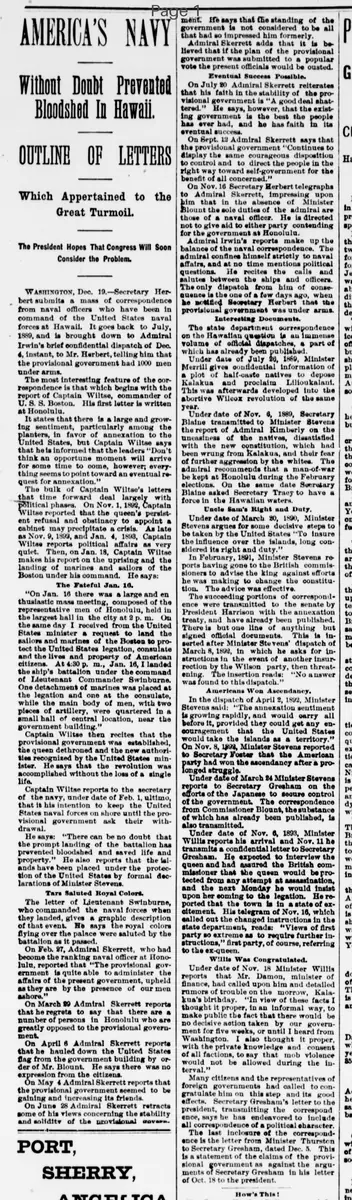
US naval officers' correspondence details the 1893 Hawaiian revolution, where USS Boston's marines landed to protect American interests, aiding the provisional government's establishment without bloodshed, amid growing annexation sentiment and political instability from 1889-1893.
Clipping
OCR Quality
Full Text
Without Doubt Prevented
Bloodshed In Hawaii.
OUTLINE OF LETTERS
Which Appertained to the
Great Turmoil.
The President Hopes That Congress Will Soon
Consider the Problem.
WASHINGTON, Dec. 19.—Secretary Herbert submits a mass of correspondence
from naval officers who have been in
command of the United States naval
forces at Hawaii. It goes back to July.
1889, and is brought down to Admiral
Irwin's brief confidential dispatch of Dec.
4, instant, to Mr. Herbert, telling him that
the provisional government had 1000 men
under arms.
The most interesting feature of the cor-
respondence is that which begins with the
report of Captain Wiltse, commander of
U. S. S. Boston. His first letter is written
at Honolulu,
It states that there is a large and grow-
ing sentiment, particularly among the
planters, in favor of annexation to the
United States. but Captain Wiltse says
that he is informed that the leaders "Don't
think an opportune moment will arrive
for some time to come, however; every-
thing seems to point toward an eventual re-
quest for annexation."
The bulk of Captain Wiltse's letters
that time forward deal largely with
political phases. On Nov. 1, 1892, Captain
Wiltse reported that the queen's persist-
ent refusal and obstinacy to appoint a
cabinet may precipitate a crisis. As late
as Nov. 9, 1892, and Jan. 4, 1893, Captain
Wiltse reports political affairs as very
quiet. Then, on Jan. 14, Captain Wiltse
makes his report on the uprising and the
landing of marines and sailors of the
Boston under his command. He says:
The Fateful Jan. 14.
"On Jan. 14 there was a large and en-
thusiastic mass meeting. composed of the
representative men of Honolulu, held in
the largest hall in the city at 2 p. m. On
the same day I received from the United
States minister a request to land the
sailors and marines of the Boston to pro-
tect the United States legation, consulate
and the lives and property of American
citizens. At 4:30 p. m.. Jan. 14. I landed
the ship's battalion under the command
of Lieutenant Commander Swinburne.
One detachment of marines was placed at
the legation and one at the consulate,
while the main body of men, with two
pieces of artillery, were quartered in a
small hall of central location, near the
government building.
Captain Wiltse then recites that the
provisional government was established,
the queen dethroned and the new authori-
ties recognized by the United States min-
ister. He says that the revolution was
accomplished without the loss of a single
life.
Captain Wiltse reports to the secretary
of the navy, under date of Feb. 1, ultimo,
that it his intention to keep the United
States naval forces on shore until the pro-
visional government ask
their
with-
drawal.
He says:
"There can be no doubt that
the prompt landing of the battalion has
prevented bloodshed and saved life and
property." He also reports that the isl-
ands have been placed under the protec-
tion of the United States by formal doc-
larations of Minister Stevens.
Tars Saluted Royal Colors.
The letter of Lieutenant Swinburne,
who commanded the naval forces when
they landed, gives a graphic description
of that event. He says the royal colors
flying over the palace were saluted by the
battalion as it passed.
On Feb. 27. Admiral Skerrett. who had
become the ranking naval officer at Hono-
luln. reported that "The provisional gov-
ermnent is quite able to administer the
affairs of the present government, upheld
as they are by the presence of our men
ashore.
On March 29 Admiral Skerrett reports
that he regrets to say that there are a
number of persons in Honolulu who are
greatly opposed to the provisional govern-
ment,
On April 6 Admiral Skerrett reported
that he hauled down the United States
dag from the government building by or-
der of Mr. Blount. He says there was no
expression from the citizens.
On May 4 Admiral Skerrett reports that
the provisional government seemed to be
gaining and increasing its friends.
On Jun. 28 Admiral Skerrett retracts
some of his views concerning the stability
and solidity of the provisional
government.
ment. He says that the standing of the
government is not considered to be all
that had so impressed him formerly.
Admiral Skerrett adds that it is be-
lieved that if the plan of the provisional
government was submitted to a popular
vote the present officials would be ousted.
Eventual Success Possible.
On July 20 Admiral Skerrett reiterates
that his faith in the stability of the pro-
visional government is "A good deal shat-
tered." He says, however, that the exist-
ing government is the best the people
has ever had, and he has faith in its
eventual success.
On Sept. 12 Admiral Skerrett says that
the provisional government "Continues to
display the same courageous disposition
to control and to direct the people in the
right way toward self-government for the
benefit of all concerned."
On Nov.16 Secretary Herbert telegraphs
to Admiral Skerrett, impressing upon
him that in the absence of Minister
Blount the sole duties of the admiral are
those of a naval officer. He is directed
not to give aid to either party contending
for the government at Honolulu.
Admiral Irwin's reports make up the
balance of the naval correspondence. The
admiral confines himself strictly to naval
affairs, and at no time mentions political
questions. He recites the calls and
salutes between the ships and officers.
The only dispatch from him of conse-
quence is the one of a few days ago, when
he notified Secretary Herbert that the
provisional government was under arms.
Interesting Documents.
The state department correspondence
on the Hawaiian question is an immense
volume of official dispatches, a part of
which has already been published.
Under date of July 26, 1889, Minister
Merrill gives confidential information of
a plot of half-caste natives to depose
Kalakaua and proclaim Liliuokalani.
This was afterwards developed into the
abortive Wilcox revolution of the same
year.
Under date of Nov. 6, 1889, Secretary
Blaine transmitted to Minister Stevens
the report of Admiral Kimberly on the
uneasiness of the natives, dissatisfied
with the new constitution. which had
been wrung from Kalakaua, and their fear
of further aggression by the whites. The
admiral recommends that a man-of-war
be kept at Honolulu during the February
elections. On the same date Secretary
Blaine asked Secretary Tracy to have a
force in the Hawaiian waters.
Uncle Sam's Right and Duty.
Under date of March 30, 1890, Minister
Stevens argues for some decisive steps to
be taken by the United States "To insure
the influence over the islands, long con-
sidered its right and duty."
In February, 1891, Minister Stevens re-
ports having gone to the British commis-
sioners to advise the king against efforts
he was making to change the constitu-
tion. The advice was effective.
The succeeding portions of correspond-
ence were transmitted to the senate by
President Harrison with the annexation
treaty, and have already been published.
There is but one line of anything but
signed official documents. This is in-
serted after Minister Stevens' dispatch of
March 8, 1892, in which he asks for in-
structions in the event of another insur-
rection by the Wilson party, then threat-
ening. The insertion reads:
"No answer
was found to this dispatch."
Americans Won Ascendancy.
In the dispatch of April 2, 1892, Minister
Stevens said: "The annexation sentiment
is growing rapidly, and would carry all
before it, provided they could get any en-
couragement that the United States
would take the islands as a territory."
On Nov. 8, 1892, Minister Stevens reported
to Secretary Foster that the American
party had won the ascendancy after a pro-
longed struggle.
Under date of March 24 Minister Stevens
reports to Secretary Gresham on the
efforts of the Japanese to secure control
of the government. The correspondence
from Commissioner Blount, the substance
of which has already been published, is
also transmitted.
Under date of Nov. 6, 1893, Minister
Willis reported his arrival and Nov. 11 he
transmits a confidential letter to Secretary
Gresham. He expected to interview the
queen and had assured the British com-
missioner that the queen would be pro-
tected from any attempt at assassination
and the next Monday he would insist
upon her coming to the legation. He re-
ported that the town is in a state of ex-
citement. His telegram of Nov. 16, which
called out the changed instructions in the
State department, reads: "Views of ex-
queen so extreme as to require further in-
structions." Ex-queen, of course, referring
to the ex-queen.
Willis Was Congratulated,
Under date of Nov. 18 Minister Willis
reports that Mr. Damon, minister of
finance, had called upon him and detailed
rumors of trouble on the morrow, Kal-
Kua's birthday. "In view of these facts I
thought it proper, in an informal way, to
make public the fact that there would be
no decisive action taken by our govern-
ment for five weeks, or until I heard from
Washington. I also thought it proper,
with the private knowledge and consent
of all factions, to say that much violence
would not be allowed during the in-
terval,
Many citizens and the representatives of
foreign governments had called to con-
gratulate him on this step and its good
effects. Secretary Gresham's letter to the
president, transmitting the correspond-
ence, says he has endeavored to include
all correspondence of a political character.
The last inclosure of the correspond-
ence is the letter from Minister Thurston
to Secretary Gresham, dated Dec. 5. This
is a statement of the claims of the provi-
sional government as against the argu-
ments of Secretary Gresham in his letter
of Oct. 18 to the president.
What sub-type of article is it?
What keywords are associated?
What entities or persons were involved?
Where did it happen?
Foreign News Details
Primary Location
Hawaii
Event Date
Jan. 14, 1893
Key Persons
Outcome
revolution accomplished without the loss of a single life; provisional government established and recognized by us minister; islands placed under us protection.
Event Details
Correspondence from US naval officers and diplomats details political instability in Hawaii from 1889, culminating in the Jan. 14, 1893 uprising where USS Boston's marines landed to protect US interests, leading to the queen's dethronement and establishment of provisional government without bloodshed. Ongoing reports assess the government's stability and US involvement through 1893.