Thank you for visiting SNEWPapers!
Sign up free
Knoxville Weekly Chronicle
Knoxville, Knox County, Tennessee
What is this article about?
W. J. Keith of Morgan County, Tennessee, refutes a false report in the Press and Herald accusing him of causing a disturbance at a Knoxville convention. As a Union delegate, he describes being threatened by rebels and criticizes the convention's rebel dominance under General Vaughn, warning against supporting such candidates.
Clipping
OCR Quality
Full Text
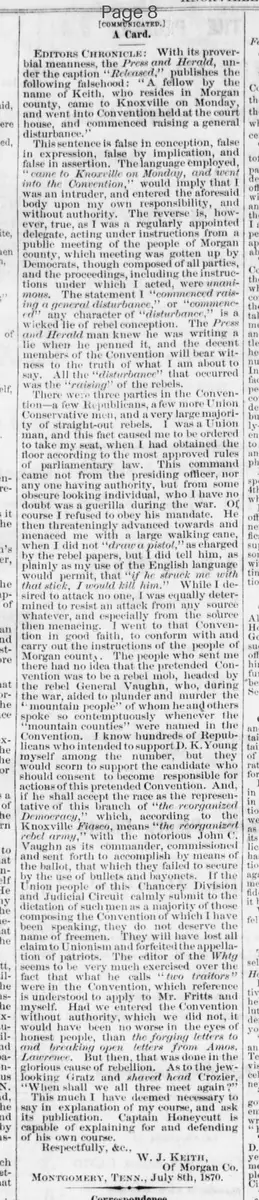
A Card.
Editors Chronicle: With its proverbial meanness, the Press and Herald, under the caption "Released," publishes the following falsehood: "A fellow by the name of Keith, who resides in Morgan county, came to Knoxville on Monday, and went into Convention held at the court house, and commenced raising a general disturbance."
This sentence is false in conception, false in expression, false by implication, and false in assertion. The language employed, "came to Knoxville on Monday, and went into the Convention," would imply that I was an intruder, and entered the aforesaid body upon my own responsibility, and without authority. The reverse is, however, true, as I was a regularly appointed delegate, acting under instructions from a public meeting of the people of Morgan county, which meeting was gotten up by Democrats, though composed of all parties, and the proceedings, including the instructions under which I acted, were unanimous. The statement "I commenced raising a general disturbance," or "commenced" any character of "disturbance," is a wicked lie of rebel conception. The Press and Herald man knew he was writing a lie when he penned it, and the decent members of the Convention will bear witness to the truth of what I am about to say. All the "disturbance" that occurred was the "raising" of the rebels.
There were three parties in the Convention—a few Republicans, a few more Union Conservatives, and a very large majority of straight-out rebels. I was a Union man, and this fact caused me to be ordered to take my seat, when I had obtained the floor according to the most approved rules of parliamentary law. This command came not from the presiding officer, nor any one having authority, but from some obscure looking individual, who I have no doubt was a guerilla during the war. Of course I refused to obey his mandate. He then threateningly advanced towards and menaced me, with a large walking cane, when I did not "draw a pistol," as charged by the rebel papers, but I did tell him, as plainly as my use of the English language would permit, that "if he struck me with that stick, I would kill him." While I desired to attack no one, I was equally determined to resist an attack from any source whatever, and especially from the source then menacing. I went to that Convention in good faith, to conform with and carry out the instructions of the people of Morgan county. The people who sent me there had no idea that the pretended Convention was to be a rebel mob, headed by the rebel General Vaughn, who, during the war, aided to plunder and murder the "mountain people" of whom he and others spoke so contemptuously whenever the "mountain counties" were named in the Convention. I know hundreds of Republicans who intended to support D. K. Young myself among the number, but they would scorn to support the candidate who should consent to become responsible for actions of this pretended Convention. And, if he shall accept the race as the representative of this branch of "the reorganized Democracy," which, according to the Knoxville Fiasco, means "the reorganized rebel army," with the notorious John C. Vaughn as its commander, commissioned and sent forth to accomplish by means of the ballot, that which they failed to secure by the use of bullets and bayonets. If the Union people of this Chancery Division and Judicial Circuit calmly submit to the dictation of such men as a majority of those composing the Convention of which I have been speaking, they do not deserve the name of freemen. They will have lost all claim to Unionism and forfeited the appellation of patriots. The editor of the Whig seems to be very much exercised over the fact that what he calls "two traitors" were in the Convention, which reference is understood to apply to Mr. Fritts and myself. Had we entered the Convention without authority, which we did not, it would have been no worse in the eyes of honest people, than the forging letters to and breaking open letters from Amos. Lawrence. But then, that was done in the glorious cause of rebellion. As to the jew-looking Gratz and shaved head Crozier, "When shall we all three meet again?"
This much I have deemed necessary to say in explanation of my course, and ask its publication. Captain Honeycutt is capable of explaining for and defending of his own course.
Respectfully, &c.,
W. J. KEITH,
Of Morgan Co.
Montgomery, Tenn., July 8th, 1870.
What sub-type of article is it?
What themes does it cover?
What keywords are associated?
What entities or persons were involved?
Letter to Editor Details
Author
W. J. Keith, Of Morgan Co.
Recipient
Editors Chronicle
Main Argument
keith refutes the press and herald's false claim that he intruded and caused disturbance at the knoxville convention, asserting he was a legitimate union delegate threatened by rebels, and urges union people to reject the rebel-dominated proceedings led by general vaughn.
Notable Details