Thank you for visiting SNEWPapers!
Sign up free
Letter to Editor
April 8, 1880
The Manchester Journal
Manchester, Bennington, Bennington County, Vermont
What is this article about?
A traveler in Rome, dated March 15, 1880, describes their experiences including visits to St. Peter's, the Coliseum by moonlight with a diverse party, the Pantheon, and religious sites, before heading to Florence. Signed F.J.F. from New York City, April 1880.
Clipping
OCR Quality
95%
Excellent
Full Text
CORRESPONDENCE.
Rome, March 15th, 1880.
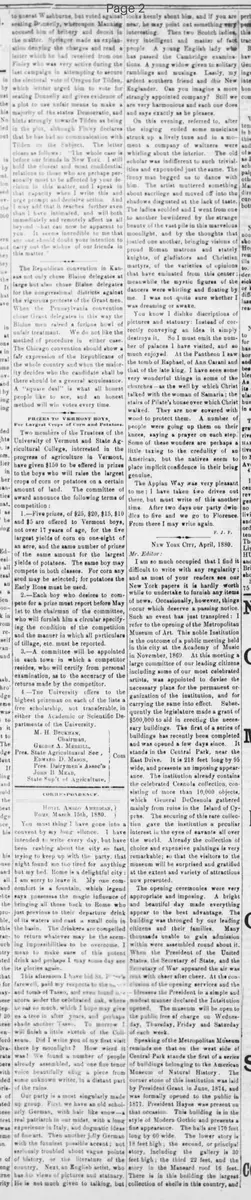
You must think I have gone into a convent by my long silence. I have intended to write every day, but have been rushing about the city so fast, trying to keep up with the party, that night found me too tired for anything but my bed. Rome is a delightful city; I am sorry to leave it. My one comfort is a fountain, which legend says possesses the magic influence of bringing all those back to Rome who just previous to their departure drink of its waters and cast a small coin in the basin. The drinkers are compelled to return whatever may be the seeming impossibilities to be overcome. I mean to make sure of this potent drink and perhaps I may some day see its glories again.
This afternoon I have bid St. Peter's farewell, paid my respects to the tomb of Tasso, and even planted an acorn under the celebrated oak, where he sat so much, which I hope may give us a tree in after years, and perhaps shade another Tasso. To-morrow I will finish a little sketch of the Coliseum. Did I write you of my first visit there by moonlight? How weird it was! I found a number of people already assembled, and one fine tenor voice beautifully sang a piece from some unknown writer, in a distant part of the ruins.
Our party is a most singularly made up group. First, we have an old scholarly German, with hair like snow—a real patriarch in our midst, with a long experience in Italy, and dogmatic ideas of fine art. Then another sly German with the funnest possible accent; not seriously troubled about vague points of history, or the literature of the country. Next, an English artist, who has his views of pictures and statuary. He is not much given to talking, but looks keenly about him, and if you are near, he may point out something very interesting. Then two Scotch ladies, very intelligent and matter of fact people. A young English lady who has passed the Cambridge examinations. A young widow given to solitary rambles and musings. Lastly, my ardent southern friend and this New Englander. Can you imagine a more strangely appointed company? Still we are very harmonious and each one does and says exactly as he pleases.
On this evening, referred to, after the singing ended some musicians struck up a lively tune and in a moment a company of waltzers were whirling about the interior. The old scholar was indifferent to such trivialities and expounded just the same. The funny man begged us to dance with him. The artist muttered something about sacrilege and moved off into the shadows disgusted at the lack of taste. The ladies scolded and I went from one to another bewildered by the strange beauty of the vast pile in this marvelous moonlight, and by the thoughts that jostled one another, bringing visions of proud Roman matrons and stately knights, of gladiators and Christian martyrs, of the varieties of opinions that have emanated from this center; meanwhile the mystic figures of the dancers were whirling and floating by me. I was not quite sure whether I was dreaming or awake.
You know I dislike descriptions of pictures and statuary: Instead of correctly conveying an idea it simply destroys it. So I must omit the number of palaces I have visited, and so much enjoyed. At the Pantheon I saw the tomb of Raphael, of Ann Catherina and that of the late king. I have seen some very wonderful things in some of the churches—as the well by which Christ talked with the woman of Samaria: the stairs of Pilate's house over which Christ walked. They are now covered with wood to protect them. A number of people were going up them on their knees, saying a prayer on each step. Some of these wonders are perhaps a little taxing to the credulity of an American, but the natives seem to place implicit confidence in their being genuine.
The Appian Way was very pleasant to me: I have taken two drives out there, but must write of this another time. After two days our party dwindles to five and we go to Florence. From there I may write again.
F.J.F.
New York City, April, 1880.
Rome, March 15th, 1880.
You must think I have gone into a convent by my long silence. I have intended to write every day, but have been rushing about the city so fast, trying to keep up with the party, that night found me too tired for anything but my bed. Rome is a delightful city; I am sorry to leave it. My one comfort is a fountain, which legend says possesses the magic influence of bringing all those back to Rome who just previous to their departure drink of its waters and cast a small coin in the basin. The drinkers are compelled to return whatever may be the seeming impossibilities to be overcome. I mean to make sure of this potent drink and perhaps I may some day see its glories again.
This afternoon I have bid St. Peter's farewell, paid my respects to the tomb of Tasso, and even planted an acorn under the celebrated oak, where he sat so much, which I hope may give us a tree in after years, and perhaps shade another Tasso. To-morrow I will finish a little sketch of the Coliseum. Did I write you of my first visit there by moonlight? How weird it was! I found a number of people already assembled, and one fine tenor voice beautifully sang a piece from some unknown writer, in a distant part of the ruins.
Our party is a most singularly made up group. First, we have an old scholarly German, with hair like snow—a real patriarch in our midst, with a long experience in Italy, and dogmatic ideas of fine art. Then another sly German with the funnest possible accent; not seriously troubled about vague points of history, or the literature of the country. Next, an English artist, who has his views of pictures and statuary. He is not much given to talking, but looks keenly about him, and if you are near, he may point out something very interesting. Then two Scotch ladies, very intelligent and matter of fact people. A young English lady who has passed the Cambridge examinations. A young widow given to solitary rambles and musings. Lastly, my ardent southern friend and this New Englander. Can you imagine a more strangely appointed company? Still we are very harmonious and each one does and says exactly as he pleases.
On this evening, referred to, after the singing ended some musicians struck up a lively tune and in a moment a company of waltzers were whirling about the interior. The old scholar was indifferent to such trivialities and expounded just the same. The funny man begged us to dance with him. The artist muttered something about sacrilege and moved off into the shadows disgusted at the lack of taste. The ladies scolded and I went from one to another bewildered by the strange beauty of the vast pile in this marvelous moonlight, and by the thoughts that jostled one another, bringing visions of proud Roman matrons and stately knights, of gladiators and Christian martyrs, of the varieties of opinions that have emanated from this center; meanwhile the mystic figures of the dancers were whirling and floating by me. I was not quite sure whether I was dreaming or awake.
You know I dislike descriptions of pictures and statuary: Instead of correctly conveying an idea it simply destroys it. So I must omit the number of palaces I have visited, and so much enjoyed. At the Pantheon I saw the tomb of Raphael, of Ann Catherina and that of the late king. I have seen some very wonderful things in some of the churches—as the well by which Christ talked with the woman of Samaria: the stairs of Pilate's house over which Christ walked. They are now covered with wood to protect them. A number of people were going up them on their knees, saying a prayer on each step. Some of these wonders are perhaps a little taxing to the credulity of an American, but the natives seem to place implicit confidence in their being genuine.
The Appian Way was very pleasant to me: I have taken two drives out there, but must write of this another time. After two days our party dwindles to five and we go to Florence. From there I may write again.
F.J.F.
New York City, April, 1880.
What sub-type of article is it?
Reflective
Informative
Historical
What themes does it cover?
Religion
Social Issues
What keywords are associated?
Rome Travel
Coliseum Moonlight
Historical Sites
Travel Party
Religious Relics
Appian Way
Pantheon Tombs
What entities or persons were involved?
F.J.F.
Letter to Editor Details
Author
F.J.F.
Main Argument
the writer shares personal reflections on their travels and experiences in rome, highlighting its historical and cultural allure amid a diverse traveling party.
Notable Details
Fountain Legend For Returning To Rome
Moonlight Visit To Coliseum With Singing And Dancing
Diverse Party Including German Scholars, English Artist, Scotch Ladies
Visits To St. Peter's, Tasso's Tomb, Pantheon, Religious Relics Like Pilate's Stairs
Planting Acorn Under Tasso's Oak