Thank you for visiting SNEWPapers!
Sign up free
Story
July 5, 1867
The Union And Journal
Biddeford, York County, Maine
What is this article about?
Article emphasizes ventilation's importance for consumptives, arguing lungs handle cold air well. Illustrates with Scottish village where airtight houses caused disease, and Labrador natives who thrive in open tents but sicken in closed houses.
Clipping
OCR Quality
95%
Excellent
Full Text
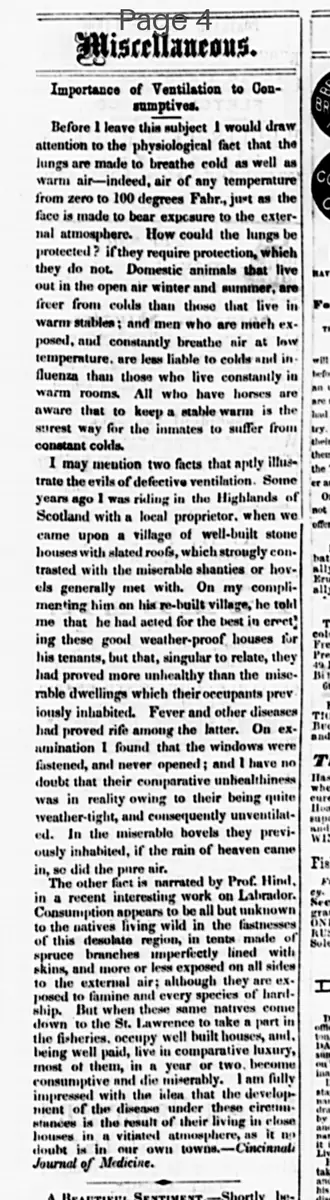
MISCELLANEOUS.
Importance of Ventilation to Consumptives.
Before I leave this subject I would draw attention to the physiological fact that the lungs are made to breathe cold as well as warm air—indeed, air of any temperature from zero to 100 degrees Fahr., just as the face is made to bear exposure to the external atmosphere.
How could the lungs be protected? if they require protection, which they do not. Domestic animals that live out in the open air winter and summer, are freer from colds than those that live in warm stables; and men who are much exposed, and constantly breathe air at low temperature, are less liable to colds and influenza than those who live constantly in warm rooms. All who have horses are aware that to keep a stable warm is the surest way for the inmates to suffer from constant colds.
I may mention two facts that partly illustrate the evils of defective ventilation. Some years ago I was residing in the Highlands of Scotland with a local proprietor, when we came upon a village of well-built stone houses with slated roofs, which strongly contrasted with the miserable shanties or hovels generally met with. On my commenting him on his re-built village he told me that he had acted for the best in erecting those good weather-proof houses for his tenants, but that, singular to relate, they had proved more unhealthy than the miserable dwellings which their occupants previously inhabited. Fever and other diseases had proved rife among the latter. On examination I found that the windows were fastened, and never opened; and I have no doubt that their comparative unhealthiness was in reality owing to their being quite weather-tight, and consequently unventilated. In the miserable hovels they previously inhabited, if the rain of heaven can get in, so can the pure air.
The other fact is narrated by Prof. Hind, in a recent interesting work on Labrador. Consumption appears to be all but unknown to the natives living wild in the fastnesses of this desolate region, in tents made of spruce branches imperfectly lined with skins, and more or less exposed on all sides to the external air; although they are exposed to famine and every species of hardship. But when these same natives come down to the St. Lawrence to take a part in the fisheries, occupy well built houses, and, being well paid, live in comparative luxury, most of them, in a year or two, become consumptive and die miserably. I am fully impressed with the idea that the development of the disease under these circumstances is the result of their living in close houses, in a vitiated atmosphere, as it no doubt is in our own towns.—Cincinnati Journal of Medicine.
Importance of Ventilation to Consumptives.
Before I leave this subject I would draw attention to the physiological fact that the lungs are made to breathe cold as well as warm air—indeed, air of any temperature from zero to 100 degrees Fahr., just as the face is made to bear exposure to the external atmosphere.
How could the lungs be protected? if they require protection, which they do not. Domestic animals that live out in the open air winter and summer, are freer from colds than those that live in warm stables; and men who are much exposed, and constantly breathe air at low temperature, are less liable to colds and influenza than those who live constantly in warm rooms. All who have horses are aware that to keep a stable warm is the surest way for the inmates to suffer from constant colds.
I may mention two facts that partly illustrate the evils of defective ventilation. Some years ago I was residing in the Highlands of Scotland with a local proprietor, when we came upon a village of well-built stone houses with slated roofs, which strongly contrasted with the miserable shanties or hovels generally met with. On my commenting him on his re-built village he told me that he had acted for the best in erecting those good weather-proof houses for his tenants, but that, singular to relate, they had proved more unhealthy than the miserable dwellings which their occupants previously inhabited. Fever and other diseases had proved rife among the latter. On examination I found that the windows were fastened, and never opened; and I have no doubt that their comparative unhealthiness was in reality owing to their being quite weather-tight, and consequently unventilated. In the miserable hovels they previously inhabited, if the rain of heaven can get in, so can the pure air.
The other fact is narrated by Prof. Hind, in a recent interesting work on Labrador. Consumption appears to be all but unknown to the natives living wild in the fastnesses of this desolate region, in tents made of spruce branches imperfectly lined with skins, and more or less exposed on all sides to the external air; although they are exposed to famine and every species of hardship. But when these same natives come down to the St. Lawrence to take a part in the fisheries, occupy well built houses, and, being well paid, live in comparative luxury, most of them, in a year or two, become consumptive and die miserably. I am fully impressed with the idea that the development of the disease under these circumstances is the result of their living in close houses, in a vitiated atmosphere, as it no doubt is in our own towns.—Cincinnati Journal of Medicine.
What sub-type of article is it?
Medical Curiosity
Curiosity
What themes does it cover?
Misfortune
Recovery
Moral Virtue
What keywords are associated?
Ventilation
Consumptives
Tuberculosis
Cold Air
Scotland Village
Labrador Natives
What entities or persons were involved?
Prof. Hind
Where did it happen?
Highlands Of Scotland, Labrador, St. Lawrence
Story Details
Key Persons
Prof. Hind
Location
Highlands Of Scotland, Labrador, St. Lawrence
Story Details
Author argues lungs need ventilation, not protection from cold air, using examples: Scottish tenants healthier in leaky hovels than airtight houses; Labrador natives free of consumption in open tents but contract it in closed houses.