Thank you for visiting SNEWPapers!
Sign up free
Literary
October 14, 1861
Cincinnati Daily Press
Cincinnati, Hamilton County, Ohio
What is this article about?
This essay argues that people, especially Americans with nervous temperaments, sleep too little and need at least eight hours of rest nightly for health. It contrasts recovery in nervous vs. lymphatic types, warns against stimulants, and advocates natural repose. Attributed to Doctor Jackson.
Clipping
OCR Quality
98%
Excellent
Full Text
We Never Sleep Too Little.
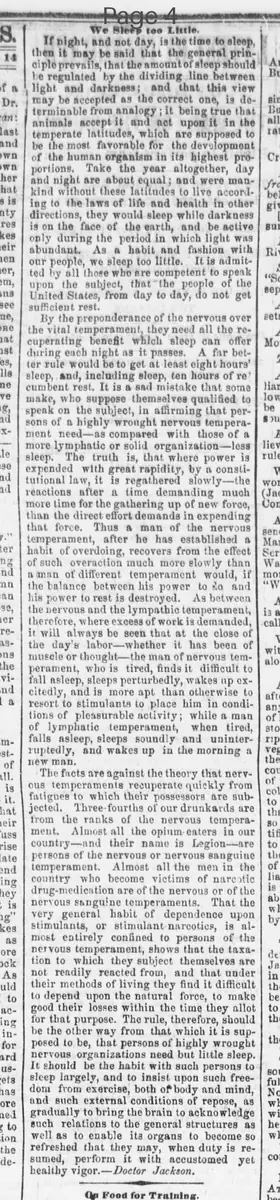
If night, and not day, is the time to sleep then it may be said that the general principle prevails, that the amount of sleep should be regulated by the dividing line between light and darkness; and that this view may be accepted as the correct one, is determinable from analogy; it being true that animals accept it and act upon it in the temperate latitudes, which are supposed to be the most favorable for the development of the human organism in its highest proportions. Take the year altogether, day and night are about equal; and were mankind without these latitudes to live according to the laws of life and health in other directions, they would sleep while darkness is on the face of the earth, and be active only during the period in which light was abundant. As a habit and fashion with our people, we sleep too little. It is admitted by all those who are competent to speak upon the subject, that the people of the United States, from day to day, do not get sufficient rest. By the preponderance of the nervous over the vital temperament, they need all the recuperating benefit which sleep can offer during each night as it passes. A far better rule would be to get at least eight hours' sleep, and, including sleep, ten hours of recumbent rest.
It is a sad mistake that some make, who suppose themselves qualified to speak on the subject, in affirming that persons of a highly wrought nervous temperament need—as compared with those of a more lymphatic or solid organization—less sleep. The truth is, that where power is expended with great rapidity, by a constitutional law, it is regathered slowly—the reactions after a time demanding much more time for the gathering up of new force than the direct effort demands in expending that force. Thus a man of the nervous temperament, after he has established a habit of overdoing, recovers from the effect of such overaction much more slowly than a man of different temperament would, if the balance between his power to do and his power to rest is destroyed. As between the nervous and the lymphatic temperament, therefore, where excess of work is demanded, it will always be seen that at the close of the day's labor—whether it has been of muscle or thought—the man of nervous temperament, who is tired, finds it difficult to fall asleep, sleeps perturbedly, wakes up excitedly, and is more apt than otherwise to resort to stimulants to place him in conditions of pleasurable activity; while a man of lymphatic temperament, when tired, falls asleep, sleeps soundly and uninterruptedly, and wakes up in the morning a new man. The facts are against the theory that nervous temperaments recuperate quickly from fatigues to which their possessors are subjected.
Three-fourths of our drunkards are from the ranks of the nervous temperament. Almost all the opium eaters in our country—and their name is Legion—are persons of the nervous or nervous sanguine temperament. Almost all the men in the country who become victims of narcotic drug-medication are of the nervous or of the nervous sanguine temperaments. That the very general habit of dependence upon stimulants, or stimulant narcotics, is almost entirely confined to persons of the nervous temperament, shows that the taxation to which they subject themselves are not readily reacted from, and that under their methods of living they find it difficult to depend upon the natural force, to make good their losses within the time they allot for that purpose. The rule, therefore, should be the other way from that which it is supposed to be, that persons of highly wrought nervous organizations need but little sleep. It should be the habit with such persons to sleep largely, and to insist upon such freedom from exercise, both of body and mind, and such external conditions of repose, as gradually to bring the brain to acknowledge such relations to the general structures as well as to enable its organs to become so refreshed that they may, when duty is resumed, perform it with accustomed yet healthy vigor.—Doctor Jackson.
If night, and not day, is the time to sleep then it may be said that the general principle prevails, that the amount of sleep should be regulated by the dividing line between light and darkness; and that this view may be accepted as the correct one, is determinable from analogy; it being true that animals accept it and act upon it in the temperate latitudes, which are supposed to be the most favorable for the development of the human organism in its highest proportions. Take the year altogether, day and night are about equal; and were mankind without these latitudes to live according to the laws of life and health in other directions, they would sleep while darkness is on the face of the earth, and be active only during the period in which light was abundant. As a habit and fashion with our people, we sleep too little. It is admitted by all those who are competent to speak upon the subject, that the people of the United States, from day to day, do not get sufficient rest. By the preponderance of the nervous over the vital temperament, they need all the recuperating benefit which sleep can offer during each night as it passes. A far better rule would be to get at least eight hours' sleep, and, including sleep, ten hours of recumbent rest.
It is a sad mistake that some make, who suppose themselves qualified to speak on the subject, in affirming that persons of a highly wrought nervous temperament need—as compared with those of a more lymphatic or solid organization—less sleep. The truth is, that where power is expended with great rapidity, by a constitutional law, it is regathered slowly—the reactions after a time demanding much more time for the gathering up of new force than the direct effort demands in expending that force. Thus a man of the nervous temperament, after he has established a habit of overdoing, recovers from the effect of such overaction much more slowly than a man of different temperament would, if the balance between his power to do and his power to rest is destroyed. As between the nervous and the lymphatic temperament, therefore, where excess of work is demanded, it will always be seen that at the close of the day's labor—whether it has been of muscle or thought—the man of nervous temperament, who is tired, finds it difficult to fall asleep, sleeps perturbedly, wakes up excitedly, and is more apt than otherwise to resort to stimulants to place him in conditions of pleasurable activity; while a man of lymphatic temperament, when tired, falls asleep, sleeps soundly and uninterruptedly, and wakes up in the morning a new man. The facts are against the theory that nervous temperaments recuperate quickly from fatigues to which their possessors are subjected.
Three-fourths of our drunkards are from the ranks of the nervous temperament. Almost all the opium eaters in our country—and their name is Legion—are persons of the nervous or nervous sanguine temperament. Almost all the men in the country who become victims of narcotic drug-medication are of the nervous or of the nervous sanguine temperaments. That the very general habit of dependence upon stimulants, or stimulant narcotics, is almost entirely confined to persons of the nervous temperament, shows that the taxation to which they subject themselves are not readily reacted from, and that under their methods of living they find it difficult to depend upon the natural force, to make good their losses within the time they allot for that purpose. The rule, therefore, should be the other way from that which it is supposed to be, that persons of highly wrought nervous organizations need but little sleep. It should be the habit with such persons to sleep largely, and to insist upon such freedom from exercise, both of body and mind, and such external conditions of repose, as gradually to bring the brain to acknowledge such relations to the general structures as well as to enable its organs to become so refreshed that they may, when duty is resumed, perform it with accustomed yet healthy vigor.—Doctor Jackson.
What sub-type of article is it?
Essay
What themes does it cover?
Temperance
Moral Virtue
What keywords are associated?
Sleep
Nervous Temperament
Health
Rest
Stimulants
American Habits
Lymphatic Temperament
What entities or persons were involved?
Doctor Jackson
Literary Details
Title
We Never Sleep Too Little.
Author
Doctor Jackson
Key Lines
A Far Better Rule Would Be To Get At Least Eight Hours' Sleep, And, Including Sleep, Ten Hours Of Recumbent Rest.
The Truth Is, That Where Power Is Expended With Great Rapidity, By A Constitutional Law, It Is Regathered Slowly—The Reactions After A Time Demanding Much More Time For The Gathering Up Of New Force Than The Direct Effort Demands In Expending That Force.
Three Fourths Of Our Drunkards Are From The Ranks Of The Nervous Temperament.