Thank you for visiting SNEWPapers!
Sign up free
Story
February 16, 1919
Laredo Weekly Times
Laredo, Webb County, Texas
What is this article about?
Post-war reconstruction commentary emphasizing returning soldiers' newfound appreciation for manual labor and self-determination, rejecting easy jobs for meaningful work in farming, engineering, and production, reducing unemployment concerns.
Clipping
OCR Quality
98%
Excellent
Full Text
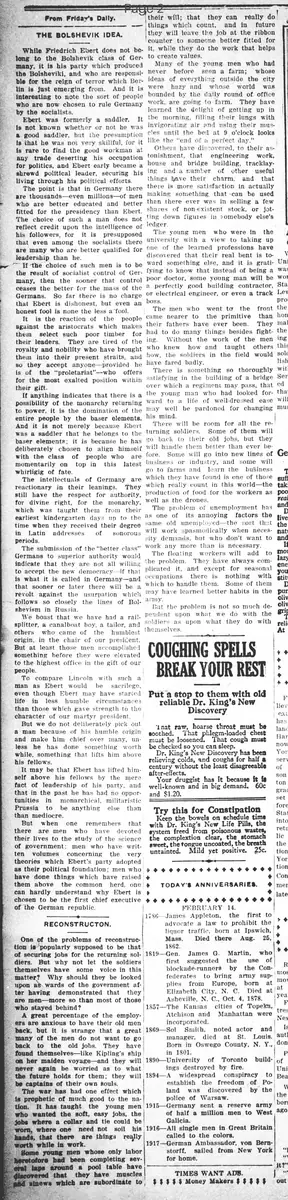
RECONSTRUCTION,
One of the problems of reconstruction is popularly supposed to be that of securing jobs for the returning soldiers. But why not let the soldiers themselves have some voice in this matter? Why should they be looked upon as wards of the government after having demonstrated that they are men—more so than most of those who stayed behind?
A great percentage of the employers are anxious to have their old men back, but it is strange that a great many of the men do not want to go back to the old jobs. They have found themselves—like Kipling's ship on her maiden voyage—and they will never again be worried as to what the future holds for them; they will be captains of their own souls.
The war has had one effect which is prophetic of much good to the nation. It has taught the young men who wanted the soft, easy jobs, the jobs where a collar and tie could be worn, where one need not soil his hands, that there are things really worthwhile in work.
Some young men whose only labor heretofore had been completing several laps around a pool table have discovered that they have muscles and sinews which are subordinate to their will: that they can really do things which count, and in future they will leave the job at the ribbon counter to someone better fitted for it, while they do the work that helps to create values.
Many of the young men who had never before seen a farm; whose ideas of everything outside the city were hazy and whose world was bounded by the daily round of office work, are going to farm. They have learned the delight of getting up in the morning, filling their lungs with invigorating air and using their muscles until the bed at 9 o'clock looks like the "end of a perfect day."
Others have discovered, to their astonishment, that engineering work, house and bridge building, tracklaying and a number of other useful things have their charm, and that there is more satisfaction in actually making something that can be used than there ever was in selling a few shares of non-existent stock, or jotting down figures in somebody else's ledger.
The young men who were in the university with a view to taking up one of the learned professions have discovered that their real bent is toward something else, and it is gratifying to know that instead of being a poor doctor, some young man will be a perfectly good building contractor, or electrical engineer, or even a track boss.
The men who went to the front came nearer to the primitive than their fathers have ever been. They had to do many things besides fighting. Without the work of the men who knew how and taught others how, the soldiers in the field would have fared badly.
There is something so thoroughly satisfying in the building of a bridge over which a regiment may pass, that the young man who had looked forward to a life of well-dressed ease may well be pardoned for changing his mind.
There will be room for all the returning soldiers. Some of them will go back to their old jobs, but they will handle them better than ever before. Some will go into new lines of business or industry, and some will go to farms and learn the business which they have found is one of those which really count in this world—the production of food for the workers as well as the drones.
The problem of unemployment has as one of its annoying factors the same old unemployed—the sort that will work spasmodically when necessity demands, but who don't want to work any more than is necessary.
The floating workers will add to the problem. They have always complicated it, and except for seasonal occupations there is nothing with which to handle them. Some of them may have learned better habits in the army.
But the problem is not so much dependent upon what we do with the soldiers as upon what they do with themselves.
One of the problems of reconstruction is popularly supposed to be that of securing jobs for the returning soldiers. But why not let the soldiers themselves have some voice in this matter? Why should they be looked upon as wards of the government after having demonstrated that they are men—more so than most of those who stayed behind?
A great percentage of the employers are anxious to have their old men back, but it is strange that a great many of the men do not want to go back to the old jobs. They have found themselves—like Kipling's ship on her maiden voyage—and they will never again be worried as to what the future holds for them; they will be captains of their own souls.
The war has had one effect which is prophetic of much good to the nation. It has taught the young men who wanted the soft, easy jobs, the jobs where a collar and tie could be worn, where one need not soil his hands, that there are things really worthwhile in work.
Some young men whose only labor heretofore had been completing several laps around a pool table have discovered that they have muscles and sinews which are subordinate to their will: that they can really do things which count, and in future they will leave the job at the ribbon counter to someone better fitted for it, while they do the work that helps to create values.
Many of the young men who had never before seen a farm; whose ideas of everything outside the city were hazy and whose world was bounded by the daily round of office work, are going to farm. They have learned the delight of getting up in the morning, filling their lungs with invigorating air and using their muscles until the bed at 9 o'clock looks like the "end of a perfect day."
Others have discovered, to their astonishment, that engineering work, house and bridge building, tracklaying and a number of other useful things have their charm, and that there is more satisfaction in actually making something that can be used than there ever was in selling a few shares of non-existent stock, or jotting down figures in somebody else's ledger.
The young men who were in the university with a view to taking up one of the learned professions have discovered that their real bent is toward something else, and it is gratifying to know that instead of being a poor doctor, some young man will be a perfectly good building contractor, or electrical engineer, or even a track boss.
The men who went to the front came nearer to the primitive than their fathers have ever been. They had to do many things besides fighting. Without the work of the men who knew how and taught others how, the soldiers in the field would have fared badly.
There is something so thoroughly satisfying in the building of a bridge over which a regiment may pass, that the young man who had looked forward to a life of well-dressed ease may well be pardoned for changing his mind.
There will be room for all the returning soldiers. Some of them will go back to their old jobs, but they will handle them better than ever before. Some will go into new lines of business or industry, and some will go to farms and learn the business which they have found is one of those which really count in this world—the production of food for the workers as well as the drones.
The problem of unemployment has as one of its annoying factors the same old unemployed—the sort that will work spasmodically when necessity demands, but who don't want to work any more than is necessary.
The floating workers will add to the problem. They have always complicated it, and except for seasonal occupations there is nothing with which to handle them. Some of them may have learned better habits in the army.
But the problem is not so much dependent upon what we do with the soldiers as upon what they do with themselves.
What sub-type of article is it?
Historical Event
Personal Triumph
What themes does it cover?
Triumph
Moral Virtue
What keywords are associated?
Reconstruction
Returning Soldiers
Job Transformation
Work Ethic
Manual Labor
Post War Change
Unemployment
Story Details
Story Details
Returning soldiers, transformed by war experience, reject pre-war easy jobs for fulfilling manual labor in farming, engineering, and production, embracing self-determination and contributing to national good while addressing reconstruction unemployment.