Thank you for visiting SNEWPapers!
Sign up free
Editorial
October 18, 1765
The New Hampshire Gazette And Historical Chronicle
Portsmouth, Greenland, Rockingham County, New Hampshire
What is this article about?
An editorial advocating for cautious and moderate approaches to state reformation, drawing analogies between politics and medicine to warn against rash changes that may cause more harm than good, emphasizing proceeding step by step and avoiding extremes.
Clipping
OCR Quality
95%
Excellent
Full Text
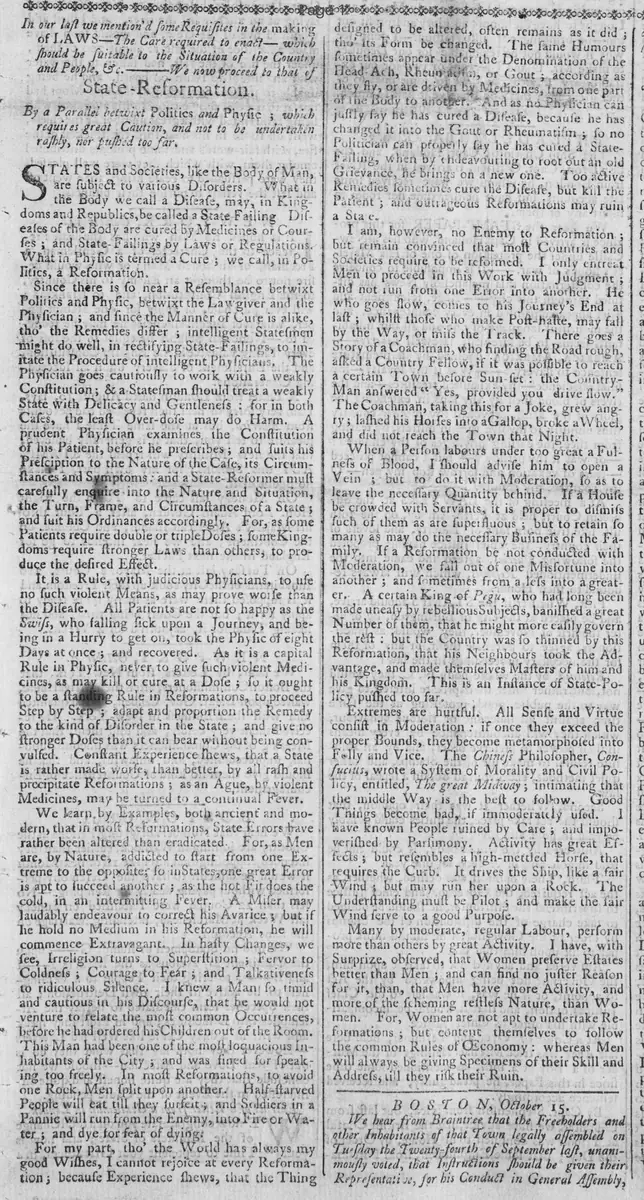
In our last we mention'd some Requisites in the making of LAWS—The Care required to enact which should be suitable to the Situation of the Country and People, &c.—We now proceed to that of State-Reformation.
By a Parallel betwixt Politics and Physic; which requires great Caution, and not to be undertaken rashly, nor push'd too far.
STATES and Societies, like the Body of Man, are subject to various Disorders. What in the Body we call a Disease, may, in Kingdoms and Republics, be called a State Failing. Diseases of the Body are cured by Medicines or Courses: and State-Failings by Laws or Regulations.
What in Physic is term'd a Cure; we call, in Politics, a Reformation.
Since there is so near a Resemblance betwixt Politics and Physic, betwixt the Lawgiver and the Physician: and since the Manner of Cure is alike, tho' the Remedies differ: intelligent Statesmen might do well, in rectifying State-Failings, to imitate the Procedure of intelligent Physicians. The Physician goes cautiously to work with a weakly Constitution: & a Statesman should treat a weakly State with Delicacy and Gentleness: for in both Cases, the least Over-dose may do Harm. A prudent Physician examines the Constitution of his Patient, before he prescribes; and suits his Prescription to the Nature of the Case, its Circumstances and Symptoms: and a State-Reformer must carefully enquire into the Nature and Situation, the Turn, Frame, and Circumstances of a State; and suit his Ordinances accordingly. For, as some Patients require double or triple Doses; some Kingdoms require stronger Laws than others, to produce the desir'd Effect.
It is a Rule, with judicious Physicians, to use no such violent Means, as may prove worse than the Disease. All Patients are not so happy as the Swiss, who falling sick upon a Journey, and being in a Hurry to get on, took the Physic of eight Days at once; and recovered. As it is a capital Rule in Physic, never to give such violent Medicines, as may kill or cure, at a Dose; so it ought to be a standing Rule in Reformations, to proceed Step by Step; adapt and proportion the Remedy to the kind of Disorder in the State; and give no stronger Doses than it can bear without being convulsed. Constant Experience shews, that a State is rather made worse, than better, by all rash and precipitate Reformations; as an Ague, by violent Medicines, may be turned to a continual Fever.
We learn by Examples, both ancient and modern, that in most Reformations, State Errors have rather been altered than eradicated. For, as Men are, by Nature, addicted to start from one Extreme to the opposite; so in States, one great Error is apt to succeed another; as the hot Fit does the cold, in an intermitting Fever. A Miser, may laudably endeavour to correct his Avarice; but if he hold no Medium in his Reformation, he will commence Extravagant. In hasty Changes, we see, Irreligion turns to Superstition; Fervor to Coldness; Courage to Fear; and Talkativeness to ridiculous Silence. I knew a Man so timid and cautious in his Discourse, that he would not venture to relate the most common Occurrences, before he had ordered his Children out of the Room.
This Man had been one of the most loquacious Inhabitants of the City; and was fined for speaking too freely. In most Reformations, to avoid one Rock, Men split upon another. Half-starved People will eat till they surfeit; and Soldiers in a Panic will run from the Enemy, into Fire or Water; and die for fear of dying.
For my part, tho' the World has always my good Wishes, I cannot rejoice at every Reformation; because Experience shews, that the Thing designed to be altered, often remains as it did:
tho' its Form be changed. The same Humours sometimes appear under the Denomination of the Head-Ach, Rheumatism, or Gout: according as they fly, or are driven by Medicines, from one part of the Body to another. And as no Physician can justly say he has cured a Disease, because he has discharged it into the Gout or Rheumatism: so no Politician can properly say he has cur'd a State-Failing, when by endeavouring to root out an old Grievance, he brings on a new one. Too active Remedies sometimes cure the Disease, but kill the Patient; and outrageous Reformations may ruin a State.
I am, however, no Enemy to Reformation; but remain convinced that most Countries and Societies require to be reformed. I only entreat Men to proceed in this Work with Judgment; and not run from one Error into another. He who goes slow, comes to his Journey's End at last: whilst those who make Post-haste, may fall by the Way, or miss the Track. There goes a Story of a Coachman, who finding the Road rough, ask'd a Country Fellow, if it was possible to reach a certain Town before Sun-set: the Country-Man answered, "Yes, provided you drive slow."
The Coachman, taking this for a Joke, grew angry; lash'd his Horses into a Gallop, broke a Wheel, and did not reach the Town that Night.
When a Person labours under too great a Fulness of Blood, I should advise him to open a Vein: but to do it with Moderation, so as to leave the necessary Quantity behind. If a House be crowded with Servants, it is proper to dismiss such of them as are superfluous; but to retain so many as may do the necessary Business of the Family. If a Reformation be not conducted with Moderation, we fall out of one Misfortune into another; and sometimes from a less into a greater. A certain King of Pegu, who had long been made uneasy by rebellious Subjects, banish'd a great Number of them, that he might more easily govern the rest: but the Country was so thinned by this Reformation, that his Neighbours took the Advantage, and made themselves Masters of him and his Kingdom. This is an Instance of State-Policy pushed too far.
Extremes are hurtful. All Sense and Virtue consist in Moderation: if once they exceed the proper Bounds, they become metamorphosed into Folly and Vice. The Chinese Philosopher, Confucius, wrote a System of Morality and Civil Policy, entitled, The great Midway; intimating that the middle Way is the best to follow. Good Things become bad, if immoderately us'd. I have known People ruined by Care; and impoverish'd by Parsimony. Activity has great Effects; but resembles a high-mettled Horse, that requires the Curb. It drives the Ship, like a fair Wind: but may run her upon a Rock. The Understanding must be Pilot; and make the fair Wind serve to a good Purpose.
Many by moderate, regular Labour, perform more than others by great Activity. I have, with Surprize, observed, that Women preserve Estates better than Men: and can find no juster Reason for it, than, that Men have more Activity, and more of the scheming restless Nature, than Women. For, Women are not apt to undertake Reformations: but content themselves to follow the common Rules of OEconomy: whereas Men will always be giving Specimens of their Skill and Address, till they risk their Ruin.
By a Parallel betwixt Politics and Physic; which requires great Caution, and not to be undertaken rashly, nor push'd too far.
STATES and Societies, like the Body of Man, are subject to various Disorders. What in the Body we call a Disease, may, in Kingdoms and Republics, be called a State Failing. Diseases of the Body are cured by Medicines or Courses: and State-Failings by Laws or Regulations.
What in Physic is term'd a Cure; we call, in Politics, a Reformation.
Since there is so near a Resemblance betwixt Politics and Physic, betwixt the Lawgiver and the Physician: and since the Manner of Cure is alike, tho' the Remedies differ: intelligent Statesmen might do well, in rectifying State-Failings, to imitate the Procedure of intelligent Physicians. The Physician goes cautiously to work with a weakly Constitution: & a Statesman should treat a weakly State with Delicacy and Gentleness: for in both Cases, the least Over-dose may do Harm. A prudent Physician examines the Constitution of his Patient, before he prescribes; and suits his Prescription to the Nature of the Case, its Circumstances and Symptoms: and a State-Reformer must carefully enquire into the Nature and Situation, the Turn, Frame, and Circumstances of a State; and suit his Ordinances accordingly. For, as some Patients require double or triple Doses; some Kingdoms require stronger Laws than others, to produce the desir'd Effect.
It is a Rule, with judicious Physicians, to use no such violent Means, as may prove worse than the Disease. All Patients are not so happy as the Swiss, who falling sick upon a Journey, and being in a Hurry to get on, took the Physic of eight Days at once; and recovered. As it is a capital Rule in Physic, never to give such violent Medicines, as may kill or cure, at a Dose; so it ought to be a standing Rule in Reformations, to proceed Step by Step; adapt and proportion the Remedy to the kind of Disorder in the State; and give no stronger Doses than it can bear without being convulsed. Constant Experience shews, that a State is rather made worse, than better, by all rash and precipitate Reformations; as an Ague, by violent Medicines, may be turned to a continual Fever.
We learn by Examples, both ancient and modern, that in most Reformations, State Errors have rather been altered than eradicated. For, as Men are, by Nature, addicted to start from one Extreme to the opposite; so in States, one great Error is apt to succeed another; as the hot Fit does the cold, in an intermitting Fever. A Miser, may laudably endeavour to correct his Avarice; but if he hold no Medium in his Reformation, he will commence Extravagant. In hasty Changes, we see, Irreligion turns to Superstition; Fervor to Coldness; Courage to Fear; and Talkativeness to ridiculous Silence. I knew a Man so timid and cautious in his Discourse, that he would not venture to relate the most common Occurrences, before he had ordered his Children out of the Room.
This Man had been one of the most loquacious Inhabitants of the City; and was fined for speaking too freely. In most Reformations, to avoid one Rock, Men split upon another. Half-starved People will eat till they surfeit; and Soldiers in a Panic will run from the Enemy, into Fire or Water; and die for fear of dying.
For my part, tho' the World has always my good Wishes, I cannot rejoice at every Reformation; because Experience shews, that the Thing designed to be altered, often remains as it did:
tho' its Form be changed. The same Humours sometimes appear under the Denomination of the Head-Ach, Rheumatism, or Gout: according as they fly, or are driven by Medicines, from one part of the Body to another. And as no Physician can justly say he has cured a Disease, because he has discharged it into the Gout or Rheumatism: so no Politician can properly say he has cur'd a State-Failing, when by endeavouring to root out an old Grievance, he brings on a new one. Too active Remedies sometimes cure the Disease, but kill the Patient; and outrageous Reformations may ruin a State.
I am, however, no Enemy to Reformation; but remain convinced that most Countries and Societies require to be reformed. I only entreat Men to proceed in this Work with Judgment; and not run from one Error into another. He who goes slow, comes to his Journey's End at last: whilst those who make Post-haste, may fall by the Way, or miss the Track. There goes a Story of a Coachman, who finding the Road rough, ask'd a Country Fellow, if it was possible to reach a certain Town before Sun-set: the Country-Man answered, "Yes, provided you drive slow."
The Coachman, taking this for a Joke, grew angry; lash'd his Horses into a Gallop, broke a Wheel, and did not reach the Town that Night.
When a Person labours under too great a Fulness of Blood, I should advise him to open a Vein: but to do it with Moderation, so as to leave the necessary Quantity behind. If a House be crowded with Servants, it is proper to dismiss such of them as are superfluous; but to retain so many as may do the necessary Business of the Family. If a Reformation be not conducted with Moderation, we fall out of one Misfortune into another; and sometimes from a less into a greater. A certain King of Pegu, who had long been made uneasy by rebellious Subjects, banish'd a great Number of them, that he might more easily govern the rest: but the Country was so thinned by this Reformation, that his Neighbours took the Advantage, and made themselves Masters of him and his Kingdom. This is an Instance of State-Policy pushed too far.
Extremes are hurtful. All Sense and Virtue consist in Moderation: if once they exceed the proper Bounds, they become metamorphosed into Folly and Vice. The Chinese Philosopher, Confucius, wrote a System of Morality and Civil Policy, entitled, The great Midway; intimating that the middle Way is the best to follow. Good Things become bad, if immoderately us'd. I have known People ruined by Care; and impoverish'd by Parsimony. Activity has great Effects; but resembles a high-mettled Horse, that requires the Curb. It drives the Ship, like a fair Wind: but may run her upon a Rock. The Understanding must be Pilot; and make the fair Wind serve to a good Purpose.
Many by moderate, regular Labour, perform more than others by great Activity. I have, with Surprize, observed, that Women preserve Estates better than Men: and can find no juster Reason for it, than, that Men have more Activity, and more of the scheming restless Nature, than Women. For, Women are not apt to undertake Reformations: but content themselves to follow the common Rules of OEconomy: whereas Men will always be giving Specimens of their Skill and Address, till they risk their Ruin.
What sub-type of article is it?
Legal Reform
Social Reform
What keywords are associated?
State Reformation
Political Moderation
Analogy To Physic
Caution In Laws
Avoiding Extremes
Judicious Reform
What entities or persons were involved?
Confucius
King Of Pegu
Editorial Details
Primary Topic
Moderation In State Reformation
Stance / Tone
Advocacy For Cautious And Moderate Political Reforms
Key Figures
Confucius
King Of Pegu
Key Arguments
States And Societies Are Like Human Bodies Subject To Disorders Cured By Laws As Medicines Are By Physicians
Reformers Should Imitate Physicians By Examining The State's Condition And Suiting Remedies Accordingly
Rash Reformations Often Worsen States By Turning One Error Into Another Extreme
Proceed Step By Step In Reforms To Avoid Convulsion Or Ruin
Moderation Is Key; Extremes In Virtue Become Vice
Examples Show Overzealous Changes Lead To New Problems