Thank you for visiting SNEWPapers!
Sign up free
Litchfield Enquirer
Litchfield, Litchfield County, Connecticut
What is this article about?
Enthusiastic Whig political meeting at Boston's Faneuil Hall, chaired by Daniel Webster, celebrating recent electoral triumphs including New York's support; featured welcoming speeches by representatives John Bell (Tennessee), Graves and Underwood (Kentucky), and Hoffman and Curtis (New York), emphasizing national unity and constitutional loyalty.
Clipping
OCR Quality
Full Text
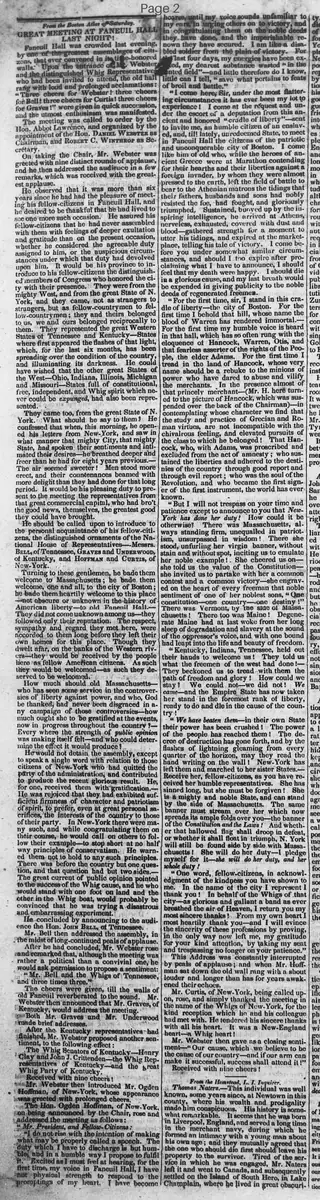
From the Boston Atlas of Saturday.
Faneuil Hall was crowded last evening, by one of the greatest assemblages of citizens, that ever convened in its time-honored walls. Upon the entrance of Mr. Webster, who had been invited to attend, the old hall rang with loud and prolonged acclamations: "Three cheers for Webster! three cheers for Bell: three cheers for Curtis! three cheers for Graves!" were given in quick succession, and the utmost enthusiasm was manifested.
The meeting was called to order by the Hon. Abbot Lawrence, and organized by the appointment of the Hon. Daniel Webster as Chairman, and Robert C. Winthrop as Secretary.
On taking the Chair, Mr. Webster was greeted with nine distinct rounds of applause, and he then addressed the audience in a few remarks, which was received with the greatest applause.
He observed that it was more than six years since he had had the pleasure of meeting his fellow-citizens in Faneuil Hall, and he desired to be thankful that he had lived to see one more such occasion. He assured his fellow-citizens that he had never assembled with them with feelings of deeper exultation and gratitude than on the present occasion, whether he considered the agreeable duty assigned to him, or the auspicious circumstances under which that duty had devolved upon him. It would be his province to introduce to his fellow-citizens the distinguished members of Congress who honored the city with their presence. They were from the mighty West, and from the great State of N. York, and they came, not as strangers to strangers, but as fellow-countrymen to fellow-countrymen; they and theirs belonged to us, we and ours belonged reciprocally to them. They represented the great Western States of Tennessee and Kentucky—States where first appeared the flashes of that light, which, for the last six months, has been spreading over the condition of the country, and illuminating its darkness. He could have wished that the other great States of the West—Ohio, Indiana, Illinois, Michigan and Missouri—States full of constitutional, free, independent, and Whig spirit which never could be expunged, had also been represented.
They came too, from the great State of N. York. What should he say to them? He confessed that when, this morning, he opened his letters from New-York, and saw in what manner that mighty City, that mighty State, had spoken, their sentiments and intimated their desires—he breathed deeper and freer than he had for eight years previous. The air seemed sweeter! Men stood more erect, and their countenances beamed with more delight than they had done for that long period. It would be his pleasing duty to present to the meeting the representatives from that great commercial capital, who had bro't the good news, themselves, the greatest good they could have brought.
He should be called upon to introduce to the personal acquaintance of his fellow-citizens, the distinguished ornaments of the National House of Representatives...Messrs. Bell, of Tennessee, Graves and Underwood, of Kentucky, and Hoffman and Curtis, of New-York.
Turning to these gentlemen, he bade them welcome to Massachusetts; he bade them welcome, one and all, to the city of Boston; he bade them heartily welcome to this place, not obscure or unknown in the history of American liberty—to old Faneuil Hall.
They did not come unknown among us—they followed only their reputation. The respect, sympathy and regard they met here, were accorded to them long before they left their own homes for this place. Though they dwelt afar, on the banks of the Western rivers, they would be received by the people here as fellow American citizens. As such they would be welcomed—as such they deserved to be welcomed.
How much should old Massachusetts—who has seen some service in the controversies of liberty against power, and who, God be thanked, had never been disgraced in any campaign of those controversies—how much ought she to be gratified at the events, now in progress throughout the country? Everywhere the strength of public opinion was making itself felt—and who could determine the effect it would produce?
He would not detain the assembly, except to speak a single word with relation to those citizens of New-York who had quitted the party of the administration, and contributed to produce the recent glorious result. He for one, received them with gratification. He was rejoiced that they had exhibited sufficient firmness of character and patriotism of spirit, to prefer, even at great personal sacrifices, the interests of the country to those of their party. In New-York there were many such, and while congratulating them on their course, he would call on others to follow their example—to stop short at no half way principles of conservatism. He warned them not to hold to any such principles.
There was before the country but one question, and that question had but two sides. The great current of public opinion pointed to the success of the Whig cause, and he who would stand with one foot on land and the other in the Whig boat, would probably be convinced that he was trying a disastrous and embarrassing experiment.
He concluded by announcing to the audience the Hon. John Bell, of Tennessee.
Mr. Bell then addressed the assembly, in the midst of long-continued peals of applause.
After he had concluded, Mr. Webster rose and remarked that, although the meeting was rather a political than a convivial one, he would ask permission to propose a sentiment: "Mr. Bell and the Whigs of Tennessee, and three times three."
The cheers were given, till the walls of old Faneuil reverberated to the sound. Mr. Webster then announced that Mr. Graves, of Kentucky, would address the meeting.
Both Mr. Graves and Mr. Underwood made brief addresses. After the Kentucky representatives had finished, Mr. Webster proposed another sentiment, to the following effect: The Whig Senators of Kentucky Henry Clay and John J. Crittenden—the Whig Representatives of Kentucky—and the great Whig Party of Kentucky.
Received with nine cheers!
Mr. Webster then introduced Mr. Ogden Hoffman, of New-York, whose appearance was greeted with prolonged cheers.
The Hon. Ogden Hoffman, of New-York, his name being announced by the Chair, rose and addressed the meeting as follows:
"Mr. President, and Fellow-Citizens:
I do not rise with the intention of making what may be properly called a speech. The duty which I have to discharge is but humble, and in a humble way I propose to fulfil it. Excited as I must feel at hearing, for the first time, my voice in Faneuil Hall, I have not physical strength to respond to the promptings of my heart. I have become hoarse, until my voice sounds unfamiliar to my ears, in urging others on to victory, and in congratulating them on the noble deeds they have done, and the imperishable renown they have secured. I am like a disabled soldier from the plain of victory. For the last four days, my energies have been exhausted, my dearest substance wasted "in the tented field"—and little therefore do I know, little can I tell, save what pertains to feats of broil and battle.
"I come here; Sir, under the most flattering circumstances it has ever been my lot to experience. I come at the request and under the escort of a deputation from this ancient and honored "cradle of liberty"—sent to invite me, an humble citizen of an enslaved, and, till lately, unredeemed State, to meet in Faneuil Hall the citizens of the patriotic and unconquerable city of Boston. I come like him of old who, while the heroes of ancient Greece were at Marathon contending for their hearths and their liberties against a foreign invader, by whom they were almost pressed to the earth, left the field of battle to bear to the Athenian matrons the tidings that their fathers, husbands and sons had nobly resisted the foe, had fought, and gloriously triumphed. Sustained, buoyed up by the inspiring intelligence, he arrived at Athens, nerveless, exhausted, covered with dust and blood—gathered strength for a moment to utter his tidings, and expired at the market-place, telling his tale of victory. I come before you under somewhat similar circumstances, and should I too expire after proclaiming what I have to announce, I should feel that my death were happy. I should die in a glorious cause, and my last breath would be expended in giving publicity to the noble deeds of regenerated freemen.
"For the first time, sir, I stand in this cradle of liberty—the city of Boston. For the first time I behold that hill, whose name the blood of Warren has rendered immortal. For the first time my humble voice is heard in that hall, which has so often rung with the eloquence of Hancock, Warren, Otis, and that fearless asserter of the rights of the People, the elder Adams. For the first time I tread in the land of Hancock, whose very name should be a rebuke to the minions of power who have dared to abuse and vilify the merchants. In the presence almost of that princely merchant—(Mr. H. here turned to the picture of Hancock, which was suspended over the back of the Chairman)—in contemplating whose character we find that the study and practice of Grecian and Roman virtues, are not incompatible with the chivalrous feeling, and elevated pursuits of the class to which he belonged! That Hancock, who, with Adams, was proscribed and excluded from the act of amnesty; who sustained the liberties and adhered to the destinies of the country through good report and through evil report; who was the soul of the Revolution, and who became the first signer of the first instrument, the world has ever known.
"But I will not trespass on your time and patience except to announce to you that New-York has done her duty! How could it be otherwise? There was Massachusetts, always standing firm, unequalled in patriotism, unsurpassed in wisdom! There she stood, unfurling her virgin banner, without stain and without spot, inciting us to emulate her noble example! She cheered us on—she told us the value of the Constitution—she invited us to partake with her a common contest and a common victory—she engraved on the heart of every freeman that noble sentiment of one of her noblest sons, "One constitution—one country—one destiny!"
There was Vermont, by the side of Massachusetts! There too was Maine! Degenerate Maine had at last woke from her long sleep of degradation and slavery at the sound of the oppressor's voice, and with one bound had leapt into the life and beauty of freedom.
"Kentucky, Indiana, Tennessee, held out their hands to welcome us! They told us what the freemen of the west had done! They beckoned us to tread with them the path of freedom and glory! How could we stay? We could not we did not! We came—and the Empire State has now taken her stand in the foremost rank of liberty, ready to do and die in the cause of the country!
"We have beaten them—in their own State their power has been crushed! The power of the people has reached them! The decree of destruction has gone forth, and by the flashes of lightning gleaming from every quarter of the horizon, may they read the hand writing on the wall! New-York has left them and marched to her sister States. Receive her, fellow-citizens, as you have received her humble representatives. She has sinned long, but she must be forgiven! She is a mighty and noble State, and can stand by the side of Massachusetts. The same banner must stream over her which now spreads its ample folds over you—the banner of the Constitution and the Laws! And whether that hallowed flag shall droop in defeat, or whether it shall float in triumph, N. York will still be found side by side with Massachusetts! She will do her duty—I pledge myself for it—she will do her duty, and her whole duty!
"One word, fellow-citizens, in acknowledgment of the kindness you have shown to me. In the name of the city I represent I thank you! In behalf of the Whigs of that city—as glorious and gallant a band as ever breathed the air of Heaven, I return you my most sincere thanks! From my own heart I most heartily thank you—and I will evince the sincerity of these professions by proving, in the only way now left me, my gratitude for your kind attention, by taking my seat and trespassing no longer on your patience."
This Address was constantly interrupted by peals of applause: and when Mr. Hoffman sat down the old wall rang with a shout louder and longer than has for years awakened their echoes.
Mr. Curtis, of New-York, being called upon, rose, and simply thanked the meeting in the name of the Whigs of New-York, for the kind reception which he and his colleague had met with. He tendered his sincere thanks with all his heart. It was a New-England heart—a Whig heart!
Mr. Webster then gave us a closing sentiment: "Our cause, which we believe to be the cause of our country—and if our arm can make it successful, success shall attend it!"
Received with nine cheers!
What sub-type of article is it?
What themes does it cover?
What keywords are associated?
What entities or persons were involved?
Where did it happen?
Story Details
Key Persons
Location
Faneuil Hall, Boston, Massachusetts
Story Details
A large assembly of citizens convened at Faneuil Hall to celebrate Whig victories, with Daniel Webster as chairman introducing and welcoming congressional representatives from Tennessee, Kentucky, and New York; speeches highlighted national unity, New York's shift from the administration party, and commitment to the Whig cause.