Thank you for visiting SNEWPapers!
Sign up free
Lynchburg Daily Virginian
Lynchburg, Virginia
What is this article about?
Governor Joseph Johnson's 1855 message to the Virginia General Assembly addresses the state's prosperous condition despite a financial deficit, praises the biennial sessions, mourns the Norfolk yellow fever epidemic, urges internal improvements like railroads, advocates for education and agriculture, and warns against Northern states' violations of fugitive slave laws, emphasizing Southern rights.
Merged-components note: Merging the Governor's Message story across pages 2 and 3, including the embedded statistical table on corn exports, as it forms a single coherent narrative unit.
Clippings
1 of 2
OCR Quality
Full Text
Wednesday Morning, December 5, 1855
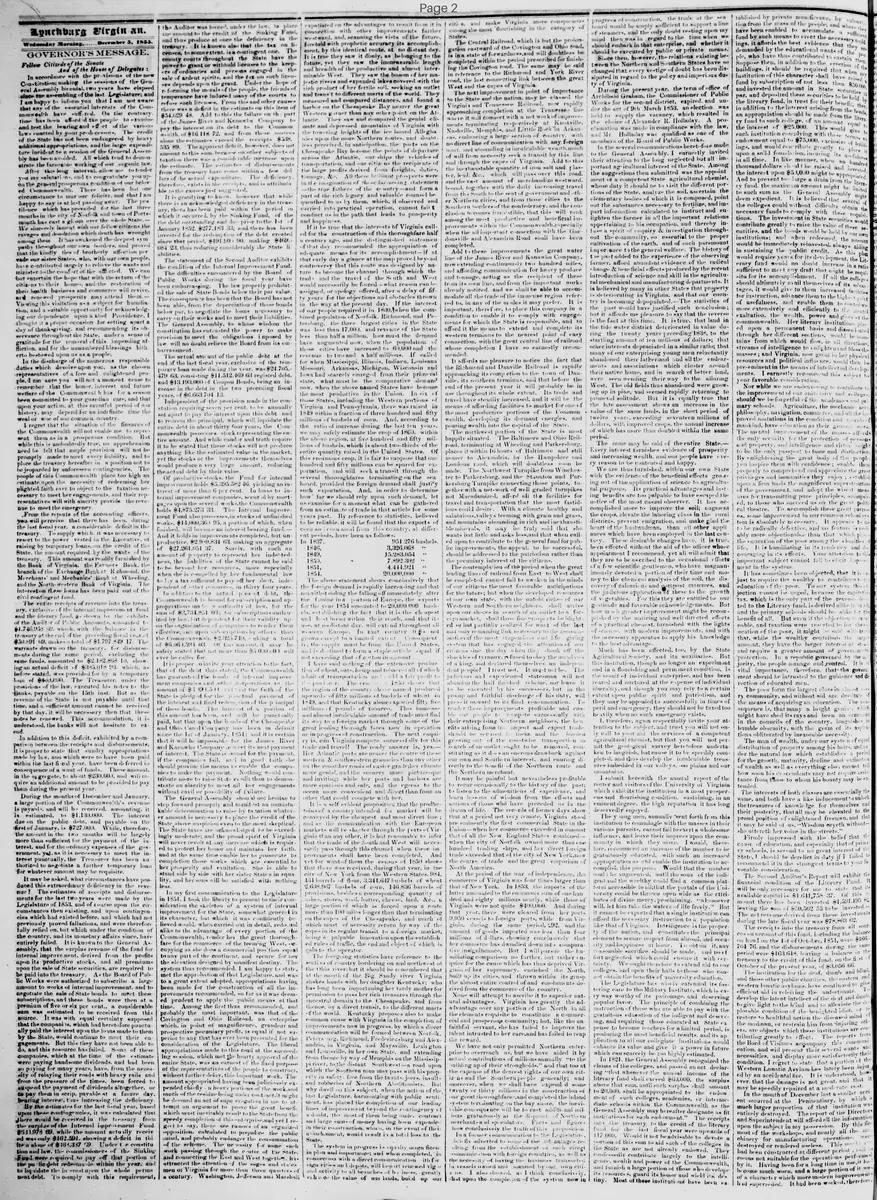
GOVERNOR'S MESSAGE.
Fellow Citizens of the Senate
And of the House of Delegates:
In accordance with the provisions of the new Constitution: making the sessions of the General Assembly biennial, two years have elapsed since the assembling of the last Legislature; and
I am happy to inform you that I am not aware that any of the essential interests of the Commonwealth have suffered. On the contrary.
time has been afforded the people to examine and test the bearing and effect of the various laws enacted by your predecessors. The credit of the State has not been endangered by heavy additional appropriations, and the large expenditure incident to a session of the General Assembly has been avoided. All which tend to demonstrate the favorable working of our organic law.
After this long interval, allow me to tender you my salutations, and to congratulate you upon the general prosperous condition of our beloved Commonwealth. There has been but one circumstance to mar our felicity, and that I am happy to say is at last passing away. The pestilence which has prevailed for the last three months in the city of Norfolk and town of Portsmouth has cast a gloom over the whole State.
We sincerely lament with our fellow citizens the ravages and desolation which death has wrought among them. It has awakened the deepest sympathy throughout our own borders, and proved that the kindly ties of brotherly affection pervade our sister States, who, with our own people, have contributed largely to relieve the wants and minister to the comfort of the afflicted. We can but entertain the hope that with the return of the citizens to their homes, and the restoration of their health business and commerce will revive, and renewed prosperity may attend them.
Viewing this visitation as a subject for humiliation, and a suitable opportunity for acknowledging our dependence upon a kind Providence, I thought it a proper occasion for setting apart a day of thanksgiving, and recommending its observance throughout the State, under a sense of gratitude for the removal of this impending affliction, and for the unnumbered blessings hitherto bestowed upon us as a people.
In the discharge of the numerous responsible duties which devolve upon you, as the chosen representatives of a free and enlightened people, I am sure you will not for a moment cease to remember that the honor, interest and future welfare of the Commonwealth has for a season been committed to your guardian care, and that upon your action, at this eventful period of our history, may depend for an indefinite time the weal or woe of our common country.
I regret that the situation of the finances of the Commonwealth will not enable me to represent them as in a prosperous condition. But while this is undoubtedly true, no apprehension need be felt that ample provision will not be promptly made to meet every liability, and to place the treasury hereafter in a position not to be jeopardized by unforeseen contingencies. The people of this Commonwealth place too high an estimate upon the necessity of redeeming her plighted faith ever to object to the taxation necessary to meet her engagements, and their representatives will with alacrity provide the revenue to meet the emergency.
From the reports of the accounting officers, you will perceive that there has been, during the last fiscal year, a considerable deficit in the treasury. To supply which, it was necessary to resort to the power vested in the Executive, of raising by temporary loans, on the credit of this State, the amount required by the wants of the treasury. This amount was readily furnished by the Bank of Virginia, the Farmers Bank, the branch of the Exchange Bank of Richmond, the Merchants' and Mechanics' Bank at Wheeling, and the Northwestern Bank of Virginia. The interest on these loans has been paid out of the civil contingent fund.
The entire receipts of revenue into the treasury, exclusive of the internal improvement fund and the literary fund, as shown by the exhibits of the Auditor of Public Accounts, amounted to $1,746,953, which, with the balance in the treasury at the end of the preceding fiscal year, of $50,391 09, makes a total of $1,797,349 17. The warrants drawn on the treasury, for disbursements during the same period, excluding the same funds, amounted to $2,182,868 10, showing an actual deficit of $385,518 93, which, as before stated, was provided for by a temporary loan of $400,000. The Treasurer, under the provisions of the law, executed his notes to the Banks, payable on the 15th inst. But as the revenue of the State is not payable until that time, and a sufficient amount cannot be received by that day, it will be necessary then that these notes be renewed. This accommodation, it is understood, the banks will not hesitate to extend.
In addition to this deficit, exhibited by a comparison between the receipts and disbursements, it is proper to state that sundry appropriations made by law, and which were to have been paid within the last fiscal year, have been deferred in consequence of a want of funds. These amount, in the aggregate, to about $230,000, and will require an additional amount to be provided to pay them during the present year.
During the months of December and January, a large portion of the Commonwealth's revenue is payable, and will be received, amounting, it is estimated, to $1,130,000. The interest due on the public debt, and payable on the first of January, is $727,000. While, therefore, the amount in the two months will be largely more than sufficient for the payment of the interest, and for the ordinary expenses of the government, yet, as it is necessary to meet the interest punctually, the Treasurer has been authorized to negotiate a further temporary loan for whatever amount may be requisite.
It may be asked, what circumstances have produced this extraordinary deficiency in the revenue? The estimates of receipts and disbursements for the last two years were made by the Legislature of 1853, and of course upon the circumstances then existing, and upon contingencies which had existed before, and which had not previously proved fallacious, and were therefore fully relied on, but which under the condition of the country, and its monetary affairs since, have entirely failed. It is known to the General Assembly, that the surplus revenue of the fund for internal improvement, derived from the profits upon its productive stocks, and all premiums upon the sale of State securities, are required to be paid into the treasury. As the Board of Public Works were authorized to subscribe a large amount to works of internal improvement, and to negotiate the sale of State bonds to meet these subscriptions, and these bonds were then at a premium of five or six per cent., a considerable sum was estimated to be received from this source. It was with equal certainty supposed that the companies, which had heretofore punctually paid the interest upon the loans made to them by the State, would continue to meet their engagements. But this they have not been able to do, and this resource has failed. Some of these companies, which at the time of the estimate were paying handsome dividends, and had been so paying for many years, have, from the necessity of relaying their roads with heavy rails and from the pressure of the times, been forced to suspend the payment of dividends altogether, or to pay them in scrip, payable at a future day, bearing interest, thus increasing the deficiency.
By the estimates for the last fiscal year, based upon these contingencies, it was calculated that there would be received in the treasury from the surplus of the Internal Improvement Fund $319,973 69, while the amount actually received was only $162,591, showing a deficit in this item alone of $157,382 69. Under the constitution and law, the commissioners of the Sinking Fund were required to pay off that portion of the public debt redeemable within the year, and to liquidate the interest upon the whole permanent debt. To comply with this requirement the Auditor was forced, under the law, to place the amount to the credit of the Sinking Fund, and thus produce at once the deficiency in the treasury. It is known also that the tax on licenses, to some extent, is a contingent one. The county courts throughout the State have the power to grant or withhold licenses to the keepers of ordinaries and persons engaged in the sale of ardent spirits, and the tax on such licenses depends upon the grant. Under the hope of reforming the morals of the people, the friends of temperance have induced many of the courts to refuse such licenses. From this and other causes there was a deficit in the estimate on this item of $54,029 48. Add to this the failure on the part of the James River and Kanawha Company to pay the interest on its debt to the Commonwealth, of $16,118 72, and from these sources alone the estimates exceed the receipts $70,535 89. The apparent deficit, however, does not amount to this sum, because on other subjects of taxation there was a considerable increase upon the estimate. The estimates of disbursements from the treasury have come within a few dollars of the actual expenditure. The deficiency therefore, exists in the receipts, and is attributable to the causes just suggested.
It is gratifying to know, however, that while there is an acknowledged deficiency in the treasury, there has been paid within the period in which it occurred, by the Sinking Fund, of the debt outstanding and due prior to the 1st of January 1852, $277,183 33; and there has been invested for the redemption of the debt created since that period, $191,909 90, making $469,093 23, thus reducing considerably the State liabilities.
The statement of the Second Auditor exhibits the condition of the Internal Improvement Fund. The difficulties encountered by the Board of Public Works during the fiscal year have been embarrassing. The law properly prohibited the sale of State Bonds below their par value. The consequence has been that the Board has not been able, from the depreciation of those bonds below par, to negotiate the loans necessary to carry on their works and to meet their liabilities. The General Assembly, to whose wisdom the constitution has entrusted the power to make provision to meet the obligations imposed by law, will no doubt relieve the Board from its embarrassment.
The actual amount of the public debt at the end of the last fiscal year, exclusive of the temporary loan made during the year, was $24,705,479 63, consisting $11,512,469 63 registered debt, and $13,193,000 of Coupon Bonds, being an increase in the debt in the two preceding fiscal years, of $6,663,704 13.
Independent of the provision made in the constitution requiring seven per cent. to be annually set apart to pay the interest upon this debt and to redeem the principal, which will liquidate the entire debt in about thirty four years, the Commonwealth possesses stock representing the entire amount. And while candor and truth require it to be stated that these stocks will not produce anything like the estimated value in the market, yet the stocks or the improvements themselves would produce a very large amount, reducing the actual debt by their value.
Of productive stocks, the Fund for internal improvement holds $5,395,582 46, yielding an interest of more than 6 per cent. In loans to internal improvement companies, secured by mortgages upon the several works, the Commonwealth holds $4,875,273 33. The Internal Improvement Fund also possesses, in stocks of unfinished works, $1,400,369 95, a portion of which, when finished, will become an interest bearing fund. And it holds in improvements completed, but unproductive, $2,589,834 63, making an aggregate of $14,261,051 37. Surely, with such an amount of property to represent her indebtedness, the liabilities of the State cannot be said to be beyond her resources, more especially when she is compelled by her fundamental law to lay a tax sufficient to pay off her debt, independent of other resources, in thirty four years.
In addition to the actual present debt, the Commonwealth is bound for subscriptions and appropriations made by authority of law, for the sum of $3,734,851 03; for subscriptions authorized by law, not dependent for their validity upon the organization of companies to render them effective, and upon subscriptions by others than the Commonwealth, $2,326,740, making a total of $6,061,591 03. Of this amount, it may be safely stated that not more than $500,000 will ever be called for.
It is proper to invite your attention to the fact, that of the debt thus stated, the Commonwealth has guaranteed the bonds of internal improvement companies and other corporations to the amount of $3,335,151, in the faith of the State is pledged for the perpetual payment of the interest and final redemption of the principal of these bonds. The interest of a portion of this amount has been, and will be punctually paid, but that upon the bonds of the Chesapeake and Ohio Canal Company has been in default since the 1st of January, 1854; and it is certain that it will be impossible for the James River and Kanawha Company to meet its next payment of interest. The State is bound for the payment, if the companies fail, and in good faith she should provide the means to enable the companies to make the payment. Nothing would contribute more to raise State credit than to demonstrate an alacrity to meet all her engagements without cavil or possibility of failure.
The General Assembly should not hesitate to step forward promptly and manifest an unmistakable determination to raise by taxation whatever amount is necessary to place the credit of the State above suspicion even to the most skeptical. The State taxes are acknowledged to be exceedingly moderate; and the proud spirit of Virginia will never revolt at any increase which is required to protect her honor and maintain her faith, and at the same time enable her to prosecute to completion those works which are essential to her prosperity and exaltation. She is able to stand side by side with her sister States in equality, and her sons will be satisfied with nothing less.
In my first communication to the Legislature in 1852, I took the liberty to present to their consideration the skeleton of a system of internal improvement for the State, somewhat general in its character, but which it was confidently believed would, when carried out in detail, redound alike to the advantage of every portion of the Commonwealth, render her the great thoroughfare for the commerce of the teeming West, occupying as she does a commercial position equal to any part of the continent, and secure for her the elevation designed by manifest destiny. The system thus recommended, I am happy to state, met the approbation of that Legislature, and was to a great extent adopted, appropriations having been made for the construction of all the improvements recommended, so far as it was deemed prudent to apply the public means at that time. Among the first thus recommended, and probably the most important, was that of the Covington and Ohio Railroad, an enterprise which, in point of magnificence, grandeur and prospective pecuniary profit, is equal if not superior to any that has ever been presented for the consideration of the Legislature. The liberal appropriations made to this road at the succeeding session, which met the hearty approval of the entire State, was an earnest of the fixed purpose of the representatives of the people to construct, without further delay, this important work. The amount appropriated having been judiciously expended chiefly upon heavy portions of the work, and much of the residue being under contract, it might be deemed an act of supererogation in me to attempt an argument to prove the great benefit which must inevitably result to the State from the speedy completion of this enterprise, and yet I regret to say, there are rumors of an organized opposition, calculated to prejudice the public mind, and probably endanger the consummation of the scheme. The necessity for some such work passing through the entire of the State, and connecting the East and West together, has attracted the attention of the sages and statesmen of Virginia for more than three quarters of a century. Washington, Jefferson and Marshall expatiated on the advantages to result from it in connection with other improvements farther westward, and, scanning the vista of the future, foretold with prophetic accuracy its accomplishment, by this identical route, at no distant day.
It is true they saw it dimly, as belonging to the future, yet they saw the immeasurable length and breadth of the productive and almost interminable West. They saw the bosom of her majestic rivers and expanded lakes covered with the rich product of her fertile soil, seeking an outlet and transit to different marts of the world. They measured and compared distances, and found a harbor on the Chesapeake Bay nearer the great Western granary than any other point on the Atlantic. They saw and compared the genial climate and depressed mountains of Virginia with the towering heights of the ice bound Alleghanies upon the more Northern routes, and doubtless perceived, in anticipation, the ports on the Chesapeake Bay become the points of departure across the Atlantic, our ships the vehicles of transportation, and our citizens the recipients of the large profits derived from freights, duties, tonnage, &c. All these brilliant prospects were in the imagination of those far-seeing statesmen - the true fathers of the country - and form a part of the rich legacy and valuable counsel bequeathed to us by them, which, if observed and carried into practical operation, cannot fail to conduct us in the path that leads to prosperity and happiness.
If it be true that the interests of Virginia called for the construction of this thoroughfare half a century ago, and the distinguished statesmen of that day recommended the appropriation of adequate means for its accomplishment - if at that early day a glance at the map proved beyond controversy that this route was designed by nature to become the channel through which the trade and the travel of the South and West would necessarily be forced - what reason can be assigned, or apology offered, after a delay of fifty years for the objections and obstacles thrown in the way at the present day. If the interest of our people required it in 1800, when the combined population of Norfolk, Richmond, and Petersburg, the three largest cities in the State was less than 17,000, and revenue of the State less than half a million, how much must the demand have augmented now, when the population of those cities have increased to 60,000 and the revenue to two and a half millions. If called for when Mississippi, Illinois, Indiana, Louisiana, Missouri, Arkansas, Michigan, Wisconsin and Iowa had scarcely emerged from their primeval state, what must be the comparative demand now, when the above named States have become the most productive in the Union. In six of those States, including the Western portions of Virginia and Pennsylvania, there was raised in 1849 within a fraction of three hundred and fifty millions of bushels of corn. And, according to the ratio of increase during the last ten years, we may safely estimate the crop of 1855, within the above region, at five hundred and fifty millions of bushels, which is about two-thirds of the entire quantity raised in the United States. Of this enormous crop, it is fair to suppose that one hundred and fifty millions can be spared for exportation, and will seek a transit through the several thoroughfares terminating on the sea board, provided the foreign demand shall justify such exportation. And, in order to determine how far we should rely upon such demand, let us examine for a moment what can be gathered from an estimate of trade in that article for some years past. By reference to statistics, believed to be reliable, it will be found that the exports of corn and corn meal from this country, at different periods, have been as follows:
| n | 1837, | 951.276 bushels |
| 1846, | 3,326,063 | |
| 1849, | 15,283,054 | |
| 1850, | 7,892,302 | |
| 1851, | 4,444,921 | |
| 1854, | 20,000,000 |
The above statement shows conclusively that the foreign demand is rapidly increasing and that notwithstanding the falling off immediately after the famine in portions of Europe, the exports for the year 1854 amounted to 20,000,000 bushels, establishing the fact that it is the cheapest and best breadstuff within their reach, and that its use, at no distant day, will extend throughout all western Europe, in that country it does not grow except to a limited extent (consequently the supply must be from the United States, and destined to form a staple article equal if not exceeding that of cotton in amount.
I have said nothing of the extensive production of wheat, oats, beef and tobacco; all of which go in quest of transportation and a fair profit to the producer. Thus the region of the country above named produces upwards of fifty millions of bushels of wheat in 1849, and that Kentucky alone exported fifty five millions of pounds of tobacco. This immense and almost incalculable amount of trade must find its way to a foreign market through some of the great leading thoroughfares now in operation or in progress of construction. The next enquiry is, can Virginia compete successfully for this trade and travel? The ready answer is, yes. Her Atlantic ports are nearer the centre of these western & southwestern granaries than any other on the coast; her roads of easier grade; her climate more genial, and the scenery more picturesque and inviting; while her ports and harbors are more spacious and safe, and the egress to the ocean more convenient and direct than from any other that could compete with her.
It is a self evident proposition that the productions of a country intended for market will be conveyed by the cheapest and most direct line; and as the communication with the European markets will be shorter through the ports of Virginia than any other, it is but reasonable to infer that the trade of the South and West will necessarily pass through this channel when these improvements shall have been completed. And yet for want of them the census of 1850 shows that there was received, during that year, in the city of New York from the Western States, 954,484 barrels of flour, 3,344,647 bushels of wheat, 2,608,967 bushels of corn, 146,836 barrels of provisions, besides a corresponding quantity of ashes, stores, wool, butter, cheese, lard, &c., a large portion of which is forced upon a route more than 200 miles longer than that terminating on the capes of the Chesapeake, and much of which must of necessity return by way of the capes in its regular transit to a foreign market, being a palpable innovation upon the established rules of traffic, the end and object of which is gain to the operator.
The foregoing statistics have reference to the section of country bordering on and northwest of the Ohio river; but it should be remembered that at the mouth of the Big Sandy river Virginia shakes hands with her daughter Kentucky; who has long been importuning her tardy mother for permission to pass her rich treasures through the ancestral domain to the Chesapeake, and from thence, by a direct transit, to the different marts of the world. Kentucky proposes also to make common cause with Virginia in the completion of improvements now in progress, by which a direct communication will be formed between Norfolk, Petersburg, Richmond, Fredericksburg and Alexandria, in Virginia, and Maysville, Lexington and Louisville, in her own State, and extending from thence by way of Memphis on the Mississippi river, to the distant Southwest - a road upon which the Southern man may pass with his property in safety, free from the taunts, jeers, insults and robberies of Northern Abolitionists. But why dwell on this subject, when the action of the last Legislature, harmonizing with public sentiment, has placed the completion of our leading lines of improvement beyond the contingency of a doubt, the most of them being under contract and large sums of money having been expended in their construction, when, in the event of their abandonment, would result in a total loss to the State.
The system in progress is equally magnificent in plan and importance; and when completed, in connection with a direct communication with foreign cities and depots, will impart renewed vigor and activity to all branches of business, greatly enhance the value of our lands, build up our cities, and make Virginia more conspicuous among the most flourishing in the category of States.
The Central Railroad, which is but the prolongation eastward of the Covington and Ohio road, is in a state of forwardness, and will doubtless be completed within the period prescribed for finishing the Covington road. The same may be said in reference to the Richmond and York River road, the last connecting link between the great West and the capes of Virginia.
The next improvement in point of importance to the State and the nation, may be classed the Virginia and Tennessee Railroad, now rapidly approaching completion at the Tennessee line where it will connect with a net work of improvements terminating respectively at Knoxville, Nashville, Memphis, and Little Rock in Arkansas, embracing a large section of country, with no direct line of communication with any foreign port, and abounding in incalculable wealth, much of will from necessity seek a transit by this line and through the capes of Virginia. Add to this the inexhaustible quantity of iron, salt and plaster, lead, &c., which will pass over this road, and the vast amount of merchandise westward bound, together with the daily increasing travel from the South to the seat of government and other Northern cities, and from those cities to the Southern borders of the confederacy, and the conclusion becomes irresistible, that this will rank among the most productive and beneficial improvements within the Commonwealth, especially when the all-important connection with the Gordonsville and Alexandria Road shall have been completed.
Add to these improvements the great water line of the James River and Kanawha Company, now extending continuously two hundred miles, and affording communication for heavy produce and tonnage, acting as the recipient of these from its own line, and from the important works already noticed, and we shall be able to accommodate all the trade of the immense region referred to, in any of the modes it may prefer. It is important, therefore, to place this company in a condition to enable it to comply with engagements for which the State is responsible, and to afford it the means to extend and complete its western terminus to the nearest point of easy connection, with the great central line of railroad whose completion I have so earnestly recommended.
It affords me pleasure to notice the fact that the Richmond and Danville Railroad is rapidly approaching its completion to the town of Danville, its southern terminus, and that before the end of the present year it will probably be in use throughout its whole extent. Its trade and travel have steadily increased, and it will be the means of affording facilities to market for one of the most productive portions of the Commonwealth, developing its dormant energies, and pouring wealth into the Capital of the State.
The northwest portion of the State is most happily situated. The Baltimore and Ohio Railroad, terminating at Wheeling and Parkersburg places it within 16 hours of Baltimore and still nearer to Alexandria, by the Hampshire and Loudoun road, which will doubtless soon be made. The Northwest Turnpike from Winchester to Parkersburg, and the Staunton and Parkersburg Turnpike connecting those points, together with a net-work of well graded turnpikes not Macadamized, afford all the facilities for travel and transportation that the most fastidious could desire. With a climate healthy and salubrious, valleys teeming with grain and grass, and mountains abounding in rich and inexhaustible minerals, it may be truly said that she wants but little and asks less, and that when called upon to contribute to the general fund for public improvements, the appeal, to be successful, should be addressed to the patriotism rather than the pecuniary interest of the citizens.
The contemplation of the period when the great leading lines of railroad from East to West shall be completed cannot fail to awaken in the minds of our citizens the most favorable anticipations for the future; but when the developed resources of our own state, with the untold riches of our Western and Southern neighbors, shall arrive upon our shores in search of an outlet to a foreign market, shall those fixtures be blighted, or but partially realized for want of the last and only remaining link necessary to the consummation of the most stupendous and life giving system that has engaged the attention of our citizens since the day when they shook off the shackles of tyranny, refused to obey the mandates of a king, and declared themselves an independent people? I trust not. It must not be. The judicious and experienced statesman will not abandon the half finished scheme, nor leave it to be executed by his successors, but in the prompt and faithful discharge of his duty, will press it onward to its final consummation. To render these improvements profitable and enable our people to compete successfully with their enterprising Northern neighbors, the benefits arising from the import and export trade should be secured to them, and the burden growing out of the coastwise transportation in search of an outlet, ought to be removed, constituting as it does an onerous drawback against our own and Southern interest, and enuring directly to the benefit of the Northern route and the Northern merchant.
It may be painful but nevertheless profitable to recur occasionally to the history of the past: to listen to the admonitions of experience, and learn lessons of wisdom from the efforts and actions of those who have preceded us in the drama of life. The records of former days show that at a period not very remote, Virginia stood pre-eminently the first commercial State in the Union - when her commerce exceeded in amount that of all the New England States combined - when the city of Norfolk owned more than one hundred trading ships, and her direct foreign trade exceeded that of the city of New York, now the centre of trade and the great emporium of North America.
At the period of the war of independence, the commerce of Virginia was four times larger than that of New York. In 1853, the imports of the latter amounted to the enormous sum of one hundred and eighty millions nearly, while those of Virginia were not quite $4,000,000. And during that year, there were cleared from her ports 9,950 vessels to foreign ports, while from Virginia, during the same period, 292, and the amount of goods imported was less than four millions of dollars, showing conclusively that her commerce has dwindled down into comparative insignificance. But I will pursue the humiliating comparison no further, but rather enquire for the cause which has thus deprived Virginia of her supremacy, enriched the North, built up its cities, and thrown within its grasp the almost entire control of and emoluments derived from the commerce of the country.
None will attempt to ascribe it to superior natural advantages. Virginia has greatly the advantage over any portion of the North in all the elements requisite to constitute a commercial and prosperous community; but, like the unfaithful servant, she has failed to improve the talent intrusted to her care, and has failed to reap the reward.
We have not only permitted Northern enterprise to overreach us, but we have aided it by actual contributions of millions annually to the building up of their strongholds, and that too at the expense of the dearest rights of our own citizens and the Southern people generally; and moreover, when we shall have expended some twenty or thirty millions in the construction of our great thoroughfares, and completed the inland system terminating on the bay shore, the inevitable consequence will be to cast additional millions gratuitously at the disposal of Northern merchants and speculators. Facts and figures show conclusively the truth of this proposition.
In a former communication to the Legislature, briefly adverted to some of the advantages resulting from the establishment of such direct communication with foreign countries, as well as the necessity of having the business transacted in vessels owned and manned by our own citizens. I also showed, as I think conclusively, that upon the completion of the system now in progress of construction, the trade at the sea board would be amply sufficient to support a line of steamers, and the only doubt resting upon my mind then was in regard to the time when we should embark in that enterprise, and whether it should be executed by public or private means.
Since then, however, the relations existing between the Northern and Southern States have so changed that every vestige of doubt has been dissipated in regard to the policy and imperious duty of Virginia.
During the present year, the term of office of Archibald Graham, the Commissioner of Public Works for the second district, expired, and under the act of 9th March 1853, an election was held to supply the vacancy, which resulted in the choice of Alexander R. Holladay. A proclamation was made in compliance with the law, and Mr. Holladay was qualified as one of the members of the Board of Public Works.
In the several communications heretofore made to the General Assembly, I earnestly invited their attention to the long neglected but all important agricultural interest of the State. Among the suggestions then submitted was the appointment of a competent State agricultural chemist, whose duty it should be to visit the different portions of the State, analyze the soil, ascertain the elementary bodies of which it is composed, point out the substances necessary to fertilize, and impart information calculated to instruct and enlighten the farmer in all the important relations appertaining to his occupation, and thereby infuse a spirit of enquiry & investigation throughout the community, so essential to the proper cultivation of the earth, and of such paramount importance to the general welfare. The history of the past added to the experience of the observing farmer, afford abundant evidence of the radical change & beneficial effects produced by the recent introduction of science and skill in the agricultural mechanical and manufacturing departments. It is believed by many in other States that property is deteriorating in Virginia, and that our country is becoming depopulated. The statistics of the past would have justified such conclusion; but it affords me pleasure to say that the reverse is the fact at this time. It is true, that land in the tide water district deteriorated in value during the twenty years preceding 1853, to the startling amount of ten millions of dollars; that other interests depreciated in a similar ratio; that many of our enterprising young men reluctantly abandoned their fatherland and all the endearments and associations which cluster around their native home, and in search of better land, were seen wending their way to the alluring West. The old fields thus abandoned were growing up in pine, and seemed rapidly returning to primeval solitude. But it is equally true that the late assessment shows an increase in the value of the same lands, in the short period of twelve years, exceeding seventeen millions of dollars, with improved crops, the annual increase of which has more than doubled within the same period.
The same may be said of the entire State. Every interest furnishes evidence of prosperity and increasing wealth, and our people have every reason to be contented and happy.
We are thus furnished, within our own State with the evidence of the beneficial effects growing out of the application of science to agricultural purposes. Its practical advantages and lasting benefits are too palpable to have escaped the notice of the most casual observer. It has accomplished more to improve the soil; augment the crops, elevate the laboring class in the rural districts, prevent emigration, and make glad the heart of the husbandman, than all other appliances which have been employed in the last century. These desirable changes have, it is true, been effected without the aid of the officer whose appointment I recommend, yet all will admit that they are to be ascribed to the occasional efforts of a few scientific gentlemen, who have magnanimously devoted a portion of their time and money to the chemical analysis of the soil, the discovery of calcareous and compost manures, and the judicious application of these to the growth of vegetables. For this they are entitled to our gratitude and favorable acknowledgements. But how much greater improvement might be accomplished by the untiring and well directed efforts of a practical chemist, furnished with the lights of science, with modern improvements, and with the necessary apparatus to apply his knowledge to the best advantage.
Much has been effected, too, by the State Agricultural Society, and its auxiliaries. But this institution, though no longer an experiment and in a flourishing and permanent condition, is the result of individual enterprise, and has been reared and nurtured at the expense of individual liberality, and though you may rely to a certain extent upon public spirit and patriotism, and they may be appealed to successfully in times of peril and emergency, they should not be taxed too heavily when no such emergency exists.
I, therefore, again respectfully invite your attention to the subject, and trust you will not only call to your aid the services of a competent agricultural chemist, but that you will not permit the geological survey heretofore undertaken to languish, but cause it to be speedily completed, and thus develop the incalculable treasures imbedded in our valleys, our plains and our mountains.
I submit herewith the annual report of the rector and visitors of the University of Virginia which exhibits the institution in a most prosperous and flourishing condition, sustaining, in an eminent degree, the high reputation it has long deservedly enjoyed.
The young men, annually sent forth from this institution to commingle with the masses in their various pursuits, cannot fail to exert a wholesome influence, and leave their impress upon the community in which they move. I would, therefore, recommend an increase of the number to be gratuitously educated, with such an increased appropriation as will enable the institution to accomplish this purpose. Would that the number could be augmented, until the sons of the indigent and the wealthy could find a common platform accessible to all; that the portals of the University could be thrown open wide as the attributes of divine mercy, proclaiming, "whosoever will, let him take the waters of life freely." But it cannot be expected that a single institution can afford the necessary instruction to a population like that of Virginia. Intelligence is the property of the nation, and constitutes the principal element to secure respect from abroad, and security and happiness at home. To obtain it, any reasonable sacrifice should be made, and no effort neglected which could ensure it with certainty.
We ought therefore to extend aid to our colleges, and open their halls to those who cannot obtain the benefits of university education. The Legislature has wisely extended its fostering care to the Military Institute, which is every way worthy of its patronage, and deserving popular favor. The principle of combining the instruction of those who are able to pay with the gratuitous education of the indigent and deserving, and requiring those educated at State expense to become teachers for a limited period, is producing the most beneficial results, and its application to all our collegiate institutions would enhance its value and give it a power in future which can scarcely be too highly estimated.
In 1821, the General Assembly recognized the claims of the colleges, and passed an act declaring that whenever the annual income of the literary fund shall exceed $60,000, the surplus above that sum, until such surplus shall amount to $20,000, shall be appropriated to the endowment of such colleges, academies, or intermediate schools within the Commonwealth as the General Assembly may hereafter designate as fit institutions for such endowment. The receipts into the treasury, to the credit of the literary fund for the last fiscal year were upwards of $117,000. Would it not be advisable to devote a portion of this sum to aid such of the colleges in the State as are not already endowed. They confessedly contribute largely to the intelligence, wealth and power of the Commonwealth, and furnish a large portion of those who develop its resources, guard its honor and wield its destiny. Most of these institutions have been established by private munificence, by subscription from the mass of the people and where the buildings have been thus accumulated, evidence is afforded that they have the necessary means to erect such as the character of their educational contributed demands, and that they shall not be less required to build than when $50,000 was raised and invested upon the amount of interest trust be securities in arising made State from from to benefi securities be the the held bond litera then by t of an amount equal to 25 000 This would give to institation equal complying 000 with exclusive these terms of build an would con ribute greatly to place it solid foundation insuring its usefulners In like manner when an hundred sh-udi be raised and iavested upon Ou0 might be appropriated prevent too barge a drain from the litere- the maximnin amount might be limited sum as thr General Assembly might expedient It is believed that several of colleges could without difficulty obtain the fundsto comply with there requisi tions The investment in State securities would greatly to raise the value of these se- and the bouds would be held by ourown and when redeemed the amount be immediately reinvested always aiding in sustaining the public credit. As this plan would require years for its development, the Literary fund would no doubt increase in a ratio sufficient to meet any draft that might be requisite for its accomplishment. If all the colleges should ultimately avail themselves of its advantages, it would give to them increased facilities for instruction, advance them to the highest point of usefulness, and enable them to contribute more extensively and efficiently to the mental exaltation, the wealth, power and glory of the commonwealth. Her literary institutions, placed upon a permanent basis and disseminated through her different sections, would be fountains from which would flow, in all directions, streams of intelligence to enlighten and bless the masses; and Virginia, now great in her physical resources and political influence, would then be pre-eminent in the means of intellectual development. I earnestly recommend this subject to your favorable consideration.
Nor while we are endeavoring to contribute to the improvement of our university and colleges, should we be forgetful of the academies and primary schools. Agriculture, the mechanic arts, philosophy, navigation, commerce, and all their improved mutations in the condition and morals of mankind, have education as their great well-spring. The mental improvement of the masses affords the only security for the protection of persons and property, and intelligence and virtue ought to be the only passport to fame and distinction. By enlightening the great body of the people, you inspire them with confidence; enable them properly to comprehend and appreciate the great privileges and immunities they enjoy; establish upon a firm basis the magnificent super-structure of the government, and adopt the wisest measures for transmitting pure principles, unimpaired, to those who succeed us on the great political theatre. To accomplish these great purposes, some improvement in our common school system is absolutely necessary. It appears to me to be radically defective, and no feature is probably more objectionable than that which places the education of the poor among the charities of life. It is humiliating in its tendency and discouraging in its effects. Your attention to this important subject cannot fail to elicit improvement in the system.
It has sometimes been objected, that it is unjust to require the wealthy to contribute to the education of the poor. To our system this objection cannot be urged, because the capitation tax, which is the only part of the revenue ted to the Literary fund, is derived alike from all and the primary schools should be alike for the benefit of all. But even if the objection were tenable, and taxation were restricted to for the education of the poor, it might be said with truth that, while the wealthy contributes the largest amount, they have the larger interest at stake and require a greater amount of government protection. In a republic governed by the majority, the people manage and control. It is of vital importance, therefore, that the government should be intrusted to the guidance and direction of educated men.
The poor form the largest class in our community, and without aid are destitute of the means of acquiring an education. The consequence is, that many a bright genius, which might have shed its rays and been an ornament in the councils of the country, languishes in humble obscurity, with the germ of its aspirations obliterated by inexorable necessity.
The man of wealth, under our system of equal distribution of property among his heirs, and under the natural law which establishes a period for the growth, maturity, decline and extinction of wealth as well as everything else, cannot tell how soon his descendants may not require assistance from those to whom his bounty may be extended.
The interests of both classes are essentially the same, and both have a like inducement to unlock the treasures of knowledge for themselves and their posterity, that all may be elevated to the proud position of enlightened freemen, and that it may be said of us, "wisdom crieth without; she uttereth her voice in the streets."
Firmly impressed with the belief that the cause of education, and especially that of primary schools, is second to no great interest of the State, I should be derelict in duty if I failed to recommend it in the strongest terms to your favorable consideration.
The Second Auditor's Report will exhibit the financial condition of the Literary Fund. It will be only necessary for me to state that its available capital is $6,611,755 37. Of this amount there has been invested $6,061,195 82 leaving the sum of $550,562 55 to be invested. The net revenue derived from these investments during the late fiscal year was $78,863 62.
The receipts into the treasury from all sources on account of this fund, including the balance on hand on the 1st of October, 1854, were $166,704 76, and the disbursements during the same period were $163,643, leaving a balance in the treasury to the credit of this fund, on the first of October of the present year, of $3,056 66.
The institution for the deaf, dumb and blind, and those other public charities, the eastern and western lunatic asylums, have continued to give efficient aid in developing the latent intellect of the deaf and dumb, to give light to the blind and to alleviate the deplorable condition of the benighted idiot, or to the maniac, or restrain him from injuring others, or restore to healthful action the diseased mind of the insane, thus contributing greatly to effect. The reports from the Board of Visitors accompany this communication, and will present their several wants and condition. I regret to state that a portion of the Western Lunatic Asylum has lately been injured by an accidental fire. It is understood, however, that the damage is not great, and that it may be speedily repaired at a moderate cost.
In the month of December last a similar accident occurred at the Penitentiary, by which a much larger proportion of that institution was entirely destroyed. The report of the Directors and Superintendent will afford all the information upon the subject in my possession. By this fire most of the workshops, and nearly all the machinery for manufacturing operations, were destroyed or rendered useless. This misfortune, though severe, is not without its compensations. The rooms not suitable for the operations performed by it, having been constructed at different periods, and having been for a long time in use, it had become much worn, and a large portion of it was of a character which more modern improvements had superseded. It had been worked, therefore, at a great disadvantage, and its destruction will enable the State to rebuild upon a more perfect plan, and with more suitable accommodations for the convicts, and more profitable to the State.
great inconvenience and to little profit. The in this respect will prove of advantage for new buildings and new machinery have been adapted to each other, and the latest improvements have been made in both. To repair this damage and prevent greater loss to the State, I immediately gave authority to the Board of Directors to cause the workshops to be destroyed by the etor to the S built upon the plan and estimates furnished by bat the labor of the convicts should be used as einselves and by the Superintendent directing ould require the sum of thirty thousand dollars as practicable It was supposed that pry machinery for the purpose. The Board complote the buildings and procure the neces- for binery and heavy timbers, upon such credit as y the General Assembly to meet the payment; jould low time for an appropriation be made fteen thousand dollars out of the civil contin- dinaddition aathorized an expenditure of of ent fund. Regulations were adopted requiring ecurate accounts to be kept and full repoit mounts hereafter to falidue, and when they be made. of the expenditure and of the re to be puid. srs. leaving to be paid fromn this fund, undez aid on this account about twelve thousad dol. From the civil contingent fund there has been he amount paid within the fiscal year of $6,344 he authority giveu about 2.500 This with asmterest upon the temporary loan made to sopply the wants of the Treasury. beretofore al. reduced that fund exceedingly and quired the strictest economy to meet the ordina- charges upon it. should bear testimony to the zeal of the superin- It is proper, before closing this subject, that I endent of the institution and the officers under him, and the energy and judgment displayed in reconstructing the work shops, repairing dama- ges. procuring and erecting machinery of the best and most substantial kind, and carrying on the extensive operations of so large an estab- lishment. with so many prisoners, under the dis- advantages by which they were surrounded. The report of the Adjutant General, herewith communicated, will exhibit, in its true aspect, the present total disorganization of the militia. The law abolishing musters has had the effect to destroy all system, and place the State in a defenceless condition. One regiment of volunteers and a few effective companies in the cities and towns of the State constitute all the force ipon which we could rely in any emergency. and ipon which we could rely in any emergency. jught this to be at a time like this? The men f other days, to whose wisdom we could have been accustomed to appeal, made it a part of our bill of rights "that a well regulated militia, coin- posed of the body of the people, trained to arms. is the proper, natural and safe defence of a free state." Is the principle less true now? It nay be burdensome in time of peace, but it is pecessary to ready to prevent, as well as to be prompt to meet aggression. Under the present circumstances, the arms which have been distributed to the militia have been scattered, and will in a short time become utterly useless. It seems to be impossible to collect them, when companies are without officers, and officers who are still in commission are without companies. Orders cannot be properly issued; and if issued, will not be executed, because there are no courts of enquiry to impose fines or o force the sanction of the law. I would recommend a reorganization of the militia, and a return ither to the former system, or to such other as your wisdom may devise, to render this necessary pranch of the public service useful and efficient. There is a vacancy existing in the fifth brigade finlitia. occasioned by the death of Brigadier General Henry I. Washington, which it will be ecesary for you to supply. The approach of the time when the charters f the principal banking institutions in the State ill expire. and the solicitude manifested on the art of those most interested in their perpetuity sill necessarily invoke your attention at an early eriod of your session; and probably no subject l be presented for your consideration and de- ision which will involve to an equal extent the noral, pecuniary and vital interests of the citizens, the general welfare and honor of the Commonwealth. The immense power and exclusive privileges granted to those institutions should be guarded with much care, while the plausible and eductive reasoning of these who are interested n their management and control, when addressed o the guardians of the people's rights: should be taken with many grains of allowance. They dercant eloquently upon the advantages of the paper system; its tendency to make money abundant; to enhance the price of labor and produce: o enable those with limited means to embark in business; to facilitate commerce; to impart life and vigor to every interest, and to build up town and country. All these appear plausible, and to those directly interested. conclusive. They present, however, the bright side of the picture, and studiously avoid the more reliable logic of experience and of facts and figures. They aim to throw a veil over the past, and gravely ask us to repudiate the salutary lessons taught by experience, and to persevere in a system of policy which has again and again conducted us to the very verge of bankruptcy and ruin. Some of us, however, have not forgotten their history nor the deleterious effects growing out of the paper system. We remember the embarrassment experienced by the government in the prosecution of the late war with Great Britain, from the absence fa speciecurrency, when our whole monetary ystem exploded, and the ruinous use of depreciated paper threatened bankruptcy to the treasury and ruin to the country. Again, about the year 1820, another explosion wk place, and desolation and dismay ensued. Specie had disappeared, and depreciated paper filled the vacuum. A general stagnation in business was the consequence, followed by stay laws property laws, and other ineffectual expedients. all of which were brought into requisition to avert the catastrophe, but in vain. Debtor and reditor suffered alike, produce and labor were comparatively valueless, and every interest in br country became stricken and paralyzed. The more recent but equally disastrous explosion of 37 is within the recollection of all. it came when we were at peace with all the world -when mmeree flourished. and the bountous hand of P'rovidence had blessed us with propitious seasons and abundant harvests-when the country was flooded with promises to pay specie which had ceased to circulate, because it had been sent sbrond, locked up in the vaults of the banks, or wnght up by the brokers, preparatory to the ming crisis, foreseen only by the shrewd speculator, who fattens upon the misfortunes of his msuspecting neighbor. Then in less time than ne revolving moon, eight hundred banks simultaneously closed their doors. and hermetically senled their iron safes. indignantly spurning com their counters the unfortunate holders of heir paper. whose credulity had induced them arely upon delusive promises. And what strange a unforeseen event produced this sudden. un wked for and disastrous calamity? A highly esjectable and intelligent committee. in their report assigning the reasons for the failure of the banks in the city of New York and elsewhere ay. "The immediate cause which compelled the mnks of New York city to suspend specie pay aent on the 4th of May last, are well known. The simultaneous withdrawal of the farg ublic deposits. and of excessive foreign redits. combined with the great and unexpected ll in the price of the principal articles of our ports, with an import of corn and breadstuffs. weh as had never before occurred, and with the ascquent inability of the country. particularly I the Southwestern States, to make the usual ,eeted remittances, did, at one and the same me. fall principally and necessarily on the gvatest commercial emporium of the Union. After a long and most arduous struggle. during which the banks though not altogether success ally, resisting the imperative foreign demand for the precious metals. were gradually deprived of a great portion of their specie. some unfortunate ineident of a local nature, operating in concert with other previously existing causes. produced distrust and panic, and, finally, one of those general runs, which, if continued, no bank that issues paper money payable on demand can ever resist. and which soon put it out of the power of those of this city to sustain specie payments. The example was followed by the banks throughout the whole country, with as much rapidity as the news of the suspension in New York reached thei, without waiting for an actual run, and principally if not exclusively on the alleged ground of the effects to be apprehended from such suspension. Thus, whilst the New York city banks are almost drained of their specie, those in other places preserved the amount which they held before the final catastrophe. Such are the reasons assigned at that day; and may we not reasonably expect that similar causes will produce similar results in future. Since then, and up to the present time. we have had frequent expansions and contractions in the money market. bordering on suspension of specie payments by the banks, which has only been prevented by the almost miraculous influx of gold from California. This alone has prevented a repetition of the scene of 1837. Indeed but for this timely apparent interposition of Providence. there is abundant reason to believe that every bank in the country would ere this have suspended, and that we should now be languishing under a heavy monetary pressure. This fortunate occurrence, thus opportunely interposed, had not even a remote connection with the paper system, except so far as to invite us to substitute a currency, intrinsically valuable and permanent in its character, for one valueless in itself, and deceptive on its face. It is a well established fact, and I advert to it with pleasure, that the State banks of Virginia have generally been judiciously conducted. and will compare favorably with any similar institutions of other States. It may be said, that Virginia has made the most of a bad system; and yet the effect has been to raise and depress, at short intervals, not only the price of labor, but of every article the laborer is compelled to purchase for the subsistence of himself and family. To give a fictitious value to every species of property, to multiply and enlarge schemes of speculation, and thereby foster and encourage an artificial and transient prosperity. by which the unwary have been betrayed into an enlargement of business and increased indebtedness, and when the time for complying with their obligations came, the banks have found it necessary to curtail and withhold accommodations. or to suspend specie payment altogether. The inevitable consequence in such cases must be a depreciation in the value of property and the bankruptcy of many of our citizens. Nor is this the only evil. It is a well ascertained fact in political economy, that increased paper circulation leads to the exportation of the precious metal; drives it from circulation: lessens the capacity of banks to redeem their notes, and thereby forces upon the public a doubtful and depreciated currency. from which relief is obtained only by those convulsions and monetary revolutions which at short intervals have visited our country. The above views on the subject of banking and paper currency have long been entertained by me. They are presented with some hesitancy. with great deference, and but little hope of meeting a coincidence of sentiment on the part of the Legislature. The great question, however, for your decision is, shall Virginia continue to rely upon a system thus defective, without any effort at improvement, and how shall that improvement be effected? I am not prepared to urge an immediate radical change in our system of currency, believing as I do that all sudden changes in monetary affairs tend to derange the general laws of trade, and unsettle the business arrangements of the country; and, therefore, any attempt at change should be by cautious and gradual process; yet, if effected at all, it must have a commencement, and probably there will never be a more propitious time than the present to enter upon such change. The influx of gold and silver from California. Australia and elsewhere, is without a parallel in the monetary history of any country, and proffers a corrective, which, if rejected, will entail upon our people a currency upon which they cannot and ought not to rely. But should the Legislature dissent from these views, and proceed to reorganize the banking system, either upon the old plan of another bank with branches. or that of independent banks. based upon State securities, I respectfully suggest the following changes or amendments to any charter now in force. or hereafter to be granted--That all notes in circulation be made payable at the counter of the bank from which they are issued; that each stockholder be held personally liable for the debts of the corporation to the amount of his or her stock respectively. I also recommend a prohibition of the issue or circulation after a specified time, of any bank note of less denomination than ten dollars. By making the measure prospective, gold and silver will speedily supply the vacuum caused by the withdrawal of the prohibited bills. Like the act of the last session, to prevent the circulation of notes under five dollars, the wholesome change will be speedily and imperceptibly effected and thus, by a wise and gradual process, notes of a higher grade may be excluded. until. at no distant day, the country have the benefit of a sound constitutional currency sufficient for all ordinary dealings, and a sure basis upon which to found bank issues and a paper currency of a higher grade, should the wants of the community demand it. The adoption of these suggestions would, it is believed, greatly improve our monetary system, especially if sanctioned and practiced by neighboring States. several of whom have strongly indicated a preference for some similar policy. In this connection I beg leave to call your attention to the repeal of all laws on the subject of usury. a subject which has recently attracted public notice in this and the adjoining States. However necessary restrictive measures of this character may have been in former times there is obviously a strong prejudice against them at present. All experience has shown that every effort to keep down the rate of interest by legislative enactments has proved abortive and failed to accomplish the end. That the price of money, like every other commodity in the market, will be regulated by demand and supply, and that any laws intended to control it are constantly violated, disregarded or evaded, the tendency being to demoralize society by inducing an habitual disregard of the laws of the State. It is, moreover, confidently believed that the laws now in force tend to increase rather than diminish the rate of interest paid, and operate to the prejudice of the borrowers. who are generally the more needy class, and whose interests are intended to be guarded. And, indeed. it is difficult to understand why the liberty of the citizen should be restricted in regard to moneyed transactions, while he is deemed competent to the management and control of all other commodities in his possession. Without entering further into discussion on the subject. I would respectfully recommend a repeal, or such modifications of these laws as will leave the citizen free to stipulate for such rate of interest as may be agreed upon by the contracting parties. chase of Mount Vernon by the Commonwealth. I In my last annual message I recommended the purchase heart as well as my own feelings, if I failed to renew should be insensible to the pulsation of the public the proposition at this time. The bare allusion to the tomb of Washington, with its hallowed shades and sacred relics, has awakened a feeling of reverence and patriotism in the American bosom, affording unmistakable evidence that not only Virginia. but most. if not all her sister States. plead with persuasive eloquence for the rescue of the sacred domicile from the threatened danger of desecration and ruin. The accompanying correspondence on the subject is respectfully submitted. sidered exorbitant. In the ordinary transaction of business it might be true : but who shall undertake to calculate the value of the homestead and the grave of Washington, with its primeval simplicity, or to place an estimate upon the thousand sacred recollections which crowd the mind and cluster around the heart, in token of admiration for him whom all delight to honor! Dollars become dust when compared with the inestimable patriotism inspired by a visit to the tomb. Thousands will repair to this American Mecca to pay homage to the illustrious dead, mcrican Mecca to pay homage to the illustrious dead. But, however ready you may be to purchase and to pay for this property, that honor has been partially wrested from you, and is reserved for the noble purpose of adorning the brow of female philanthropy. The Mount Vernon association of ladies have been zealously engaged in collecting the necessary funds, and it is understood that a considerable amount has already been realized. They magnanimously claim the honor of paying the purchase money, and with becoming modesty request the General Assembly to authorize the purchase in the name of the Commonwealth, so that the title may be vested in Virginia, and the property be under her control and direction with an assurance to all that the sacred repository of the mighty dead will be forever kept free from possible pollution. Such appeal from such a source will not be unheeded when addressed to a Virginia Legislature This subject leads to a reference to the Virginia Washington Monument on our Capitol Square. It affords me pleasure to state that the granite portion of the structure has been for some time completed. and the expenditure on that account has ceased The commissioners of the monument have received from Mr. Crawford, the artist, the statues of Patrick Henry and Thomas Jefferson. and a portion of other equipments. They have deemed it best, however, not to place the statues upon their intended pedestals until the equestrian statue of Washington, for which the structure was erected. is completed and shall surmount the whole. In the mean time, the two statues have been placed temporarily upon the platform of the Capitol steps, affording an opportunity for inspection gratifying to the public. Justice to the genius of the artist requires that I should commend the happy execution of his task, at once securing his fame, accomplishing a work worthy of the great names intended to be commemorated. and fulfilling the hopes and expectations of the State. But the General Assembly are aware that those statues and equipments will not complete the design. The appropriation already made has been exhausted, and there are four statues besides other equipments necessary for its completion. It would be well to authorize them to be contracted for at once, limiting the amount to be expended in any year to such sum as you may deem proper. Under the act of March 3. 1854, for running and marking the boundary line between the States of Virginia and Maryland, I appointed a commissioner on the part of this State. to act in conjuction with the commissioner of the State of Maryland. to execute the object of the act By his report and correspondence, herewith communicated, you will perceive that the commissioner has failed, and the reasons why it cannot be accomplished without further legislation The Legislature of Maryland asked the appointment of the commissioners. with a view to the settlement of the differences between the two States both as to the western and the eastern boundary. The Legislature of Virginia provided entirely for settling the western boundary. The commissioner on the part of Maryland stated. that "the two acts of the General Assembly of Maryland were regarded by the Legislature as one object. but the Constitution required that they should be passed separately," and under these circumstances. he did not feel at liberty to run one line without the other. The conference of the commissioners was thus terminated. and it devolves on the General Assembly to make such further provisions on the subject as it may deem expedient. On the 31st August. 1852, Congress passed an act providing for the satisfaction in scrip of outstanding Virginia land warrants issued for military services in the war of the revolution. This act was passed. it is presumed. in consequence of a resolution of the General Assembly. instructing our Senators and requesting our Representatives in Congress to procure its enactment; and as an inducement, these resolutions proposed the surrender by deed to the United States of all the lands then held by Virginia in the military district between the Miami and Scioto rivers in the State of Ohio, and the acceptance of such act as a full discharge of the United States from all liability on account of Virginia bounties. The act of August 31st, 1852. was passed in conformity with these resolutions. and accordingly. as chief magistrate of the State, I duly executed a deed. conveying to the United States all the lands owned by Virginia in the military district of Ohio But the act of August 31st. 1852. contained a provision. that before issuing scrip the Secretary of the Interior should be satisfied that the warrants surrendered had been justly and fairly issued in pursuance of the laws of Virginia. "This provisional feature of the law was designed doubtless to exclude from scrip cases tainted with fraud, or shown by subsequent testimony to be manifestly erroneous. But the law has been so construed as to require a re-examination of every claim allowed by the authorities of Virginia: and under that construction a large number of such claims have been rejected by the department at Washington. and are of course unavailable to the claimant in Virginia, though maturely considered and duly adjudicated by her appointed tribunals The dignity of the Commonwealth, and justice to the individual claimant as well as good faith, seem to me to require that the law of Congress on the subject should be so amended as to authorize the issue of scrip in all cases duly recognized by this State, unless fraud be detected, or manifest error be shown. The subject being one of interest to very numerous citizens of the State, and involving a large amount. I deem it my duty to bring it to the attention of the Legislature Since your last session, I have received. from several of the States of this confederacy, resolutions upon various subjects. with a request that they may be submitted to your consideration. In accordance with this request, they are herewith communicated. The resolutions from the States of Rhode Island Maine, Massachusetts and Connecticut upon the subject of the establishment of Territorial Government for Nebraska. and Kansas, and the admission into the Union of these Territories as States, and relative to the fugitive slave law will no doubt attract your attention. The whole scope and tenor of these resolutions are at war with Southern interests and institutions. and they are based upon the idea that the States of this Union are not entitled to equal rights, and that the people of one section are to be allowed privileges and capacities which are to be denied to the people of another. This assumption should be met promptly. To such degradation we should not submit. The people of Virginia have the same inalienable right to carry any species of property possessed by their citizens to any Territory of the United States. that the people of any other State have to carry any species of their property, and Congress have no authority to pass laws allowing the right to one state and denying it to another Ihe people of some of the States abolished slavery within their limits, declaring that "sound policy required that it should be effected therein, as soon as it might be consistent with the rights of individuals, and the public safety and welfare What right have they to say that other States shall not equally judge whether sound policy requires it to be abolished within their jurisdiction, and when it will be consistent with the rights of individuals. and the public safety and welfare? What right have they to declare that other independent sovereignities have not equal authority to maintain, if it seems to them proper. that sound policy requires the continuance or establishment of slavery within their limits, and have not equal power to declare whether it be consistent with the rights of individuals that it should be continued or abolished The government of the United States has no such power delegated to it It belongs alone to the people, when they come to establish the fundamental law for their own government, and Congress has no authority to prohibit any State from coming into the Union, because slavery exists or does not exist within its limits It is a false philosophy which teaches that the institutions which have proved good for one people are and will be good for all future Commonwealths It is not true that the institutions of Austria, or Russia, or Turkey, which they think good. are best for the United States. It is not true that the institutions of Connecticut would be best for Virginia; and if it were true, it is no less false to attempt a crusade against nations or States to compel them to embrace principles or laws obnoxious to them, because they are deemed good and wholesome by others. The true and only sound principle is for each State or nation to adapt its laws and constitution to the circumstances which surround it, and in accordance with the wishes of a majority of its people, and to abstain from interference with the concerns of others. This principle, if adhered to, will prevent the germination of the seed of civil dissension and disunion, which false and designing men are continually sowing broadcast over this land. Congress had no right in 1820 to pass the Missouri compromise. It had no right to prohibit the introduction of slavery above one line, and to permit it or to entail it upon the people below that line. The South submitted then to a flagrant violation of its rights, for the sake of peace, for the sake of fraternal affection, to obtain quiet and repose from incessant agitation and annoyance. Instead of repose it only opened the flood gates of incessant interference, and let loose a host of fanatics to attempt other and more flagrant violations of our rights, and to destroy both social and national happiness. The act establishing the compromise has now been repealed. By such repeal, slavery is neither recognized nor encouraged, nor is it prohibited or abolished. All are left to their constitutional rights. We ought not we cannot, with honor. with self respect, with cut humiliation and debasement. permit this iniquity to be agaln established for us. The constitutional guarantees must be respected and executed. We ought to take a firm stand. and let our ultimatum be absolute and unconditional. If we do not, the Union is worthless and will become an engine of un reitigated oppression As an evidence of what we are to expect. I refer you to the late act of the General Assembly of Massachusetts. and ask you to examine it carefully, and calmly if you can. That act is so extraordinary in its character, that I invoke your attention to the dangerous tendency of its leading provisions. Under the title of an act to protect the rights and liberties of the people of the Commonwealth of Massachusetts, it is provided that the act of that State further to protect personal liberty shall apply to the acts of Congress of the 18th of September, 1850. providing for the return of slaves escaping from their masters, and that the writ of habeas corpus shall extend to every person, imprisoned or restrained of his liberty, as of right, and of course. that it may be issued by any court of record, or any judge or justice of the peace in the State returnable to the Supreme Court or any judge thereof: and if it appears that the party restrained was claimed as a fugitive from service or labor in another State he may be admitted to bail in any sum not exceeding two thousand dollars. The claimant is required to state in writing the facts on which he relies, with precision and certainty. In some upon the plea of not guilty is directed to be joined on the facts stated A jury is to be empaneled thereon, who may return a general verdict, and the finding of the verdict of not guilty is declared final and conclusive. And it is provided that no confession admission or declaration of the alleged fugitive against himself shall be given in evidence - Upon every question of fact involved in the issue the burden of proof rests on the claimant, and the facts alleged and necessary estabtished must proved the testimony of at least two credible witnesses, or other legal evidence equivalent thereto. No ex parte deposition or affidavit is allowed as proof in behalf of the claimant, and no presumption shall arise in favor of the claimant from any proof that the alleged fugitive or any of his ancestors had been actually held as a slave. without proof that such holding was legal. Thus it will be seen, that after arresting a fugitive by habeas corpus. on the part of the officer who may have arrested him under the laws of Congress, the owner, by this act, is placed under conditions impossible to be complied with, unless at an expense far greater than the value of his property Again. the judge or court, before whom the writ may be returned. may admit the slave to bail in any sum from one cent to two thousand dollars. and discharge him from custody. and in this way deprive the owner of his slave. But the unfriendly disposition of the Legislature of Massachusetts towards the slaveholding States is more clearly manifested in the character of the penalties adopted to enforce this most unjust act. They have not only rendered the recovery of a fugitive slave ianpossible under the ir own act. but they have provided for punishing, in the severest manner the owner who may attempt to recover his slave from that State and fail in such attempt. The act further provides, that if any person shall remove, or assist in removing. or come into that State with the intention of removing, or assisting in removing, or to procure or assist to be removed, any person not held to service, or labor, with intent to subject him to such service or labor, such person shall be fined not less than one thousand nor more than five thousand dollars, and be imprisoned in the State prison not less than one Im ni:t, Ihm yit ety T his is the penalty for an unsuccessful attempt to recover a runaway slave. It is further provided. that no person holding any office of honor. trust or emolument in that State, shall in any capacity issue any warrant or other process, or grant any certificate, under, or by virtue of either of the acts of Congress, for the rendition of fugitive slaves. And any person who shall grant any certificate under either of the said acts of Congress, shall vacate any office he may hold under the State, and shall be forever thereafter ineligible to any office of trust, honor or emolument under the laws of that Commonwealth. And any person who shall act as counsel for any claimant of an alleged fugitive from service or labor, under either of the said acts of Congress shall vacate any commission he may hold, and be thereafter incapacitated from appearing as counsel or attorney in the courts of that Commonwealth These two provisions shall not apply to removal from Judicial office, but if any judge shall perform either of the acts, it shall be a breach of good behavior and reason for loss of public confidence, and sufficient ground for impeachment or removal, by address. It is also declared, that every sheriff, deputy sheriff. jailor, coroner, constable, or other officer of the State, or the police of any city or town. or any district court, city or town officer. or any officer or other member of the volunteer militia of the Commonwealth, who shall assist. imprison. detain or restrain. or aid in restraining any person for the reason that he is claimed, or adjudged to be a fugitive from service or labor, shall be fined not less than one thousand and not more than two thousand dollars, and imprisoned in the State prison not less than one nor more than two years and the volunteer militia are prohibited from acting in any manner in the seizure, detention or rendiion of a fugitive slave under the like fine and imprisonment This act makes provision for the appointment of commissioners in every county in the State, to protect, defend and secure to any alleged fugitive slave a fair and impartial trial by jury. and the benefit of its provisions. The fees and expenses of the commissioners, witnesses and officers in such defence. &c, to be paid by the State No jail or prison of that State. or of any county therein. shall be used to imprison any person accused or convicted of any offence created by either of the laws of Congress, passed in 1793 or 1850, respecting fugitives from justice, and persons escaping from the service of their masters, or who may be convicted of obstructing or resisting any process. warrant or order issued under either of those laws, nor for rescuing any person detained under said laws. nor for the imprisonment of any person arrested on process or execution for damages or penalties accruing or claimed in consequence of any aid rendered to an escaping fugitive slave. Thus. it will be seen that the whole purpose of this act is to render null and void acts of Congress passed to execute clause of the Constitution essential to the security of slave property in the Southern States, and without which no slave holding State would for a moment have ratified the Constitution. The Constitution provides expressly, "that no person held to service or labor in one State, under the laws thereof escaping into another, shall, in consequence of any law or regulation therein be discharged from such service or labor, but shall be delivered up on claim of the party to whom such service or labor may be due The act of Massachusetts. in every paragraph, is intended by its framers avowedly to liberate, and expressly provides for discharging every slave from such service or labor, and to prevent his being delivered up, under any circumstances, to his owner The act of Congress of 1793, and the amendatory act of 1850, providing. for the rendition of fugitive slaves. were enacted solely and expressly to execute this clause of the Constitution, and are in accordance with its spirit and letter The second clause of the sixth article of the Constitution also declares. 'that the Constitution and the laws of the United States, which shall be made in pursuance thereof, shall be the supreme law of the land, and the Judges in every State shall be bound thereby, anything in the Constitution or laws of any State to the contrary notwithstanding It requires no argument to prove that the act of Massachusetts is precisely such a law or regulation as the Constitution intended to provide against. If any State can thus violate and set at naught the fundamental law in one particular, it may in all, and no security or safeguard is left for the preservation of our rights or liberties. If this government is worth preserving, it must be maintained in its purity, and rights solemnly guaranteed must be respected It becomes a subject of deep importance and of vital consequence The people that would tamely submit to a deprivation of their rights are unworthy of the appellation of freemen Virguia contributed with her heart's blood to establish this Union She cherishes its hallowed objects and would sacrifice much to maintain it But. there is a point when submission to injustice and gross wrong is degradation and infamy In the hope of preserving the legacy of our fathers. and holding up these independent States to the admiration of the world as examples of the glorious results of liberty restrained by wholesome laws, Virginia has yielded much, borne much In patience. permitted repeated and improper interference with her domestic relations. endangering her peace, witnessed the violation of solemn obligations and compacts, and finally, unwarrantable assaults upon the constitution. We have warned our Northern brethren of the evil tendency of their acts, not only in the direct assault upon our rights, but by the inevitable effect of such a course to destroy friendly relations We have reminded them of our former happy intercourse and unqualified brotherly affection. We have remonstrated, protested, appealed to them. "They. too, have been deaf to the voice of justice and consanguinity " It becomes us. then to enquire solemnly, what course we shall pursue ? Many suggestions have occupied the public mind By some it has been suggested to adopt a system of retaliation, by taking possession of their vessels and other property when within our jurisdiction, and by acting towards theirs, when attempting to assert their rights. precisely as they act towards a master attempting to secure his slave. passing laws similar to theirs, and harassing and annoying them with criminal prosecutions. penalties and forfeitures. By others it has been thought best to discriminate against the States which exhibit hostility to our institutions, by imposing rigid commercial restrictions, laying taxes upon their goods. and obstructing their intercourse, by every means sanctioned by the Constitution. Some would appeal to our sister States who suffer similar ills with us. and recommend a call of a Southern Convention to consult together for our safety and the security of our property, and if need be, resume those sovereign powers now delegated to the Federal Government-while others would at once rush into the alternative of dissolving the Union, and refuse to submit to Constitutional provisions, which are violated with impunity under the sanction of State authority Such propositions gravely mooted by legislative bodies. by executive functionaries and by the people in their primary assemblies are solemn warnings of imminent danger History teaches to what they lead. When men begin to talk of pledging their lives their fortunes and their sacred honor to preserve their rights we need not be told that the spirit of the fathers of the Revolution is animated Ihe subject is one for deep reflection and wise counsel Threats and menaces are useless. I leave it to the calm consideration and dignified action of the General Assembly confidently believing that no rash step will be taken but that when action is decided on. it will be such as will vindicate our rights. redound to the honor of the Commonwealth and the glory of the Union Ihase thus freely exhibited to the General Assembly my views on the condition of the Commonwealth. of her great works. institutions and interests, recommending such action as I have suggested and invoked your aid in raising Virginia to the eminence she ought to occupy My term is about to expire by Constitutional limitation My successor has been appointed by an overwhelming majority demonstrating that he possesses. as he deserves the confidence of the people I shall retire to private life with the consciousness of having discharged my duty to the best of my ability looking to Virginia's advancement with a longing eye, and trusting with the most perfect reliance to you. and to my successor. to protect her interests. guard her rights and her honor. and perpetuate her fame DECEMBER 3 JOS JOHINSON
What sub-type of article is it?
What themes does it cover?
What keywords are associated?
What entities or persons were involved?
Where did it happen?
Story Details
Key Persons
Location
Commonwealth Of Virginia
Event Date
1855 12 03
Story Details
Governor Joseph Johnson delivers his final message to the Virginia General Assembly, reporting on state finances with a deficit but optimism for recovery, the yellow fever epidemic in Norfolk and Portsmouth, advocacy for internal improvements including railroads to connect East and West, promotion of agriculture and education reforms, banking system critiques, and strong defense of Southern rights against Northern states' interference with fugitive slave laws.