Thank you for visiting SNEWPapers!
Sign up free
The Virginia Gazette
Williamsburg, Virginia
What is this article about?
This letter critiques a pamphlet by James Rivington's advertiser that seeks to undermine American unity against British policies. The author argues that colonial militias, numbering in the tens of thousands, can effectively resist a small British force of 7,000, using historical examples like the Quebec campaign and Prussian army to bolster confidence in American defense capabilities and liberties.
Merged-components note: This is a single continuous political essay addressed to the People of America, critiquing a pro-British pamphlet; it spans pages 1-3 with sequential reading order and coherent topic flow; relabeled from 'editorial' for parts 2 and 3 to 'letter_to_editor' as it fits a public debate/response piece.
Clippings
1 of 3
OCR Quality
Full Text
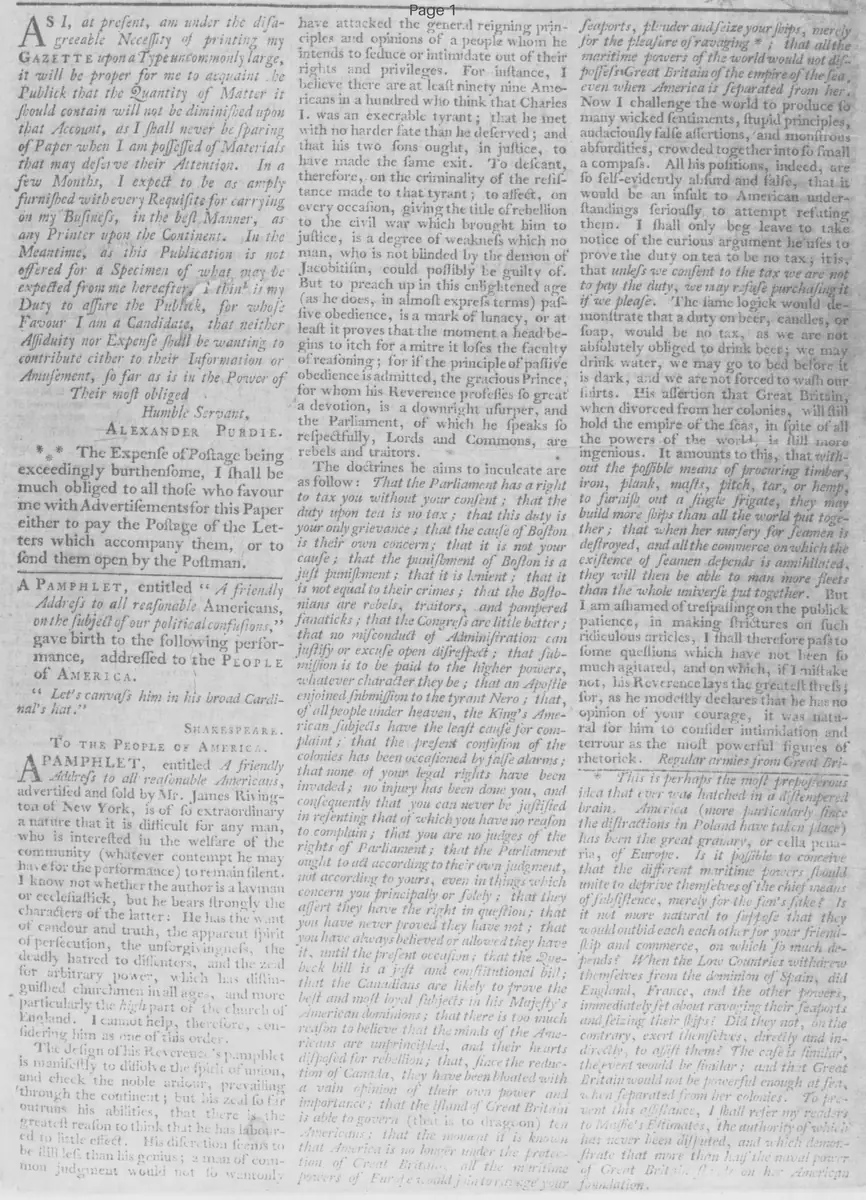
"Let's canvas him in his broad Cardinal's hat."
SHAKESPEARE.
To the People of America.
PAMPHLET, entitled A friendly Address to all reasonable Americans, advertised and sold by Mr. James Rivington of New York, is of so extraordinary a nature that it is difficult for any man, who is interested in the welfare of the community (whatever contempt he may have for the performance) to remain silent. I know not whether the author is a layman or ecclesiastic, but he bears strongly the characters of the latter: He has the wit of candour and truth, the apparent spirit of persecution, the unforgivingness, the deadly hatred to dissenters, and the zeal for arbitrary power, which has distinguished churchmen in all ages, and more particularly the high priests of the church of England. I cannot help, therefore, seeing him as one of this order.
The design of his Reverence's pamphlet is manifestly to dissolve the spirit of union, and check the noble ardour, prevailing through the continent; but his zeal so far outruns his abilities, that there is the greatest reason to think that he has laboured to little effect. His discretion seems to be still less than his genius; a man of common judgment would not so wantonly
Hessians, Hanoverians, royal standards erected, skillful Generals, legions of Canadians, and unnumbered tribes of Savages, Swords flaming in the front and rear, pestilence, desolation and famine, are all marshalled in a most dreadful order by this church militant author. But let us somewhat minutely examine the picture, and see whether, stripped of its false colouring, it has any thing really terrifying. His Reverence begins with assuring us, that there is no room to doubt but that such an army as was employed in the reduction of Canada (that is, an army of 7000 men) would be more than sufficient for the conquest of all the disaffected American colonies (which are, in fact, all the colonies) should such a resolution become necessary in order to reduce them to obedience. For my own part, I think there is very great reason to doubt that 7000, even of the best troops, are able to conquer 200,000 of the most disorderly peasantry upon earth, if they are animated in defence of every thing they hold most dear and sacred; and there is still greater reason to doubt that 7000 very indifferent troops, composed of the refuse of an exhausted nation, few of whom have seen action of any kind, should be able to conquer 200,000 active vigorous yeomanry, fired with the noble ardour we see prevalent through the continent, all armed, all expert in the use of arms almost from their cradles. The success of Quebec, it is true, does infinite honour to the English arms; the army was, I believe, only 7000; the enemy were perhaps more than double, but 16,000 men are not 200,000. The fate of Canada depended upon one decisive action, but it is impossible to calculate how many victories must be gained before these colonies could be subdued, whereas a single victory gained by the colonies must decide the contest in their favour.
In the affair of Quebec, there is another circumstance to be considered; it was Wolfe who commanded, a man of the most wonderful talents, formed to level all difficulties, to render the most despicable soldiery almost instantaneously an army of heroes. In short, the genius of the man was so extraordinary, the event was so extraordinary, that no inferences can be drawn from it; but this, without presumption, may be asserted, that no general now existing in the British service would, with double or treble his number, have succeeded in the same circumstances. One thing more I must add in honour of that illustrious personage, that the same greatness of soul which qualified him to conquer the natural hereditary enemies of his country would have made him reject with horror the hangman's office; which others, who are not endowed with conquering attributes, will with readiness accept.
It is notorious that Mr. Wolfe was not only the first of soldiers, but that he was a most liberal virtuous citizen; that he was passionately attached to the liberties of his country, and of mankind; and that he was particularly an enemy to large standing armies, in time of peace. It is, on the other hand, remarkable, that all the advocates for standing armies, all those who are the fondest of the saddling and parade of war, are the most active in avoiding real service.
This tremendous soothsayer, on the supposition that so great a miracle should happen in our favour, as that the trifling body of 500,000 men, though firmly united (for every man in America, firmly united, would not amount to less) should be able to withstand his 7000, goes on to rattle in our ears armies of Hessians and Hanoverians. I wish to Heaven he had for once deviated into probability and truth. I wish 10,000 of them could possibly be transported to-morrow. The purpose they would answer is a purpose devoutly to be wished for, they would be an addition to this continent of just so many useful and excellent citizens; for I will venture to affirm (affirming is infectious) that in less than four months not two of these 10,000 would remain with their colours. But does not this Reverend Gentleman know, that in the year 1764 a convention was formed by most of the Princes of the Empire, at the head of which convention were the Emperor himself and the King of Prussia, to prevent the alarming emigration which threatened depopulation to Germany? Does he not know that no troops can march out of the Empire without the consent of the Empire? Does he not know that the Elector of Hanover and the Emperor are upon exceeding ill terms? Does he not know that the Elector of Hanover and the King of Prussia are still upon worse? Is he sure that the Landgrave of Hesse would sell his Troops? For, as not one man would return back to their country, he must consider them as for ever sold. Is he sure that, as the finances of Great Britain stand, the vast sum necessary for this purchase would be conveniently found? Is he sure that the state of Hanover would consent to such a draining of their country? I know not how it is; but his Most Excellent Majesty George III. who in England is justly esteemed the most gracious of sovereigns, the wisest, greatest, and best of Kings, is not very popular in the electorate of Hanover. These people seem to think it hard that 270,000l. should annually be drawn from them, for the purpose (as they conceive it) of corrupting the members of St. Stephen's chapel, in order to support the power and authority of a set of men who from the beginning have been enemies to the succession of the Hanover line, and who shewed a particular animosity to their last and favourite Prince George II. But these difficulties (great and insurmountable as to a common mortal they appear) our divine exorcist has in an instant conjured down, and by a single motion of his enchanted wand has transported whole armies, in spite of their respective Princes, and without the consent of their respective states, from the interior parts of Germany across the Atlantick into the plains of New England and Pennsylvania; but he does not confine himself to the introduction of his Germans. He proceeds next to erect the royal standard, to which he tells us that all who have the courage to declare themselves now friends to government will undoubtedly resort; and these, he says, in a good cause, will be of themselves formidable to their opposers. Dreadfully formidable they must be, indeed! There would resort to it, let me see (for the respectable town of Rye have declared themselves a kind of neutrals, rather than friends to government) there would resort to it, Mr. Justice Sewell, the Honourable Mr. Paxton, Brigadier Ruggles, and about eight or ten more mandamus Councilmen, with perhaps twice their number of expectants, and not less than twenty of the unrecanted Hutchinsonian addressers; these the four Provinces of New England alone would send forth. New York would furnish six, seven, or probably eight volunteers, from a certain knot, who are in possession or expectation of contracts, and the fourth part of a dozen of high-flying church of England romanised priests. I represent to myself the formidable countenance they will make, when arranged under the royal or ministerial standard; but what will add to the terrour of the appearance will be their Reverend Pontifex himself, whom I conceive marching in the front, an inquisitorial frown upon his brow, his bands and canonicals floating to the air, bearing a cross in his hands, with the tremendous motto, In hoc signo vinces, flaming upon it in capital letters of blood, leading them on, and exciting them to victory. It is impossible that men, who are not under an infatuation by the judgment of Heaven, should flatter themselves that 40,000 American yeomanry (for we are assured, by the same great authority, that more than 40,000 cannot be brought to action) should stand the shock of this dreadful phalanx.
But I should beg pardon for attempting to be ludicrous, upon a subject which demands our utmost indignation. I shall now, therefore, on the presumption that the people of England should be so lost to sense, virtue, and spirit, as to suffer their profligate ministers to persevere in their present measures, endeavour to state to you what is their force, and what is yours. I shall endeavour to remove the false terrours which his writer would hold out in order to intimidate you on the defence of your liberties and those of your posterity, that he and his similars may wallow in sinecures and benefices heaped up from the fruits of your labour and industry.
Great Britain has, I believe, of infantry at home (comprehending Ireland, and exclusive of the guards) 15,000 men. They find the greatest difficulty in keeping the regiments up to any thing near their establishment; what they are able to procure are of the worst sort. They are composed of the most debauched weavers apprentices, the scum of the Irish Roman Catholicks, who desert upon every occasion, and a few Scotch, who are not strong enough to carry packs. This is no exaggeration; those who have been lately at Boston represent the soldiers there (one or two regiments excepted) as very defective in size, and apparently in strength. But we shall be told they are still regulars, and regulars have an irresistible advantage. There is, perhaps, more imposition in the term regular troops than in any of the jargon that issues from the mouth of a quack. I do not mean to insinuate that every mob are equal to a disciplined body of men, but that the essentials necessary to form good soldiers in real service may be acquired in a few months. I mean, that it is very possible for men to be clothed in red, to be expert in all the tricks of the parade, to call themselves regular troops, and yet, by attaching themselves principally or solely to the tinsel and show of war, be totally unfit for real service. This, I am told, is a good deal the case of the present British infantry: If they can acquit themselves tolerably in the puerile reviews exhibited for the amusement of royal masters and misses in Hyde Park, or Wimbledon common, it is sufficient.
In the beginning of the late war, some of the most esteemed regular regiments were sent over to this country; they were well dressed, they were well powdered, they were perfect masters of their manual exercise, they fired together in platoons, but fatal experience taught us that they knew not how to fight. While your militia were frequently crowned with success, these regulars were defeated or baffled for three years successively, in every part of the continent. At length, indeed (after repeated losses and disgraces) they became excellent troops, but not until they had absolutely forgotten every thing which, we are assured, must render regulars quite irresistible. The corps sent from this country under General Monkton was, I believe, for its number, one of the best armies that ever was led to conquest, and yet, if I have been rightly informed, there was not a
[Footnote] There cannot be a stronger illustration of the truth here advanced than the Prussian army. They are composed of about one third of the King's own subjects, two thirds foreigners. The third, consisting of his own subjects, are, when the exercising season is over (which lasts six or seven weeks) suffered to return to their families, and attend to the business of husbandry. Half of the other two thirds, consisting of foreigners, are not only permitted, but encouraged, to work at their trades in the garrison towns, and never touch a musket for the rest of the year. So that, in fact, only one third are, in the modern language, to be called regular soldiers; these generally make their escape the first opportunity. It may be said, therefore, that the King of Prussia has gained all his victories with a sort of militia.
This regiment or the only that could go through the manual exercise, or at best they performed it most wretchedly. It is likewise said, that when, after their glorious and rapid conquest of Martinico, they were joined by the spruce regiments from Europe, such was their uncouth appearance that they were scarce honoured with the title of soldiers by those Gentlemen. Upon the whole, it is most certain that men may be smartly dressed, keep their arms bright, be called regulars, be expert all the antics of a review, and yet be very unfit for real action. It is equally certain, that a militia, by confining themselves to essentials, by a simplification of the necessary manoeuvres, may become, in a very few months, a most formidable infantry. The yeomanry of America have, besides, infinite advantages over the peasantry of other countries; they are accustomed, from their infancy, to fire arms; they are expert in the use of them: whereas the lower and middle people of England are, by the tyranny of certain laws, almost as ignorant in the use of a musket as they are of other ancient catapulta. The Americans are likewise, to a man, skilful in the management of the instruments necessary for all military works; such as spades, pickaxes, hatchets, &c. Taking, therefore, all circumstances into consideration, there will be no rashness in arming, that this continent may have formed for action, in three or four months, 80,000 infantry: for as to the assertion of the friendly adviser, that no more than 50,000 could act to advantage, I confess I do not understand it, nor do I believe he understands it himself man ans that 60,000 men cannot be ranged in a field capable of containing only 40,000, we shall all agree with him; but how, in the operation of a war, upon a vast continent, double this number should be a disadvantage, I can have no conception. Let one simple general plan be adopted for the formation and subdivision of your battalions: let them be instructed only in so much of the manual exercise as to prevent confusion, and incidents in loading and firing: let them be taught to form, to retreat, to advance, to change their front, to rally by their colours; let them be taught to reduce themselves from a line of fire to a line of impression, that is, from two deep to four, six, or eight. This is all so easy, and simple, that it may be acquired in three months. Let some plan of this sort be adopted, I say, and there is no doubt but that, in the time I have prescribed, you may have an army on foot of 50, 80, or 100,000 men, equal to all the services of war. Should this be admitted, it will be still objected that you have no able officers to conduct you. I do not know that you have; but is it certain that those come to dragoon you have better? I have taken some pains to inform myself what methods these Gentlemen, said to be bred to arms, take to qualify themselves in a superior degree for the profession. What is their routine of instruction? Do they read much? I am assured that they do not. From books alone the theory of war can be acquired, and the English service in times of peace affords them no practical lessons; for mounting guard once or twice a week, or the preparation for the review of a single regiment, can never be esteemed as such. It is much to be lamented that the Gentlemen of the army do not apply more of the many leisure hours they have upon their hands to reading. The majority of them are of a generous disposition, which, did they cultivate, by conversing with the great historians and orators of antiquity, and the more liberal political writers of our own country, a standing army would be something less an object of jealousy to all virtuous citizens. We might perhaps see them, instead of being advocates and partisans of the present Ministry, act check upon their wickedness. I am inclined to think that few, or none of Another circumstance, Americans, may be added for your comfort. It has been allowed, by some of the most candid of the regulars themselves, that during the last war upon this continent your countrymen, the provincial field officers, were in general more understanding and capable than their own of the same rank. But the history of the civil war in the year 1641 furnishes us with the strongest instances that excellent officers may be soon formed from country Gentlemen, citizens, lawyers, and farmers. The Parliament's army (or, as our priestly writer would call them, the rebellious republicans) were chiefly composed of this class of men. In the beginning of this war, they were treated with the same affected contempt, and almost in the same opprobrious terms, as you, the people of America, are by your friendly and decent adviser. Whoever would infer from the tenour of these papers that the writer is desirous of precipitating, or could look with indifference upon the calamities of a civil war, does him great injustice. He considers them with all the horror natural to a feeling man and honest citizen. He execrates the memory of those men to whom they may justly be attributed, but he is persuaded that they never originated (at least in states of any considerable extent) in the turbulent dispositions of the people, nor in the arts of demagogues, but in the oppression of their rulers, in the wantonness, folly, pride, or avarice of Kings, Ministers or Governours. The Grislers of Switzerland, the Granvels of Holland, the Laud and Straffords of England, were the undoubted authors of the tragedies acted in their respective countries: and if this continent should be stained with the blood of a single citizen, it can never be charged to the unreasonable pretensions of the people, but to the Barnards, Hutchinsons, and some other traitors of a similar stamp. He is convinced, that being prepared for a civil war is the surest means of preventing it: that to keep the swords of your enemies in their scabbards, you must whet your own. He is convinced, that remonstrances, petitions, prayers, and supplications, will make no impressions on our callous Court and abandoned Parliament. England, Ireland, America, even Guernsey, Jersey, and Minorca, are witnesses of their inefficacy. He is convinced, that fear alone can operate; there are symptoms that it already begins to operate. The monster tyranny already begins to pant; press her now with ardour, and she is down. Already the Ministry have expressed in their letters an inclination to make some concessions, to meet you half way; which I suppose may be construed thus, "that as they find they have it not in their power to establish, by force, the despotism which they aimed at, they shall be very well satisfied if you will just cede so much of your rights and privileges as will enable them, by extending their pecuniary influence, and apping your virtue, to take away the rest at their leisure." There now remains, people of America, one consideration, which (however it may the officers, have condescended to inform themselves of the merit of the present contest. Let me conjure them, for once, to read coolly and candidly the whole process, afterwards to lay their hands upon their hearts, and answer, whether the people of America in general, and of Boston in particular, are more sinned against or sinning? Now I am upon the subject of the officers of the army, I take the opportunity of mentioning, with the respect due to him, one Gentleman of high rank among them. His general conduct while in command was so liberal, and his letters, quoted in the House of Commons, were so fair, candid, and friendly to the continent, that he is entitled to the thanks of America. He is indeed of a country that owes not only its prosperity, but its existence, to the same principles which alienate America. be taken) I think it my duty to offer. History tells us that the free states of Greece, Thebes, Sparta, Athens, and Syracuse, were all, in their turns, subjugated by the force or art of tyrants. They almost all, in their turns, recovered their liberty, and destroyed their tyrants. The first act, upon the recovery of their liberty, was to demolish those badges of slavery, citadels, strong holds, and military tenements; the Switzers did the same; the people of England (lost in corruption and lethargy as they are) could never be prevailed upon to suffer barracks amongst them; even the courtly Blackstone is startled at the idea. No separate camps, no barracks, no inland fortresses, says he, should be allowed; in fact, wherever barracks are, freedom cannot be said to exist, or she exists so lamely as scarcely to deserve the name. It is worth your consideration, Americans, whether these badges should remain or no. I shall now conclude, brave citizens, with invoking the Almighty God, from whom all virtues flow, to continue you in that spirit of unanimity and vigour which must ensure your success, and immortalize you, through all ages, as the champions and patrons of the human race.
What sub-type of article is it?
What themes does it cover?
What keywords are associated?
What entities or persons were involved?
Letter to Editor Details
Recipient
To The People Of America
Main Argument
the pamphlet by a churchman-like author aims to discourage american resistance to british policies by exaggerating threats from a small british army, foreign mercenaries, and loyalists; however, the author argues that well-armed and motivated american yeomanry, potentially 80,000 strong, can effectively defend their liberties, as historical precedents like quebec and prussian forces demonstrate that militia can succeed against regulars.
Notable Details