Thank you for visiting SNEWPapers!
Sign up free
The Madisonian
Washington, District Of Columbia
What is this article about?
1843 editorial from a Democratic newspaper attacks the Washington Globe for hypocrisy and alleged secret coalition between Clay and Van Buren supporters, defends Tyler administration's neutrality toward Van Buren, criticizes attacks on Clay, and shares a letter indicating strong New England support for Calhoun over Van Buren in the upcoming presidential election.
Clipping
OCR Quality
Full Text
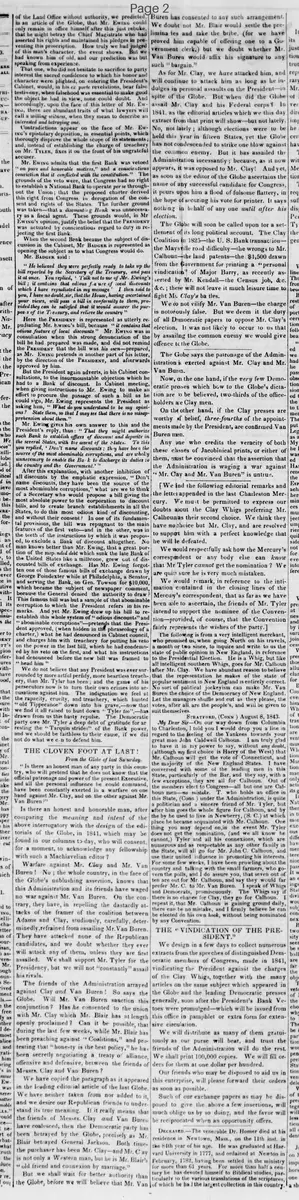
From the Globe of last Saturday.
"Is there an honest man of any party in this country, who will pretend that he does not know that the official patronage and power of the present Executive, and all the personal influence he could command, have been constantly exerted in a warfare on one hand against Mr. Clay, and on the other against Mr. Van Buren?"
Is there an honest and honorable man, after comparing the meaning and intent of the above interrogatory with the design of the editorials of the Globe, in 1841, which may be found in our columns to-day, who will consent, for a moment, to acknowledge any fellowship with such a Machiavellian editor?
Warfare against Mr. Clay and Mr. Van Buren! No; the whole country, in the face of the Globe's unblushing assertion, knows that this Administration and its friends have waged no war against Mr. Van Buren. On the contrary, they have, in repelling the dastardly attacks of the framer of the coalition between Adams and Clay, studiously, carefully, determinedly, refrained from assailing Mr. Van Buren. They have attacked none of the Republican candidates, and we doubt whether they ever will attack any of them, unless they are first assailed. We shall support Mr. Tyler for the Presidency, but we will not "constantly" assail his rivals.
The friends of the Administration arrayed against Clay and Van Buren! So says the Globe. Will Mr. Van Buren sanction this conjunction? Has he consented to the union with Mr. Clay which Mr. Blair has at length openly proclaimed? Can it be possible, that during the last few weeks, while Mr. Blair has been preaching against "Coalitions," and protesting that "honesty is the best policy," he has been secretly negotiating a treaty of alliance, offensive and defensive, between the friends of Messrs. Clay and Van Buren?
We have copied the paragraph as it appeared in the leading editorial article of the last Globe. We have neither taken from nor added to it; and we desire our Republican friends to understand its true meaning. If it really means that the friends of Messrs. Clay and Van Buren have coalesced, then the Democratic party has been betrayed by the Globe, precisely as Mr. Blair betrayed General Jackson. Both times the purchaser has been Mr. Clay—and Mr. Clay is not only a Western man, but he is Mr. Blair's "old friend and connexion by marriage."
But we shall wait for better authority than the Globe, before we will believe that Mr. Van Buren has consented to any such arrangement. We doubt not Mr. Blair would settle the preliminaries and take the bribe, (for we have proved him capable of offering one to a Government clerk,) but we doubt whether Mr. Van Buren would affix his signature to any such "bargain."
As for Mr. Clay, we have attacked him, and will continue to attack him as long as he indulges in personal assaults on the President—in spite of the Globe. But when did the Globe assail Mr. Clay and his Federal corps? In 1841, as the editorial articles which we this day extract from that print will show—but not lately. No, not lately; although elections were to be held this year in fifteen States, yet the Globe has not condescended to strike one blow against the common enemy. But it has assailed the Administration incessantly; because, as it now appears, it was opposed to Mr. Clay! And yet, as soon as the editor of the Globe ascertains the name of any successful candidate for Congress it pours upon him a flood of fulsome flattery, in the hope of securing his vote for printer. It says nothing in behalf of any one until after his election.
The Globe will soon be called upon for a settlement of its long political account. The Clay Coalition in 1825—the U. S. Bank transaction—the Maysville road difficulty—the wrongs to Mr. Calhoun—the land patents—the $1,500 drawn from the Government for printing a "personal vindication" of Major Barry, as recently as— serted by Mr. Kendall—the Census job, &c. &c.; these will not leave it much leisure time to fight Mr. Clay's battles.
We do not vilify Mr. Van Buren—the charge is notoriously false. But we deem it the duty of all Democratic papers to oppose Mr. Clay's election. It was not likely to occur to us that by assailing the common enemy we would give offence to the Globe.
The Globe says the patronage of the Administration is exerted against Mr. Clay and Mr. Van Buren. Now, on the one hand, if the very few Democratic presses which bow to the Globe's dictation are to be believed, two-thirds of the office-holders are Clay men. On the other hand, if the Clay presses are worthy of belief, three-fourths of the appointments made by the President, are confirmed Van Buren men. Any one who credits the veracity of both these classes of Jacobinical prints, or either of them, must be convinced that the assertion that the Administration is waging a war against "Mr. Clay and Mr. Van Buren" is untrue.
We find the following editorial remarks and the letter appended in the last Charleston Mercury. We must be permitted to express our doubts about the Clay Whigs preferring Mr. Calhoun as their second choice. We think they have no choice but Mr. Clay, and are resolved to support him with a perfect knowledge that he will be defeated.
We would respectfully ask how the Mercury's correspondent or any body else can know that Mr. Tyler cannot get the nomination? We are quite sure he is very much mistaken.
We would remark, in reference to the intimation contained in the closing lines of the Mercury's correspondent, that as far as we have been able to ascertain, the friends of Mr. Tyler intend to support the nominee of the Convention—provided, of course, that the Convention fairly represents the wishes of the party.
The following is from a very intelligent merchant, who promised us, when going North on his travels a month or two since, to inquire and write to us the state of public opinion in New England, in reference to the Presidential Election. He is a Whig, but like all intelligent Southern Whigs, goes for Mr. Calhoun after Mr. Clay. We have abundant reason to believe that the representation he makes of the state of popular sentiment in New England is entirely correct. No sort of political jockeyism can make Mr. Van Buren the choice of the Democracy of New England. Let the managers shuffle and cut as they please, the votes, after all, are the people's, and will be given to suit themselves.
Stratford, (Conn.) August 8, 1843.
My Dear Sir—On our way down from Columbia to Charleston, I told you I would drop you a line in regard to the feeling of the Yankees towards your great man John Caldwell Calhoun. I am truly glad to have it in my power to say, without any doubt, (although my first choice is Harry of the West) that Mr. Calhoun will get the vote of Connecticut, and the majority of the New England States. I have conversed with some of the leading men in this State, particularly of the Bar, and they say, with a few exceptions, they are all for Calhoun. Out of the members elect to Congress—all but one are Calhoun men—no mistake. T., who holds an office in this State, (Conn.) under the Administration, is quite a politician and a sincere friend of Mr. Tyler, but after him goes the whole figure for Calhoun, and by the by he used to live in Newberry, (S. C.) at which place he became acquainted with Mr. Calhoun. One thing you may depend on, in the event Mr. Tyler does not get the nomination, (and we all know he cannot,) Tyler and all his connexions, which are numerous and as respectable as any other family in the State, will all go for Mr. John C. Calhoun, and use their united influence in promoting his interests.
For some few weeks, I have been prowling about the country and talking with the small farmers, who govern the polls, and I do assure you, that seven out of ten are out for Mr. Calhoun, and say they would far prefer Mr. C. to Mr. Van Buren. I speak of Whigs and Democrats, promiscuously. The Whigs say if there is no chance for Clay, they go for Calhoun. I repeat it, that Mr. Calhoun is gaining ground daily, there can be no mistake, and I firmly believe he can be elected on his own hook, without being nominated by any Convention.
What sub-type of article is it?
What themes does it cover?
What keywords are associated?
What entities or persons were involved?
Where did it happen?
Story Details
Key Persons
Location
United States
Event Date
1843
Story Details
Editorial denounces the Globe newspaper for duplicitous editorials suggesting administration warfare against both Clay and Van Buren, accuses Blair of betraying Democrats via secret coalition with Clay, defends Tyler's support without attacking rivals, critiques Globe's past attacks and flattery, lists Blair's scandals, and includes a letter reporting strong New England preference for Calhoun over Van Buren.