Thank you for visiting SNEWPapers!
Sign up free
Editorial
January 26, 1818
Daily National Intelligencer
Washington, District Of Columbia
What is this article about?
Editorial defends US Executive's occupation of Amelia Island in 1817, citing 1811 congressional act authorizing action to prevent foreign powers from seizing East Florida, and longstanding policy to protect US interests amid Spanish instability. Refutes critics in Aurora for conflating issues and questioning authority.
Clipping
OCR Quality
98%
Excellent
Full Text
WASHINGTON
MONDAY, JANUARY 26.
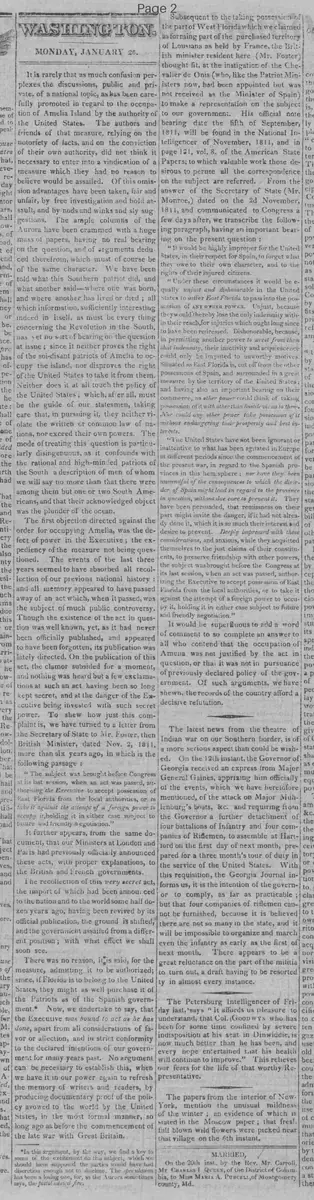
It is rarely that as much confusion perplexes the discussions, public and private, of a national topic, as has been carefully promoted in regard to the occupation of Amelia Island by the authority of the United States. The authors and friends of that measure, relying on the notoriety of facts, and on the conviction of their own authority, did not think it necessary to enter into a vindication of a measure which they had no reason to believe would be assailed. Of this omission advantages have been taken, fair and unfair, by free investigation and bold assault, and by nods and winks and sly suggestions. The ample columns of the Aurora have been crammed with a huge mass of papers, having no real bearing on the question, and of arguments deduced therefrom, which must of course be of the same character. We have been told what this Southern patriot did, and what another said—where one was born, and where another has lived or died; all which information, sufficiently interesting indeed in itself, as must be every thing concerning the Revolution in the South, has yet no sort of bearing on the question at issue; since it neither proves the right of the soi-disant patriots of Amelia to occupy the island, nor disproves the right of the United States to take it from them. Neither does it at all touch the policy of the United States; which, after all, must be the guide of our statesmen, taking care that, in pursuing it, they neither violate the written or common law of nations, nor exceed their own powers. The mode of treating this question is particularly disingenuous, as it confounds with the rational and high-minded patriots of the South a description of men of whom we will say no more than that there were among them but one or two South Americans, and that their acknowledged object was the plunder of the ocean.
The first objection directed against the order for occupying Amelia, was the defect of power in the Executive; the expediency of the measure not being questioned. The events of the last three years seemed to have absorbed all recollection of our previous national history; and all memory appeared to have passed away of an act which, when it passed, was the subject of much public controversy. Though the existence of the act in question was well known, yet, as it had never been officially published, and appeared to have been forgotten, its publication was lately directed. On the publication of this act, the clamor subsided for a moment, and nothing was heard but a few exclamations at such an act having been so long kept secret, and at the danger of the Executive being invested with such secret power. To shew how just this complaint is, we have turned to a letter from the Secretary of State to Mr. Foster, then British Minister, dated Nov. 2, 1811, more than six years ago, in which is the following passage:
"The subject was brought before Congress at its last session, when an act was passed, authorizing the Executive to accept possession of East Florida from the local authorities, or to take it against the attempt of a foreign power to occupy it, holding it in either case subject to future and friendly negotiation."
It further appears, from the same document, that our Ministers at London and Paris had previously officially announced these acts, with proper explanations, to the British and French governments. The recollection of this very secret act, the import of which had been announced to the nation and to the world some half dozen years ago, having been revived by its official publication, the ground is shifted, and the government assailed from a different position; with what effect we shall soon see.
There was no reason, it is said, for the measure, admitting it to be authorized; since, if Florida is to belong to the United States, they might as well purchase it of the Patriots as of the Spanish government. Now, we undertake to say, that the Executive was bound to act as he has done, apart from all considerations of favor or affection, and in strict conformity to the declared intentions of our government for many years past. No argument can be necessary to establish this, where we have it in our power again to refresh the memory of writers and readers, by producing documentary proof of the policy avowed to the world by the United States, in the most formal manner, so long ago as before the commencement of the late war with Great Britain.
*In this argument, by the way, we find a key to some of the excitement on this subject, which we should have supposed the parties would have had discretion enough not to disclose. The speculation has been a losing one, for, as the Aurora sometimes says, the pistol had missed fire.
Subsequent to the taking possession of the part of West Florida which we claimed as forming part of the purchased territory of Louisiana as held by France, the British minister resident here (Mr. Foster) thought it, at the instigation of the Chevalier de Onis (who, like the Patriot Ministers now, had been appointed but was not received as the Minister of Spain) to make a representation on the subject to our government. His official note bearing date the fifth of September, 1811, will be found in the National Intelligencer of November, 1811, and in page 131, vol. 8, of the American State Papers; to which valuable work those desirous to peruse all the correspondence on the subject are referred. From the answer of the Secretary of State (Mr. Monroe,) dated on the 2d November, 1811, and communicated to Congress a few days after, we transcribe the following paragraph, having an important bearing on the present question:
"It would be highly improper for the United States, in their respect for Spain, to forget what they owe to their own character, and to the rights of their injured citizens.
Under these circumstances it would be equally unjust and dishonorable in the United States to suffer East Florida to pass into the possession of ANY OTHER POWER. Unjust, because they would thereby lose the only indemnity within their reach, for injuries which ought long since to have been redressed. Dishonorable, because, in permitting another power to wrest from them that indemnity, their inactivity and acquiescence could only be imputed to unworthy motives. Situated as East Florida is, cut off from the other possessions of Spain, and surrounded in a great measure by the territory of the United States; and having also an important bearing on their commerce, no other power could think of taking possession of it with other than hostile views to them. Nor could any other power take possession of it without endangering their prosperity and best interests.
The United States have not been ignorant or inattentive to what has been agitated in Europe at different periods since the commencement of the present war, in regard to the Spanish provinces in this hemisphere; nor have they been unmindful of the consequences to which the disorder of Spain might lead in regard to the province in question, without due care to prevent it. They have been persuaded, that remissness on their part might invite the danger, if it had not already done it, which it is so much their interest and desire to prevent. Deeply impressed with these considerations, and anxious, while they acquitted themselves to the just claims of their constituents, to preserve friendship with other powers, the subject was brought before the Congress at its last session, when an act was passed, authorizing the Executive to accept possession of East Florida from the local authorities, or to take it against the attempt of a foreign power to occupy it, holding it in either case subject to future and friendly negotiation."
It would be superfluous to add a word of comment to so complete an answer to all who contend that the occupation of Amelia was not justified by the act in question, or that it was not in pursuance of previously declared policy of the government. Of such arguments, we have shewn, the records of the country afford a decisive refutation.
MONDAY, JANUARY 26.
It is rarely that as much confusion perplexes the discussions, public and private, of a national topic, as has been carefully promoted in regard to the occupation of Amelia Island by the authority of the United States. The authors and friends of that measure, relying on the notoriety of facts, and on the conviction of their own authority, did not think it necessary to enter into a vindication of a measure which they had no reason to believe would be assailed. Of this omission advantages have been taken, fair and unfair, by free investigation and bold assault, and by nods and winks and sly suggestions. The ample columns of the Aurora have been crammed with a huge mass of papers, having no real bearing on the question, and of arguments deduced therefrom, which must of course be of the same character. We have been told what this Southern patriot did, and what another said—where one was born, and where another has lived or died; all which information, sufficiently interesting indeed in itself, as must be every thing concerning the Revolution in the South, has yet no sort of bearing on the question at issue; since it neither proves the right of the soi-disant patriots of Amelia to occupy the island, nor disproves the right of the United States to take it from them. Neither does it at all touch the policy of the United States; which, after all, must be the guide of our statesmen, taking care that, in pursuing it, they neither violate the written or common law of nations, nor exceed their own powers. The mode of treating this question is particularly disingenuous, as it confounds with the rational and high-minded patriots of the South a description of men of whom we will say no more than that there were among them but one or two South Americans, and that their acknowledged object was the plunder of the ocean.
The first objection directed against the order for occupying Amelia, was the defect of power in the Executive; the expediency of the measure not being questioned. The events of the last three years seemed to have absorbed all recollection of our previous national history; and all memory appeared to have passed away of an act which, when it passed, was the subject of much public controversy. Though the existence of the act in question was well known, yet, as it had never been officially published, and appeared to have been forgotten, its publication was lately directed. On the publication of this act, the clamor subsided for a moment, and nothing was heard but a few exclamations at such an act having been so long kept secret, and at the danger of the Executive being invested with such secret power. To shew how just this complaint is, we have turned to a letter from the Secretary of State to Mr. Foster, then British Minister, dated Nov. 2, 1811, more than six years ago, in which is the following passage:
"The subject was brought before Congress at its last session, when an act was passed, authorizing the Executive to accept possession of East Florida from the local authorities, or to take it against the attempt of a foreign power to occupy it, holding it in either case subject to future and friendly negotiation."
It further appears, from the same document, that our Ministers at London and Paris had previously officially announced these acts, with proper explanations, to the British and French governments. The recollection of this very secret act, the import of which had been announced to the nation and to the world some half dozen years ago, having been revived by its official publication, the ground is shifted, and the government assailed from a different position; with what effect we shall soon see.
There was no reason, it is said, for the measure, admitting it to be authorized; since, if Florida is to belong to the United States, they might as well purchase it of the Patriots as of the Spanish government. Now, we undertake to say, that the Executive was bound to act as he has done, apart from all considerations of favor or affection, and in strict conformity to the declared intentions of our government for many years past. No argument can be necessary to establish this, where we have it in our power again to refresh the memory of writers and readers, by producing documentary proof of the policy avowed to the world by the United States, in the most formal manner, so long ago as before the commencement of the late war with Great Britain.
*In this argument, by the way, we find a key to some of the excitement on this subject, which we should have supposed the parties would have had discretion enough not to disclose. The speculation has been a losing one, for, as the Aurora sometimes says, the pistol had missed fire.
Subsequent to the taking possession of the part of West Florida which we claimed as forming part of the purchased territory of Louisiana as held by France, the British minister resident here (Mr. Foster) thought it, at the instigation of the Chevalier de Onis (who, like the Patriot Ministers now, had been appointed but was not received as the Minister of Spain) to make a representation on the subject to our government. His official note bearing date the fifth of September, 1811, will be found in the National Intelligencer of November, 1811, and in page 131, vol. 8, of the American State Papers; to which valuable work those desirous to peruse all the correspondence on the subject are referred. From the answer of the Secretary of State (Mr. Monroe,) dated on the 2d November, 1811, and communicated to Congress a few days after, we transcribe the following paragraph, having an important bearing on the present question:
"It would be highly improper for the United States, in their respect for Spain, to forget what they owe to their own character, and to the rights of their injured citizens.
Under these circumstances it would be equally unjust and dishonorable in the United States to suffer East Florida to pass into the possession of ANY OTHER POWER. Unjust, because they would thereby lose the only indemnity within their reach, for injuries which ought long since to have been redressed. Dishonorable, because, in permitting another power to wrest from them that indemnity, their inactivity and acquiescence could only be imputed to unworthy motives. Situated as East Florida is, cut off from the other possessions of Spain, and surrounded in a great measure by the territory of the United States; and having also an important bearing on their commerce, no other power could think of taking possession of it with other than hostile views to them. Nor could any other power take possession of it without endangering their prosperity and best interests.
The United States have not been ignorant or inattentive to what has been agitated in Europe at different periods since the commencement of the present war, in regard to the Spanish provinces in this hemisphere; nor have they been unmindful of the consequences to which the disorder of Spain might lead in regard to the province in question, without due care to prevent it. They have been persuaded, that remissness on their part might invite the danger, if it had not already done it, which it is so much their interest and desire to prevent. Deeply impressed with these considerations, and anxious, while they acquitted themselves to the just claims of their constituents, to preserve friendship with other powers, the subject was brought before the Congress at its last session, when an act was passed, authorizing the Executive to accept possession of East Florida from the local authorities, or to take it against the attempt of a foreign power to occupy it, holding it in either case subject to future and friendly negotiation."
It would be superfluous to add a word of comment to so complete an answer to all who contend that the occupation of Amelia was not justified by the act in question, or that it was not in pursuance of previously declared policy of the government. Of such arguments, we have shewn, the records of the country afford a decisive refutation.
What sub-type of article is it?
Foreign Affairs
Imperialism
Constitutional
What keywords are associated?
Amelia Island Occupation
East Florida Policy
Us Executive Power
Spanish Provinces
Congressional Act 1811
Foreign Powers Threat
What entities or persons were involved?
United States Executive
Amelia Island Patriots
Spanish Government
Mr. Monroe
Mr. Foster
Chevalier De Onis
Aurora
Editorial Details
Primary Topic
Defense Of Us Occupation Of Amelia Island
Stance / Tone
Strongly Supportive Of Executive Action And Established Policy
Key Figures
United States Executive
Amelia Island Patriots
Spanish Government
Mr. Monroe
Mr. Foster
Chevalier De Onis
Aurora
Key Arguments
Executive Authorized By 1811 Congressional Act To Occupy East Florida Against Foreign Powers
Us Policy Prevents Other Nations From Seizing Florida, Protecting Commerce And Interests
Occupation Aligns With Long Declared Intentions, Announced To Britain And France
Critics In Aurora Irrelevantly Focus On Southern Patriots' Backgrounds
Allowing Foreign Occupation Would Be Unjust And Dishonorable Given Us Claims
Measure Not About Purchasing From Patriots But Securing Against Plunderers