Thank you for visiting SNEWPapers!
Sign up free
New Hampshire Statesman And Concord Register
Concord, Merrimack County, New Hampshire
What is this article about?
The Prison Discipline Society, organized in Boston on June 30, 1825, held its first anniversary on June 2, 1826. Their report details visits to prisons in 13 states and DC, revealing appalling conditions like mixed prisoner classifications fostering crime. Recommends solitary confinement and separation. Praises New Hampshire Penitentiary's success under Warden Moses C. Pilsbury due to moral instruction and vigilant management.
Clipping
OCR Quality
Full Text
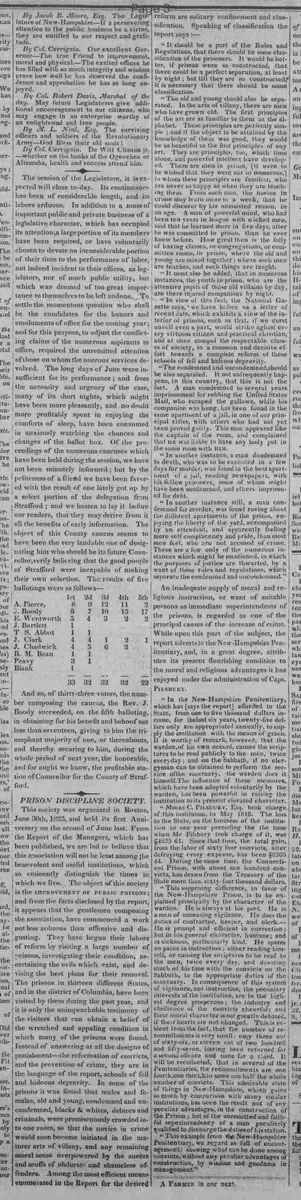
This society was organized in Boston, June 30th, 1825, and held its first Anniversary on the second of June last. From the Report of the Managers, which has been published, we are led to believe that this association will not be least among the benevolent and useful institutions, which so eminently distinguish the times in which we live. The object of this society is the IMPROVEMENT OF PUBLIC PRISONS; and from the facts disclosed by the report, it appears that the gentlemen composing the association, have commenced a work not less arduous than offensive and disgusting. They have begun their labors of reform by visiting a large number of prisons, investigating their condition, ascertaining the evils which exist, and devising the best plans for their removal. The prisons in thirteen different States, and in the district of Columbia, have been visited by them during the past year, and it is only the unimpeachable testimony of the visitors that can obtain a belief of the wretched and appalling condition in which many of the prisons were found. Instead of answering at all the designs of punishment—the reformation of convicts, and the prevention of crime, they are in the language of the report, schools of fell and hideous depravity. In some of the prisons it was found that males and females, old and young, condemned and uncondemned, blacks & whites, debtors and criminals, were promiscuously crowded into one room, so that the novice in crime would soon become initiated in the maturer arts of villany, and any remaining moral sense overpowered by the sneers and scoffs of obdurate and shameless offenders. Among the most efficient means enumerated in the Report for the desired reform are solitary confinement and classification. Speaking of classification the report says: —
It should be a part of the Rules and Regulations, that there should be some classification of the prisoners. It would be better, if prisons were so constructed, that there could be a perfect separation, at least by night; but till they are so constructed it is necessary that there should be some classification.
"The old and young should also be separated. In the arts of villany, there are men who have grown old. The first principles of the art are as familiar to them as the alphabet. These principles are perfectly simple; and if the object to be attained by the knowledge of them was good, they would be as beautiful as the first principles of any art. They are principles, too, which time alone, and powerful intellect have developed. There are men in prison, (it were to be wished that they were not so numerous,) to whom these principles are familiar, who are never so happy as when they are teaching them. From such men, the novice in crime may learn more in a week, than he could discover by his unassisted reason, in an age. A man of powerful mind, who had been ten years in league with wicked men, said that he learned more in five days, after he was committed to prison, than he ever knew before. How great then is the folly of having classes, or congregations, or committee rooms, in prison, where the old and young are mixed together; where such men are teachers, and such things are taught.
"It must also be added, that in numerous instances, the youth in prison, who are the attentive pupils of these old villains by day, are their injured companions by night.
"In view of this fact, the National Gazette says, 'we have before us a letter of recent date, which exhibits a view of the interior of prisons, such as that, if we durst unveil even a part, would strike aghast every virtuous citizen and practical christian. and at once compel the respectable classes of society, to a common and decisive effort towards a complete reform of these schools of fell and hideous depravity.
"The condemned and uncondemned, should be also separated. It not unfrequently happens, in this country, that this is not the fact. A man condemned to several years imprisonment for robbing the United States Mail, who escaped the gallows, while his companion was hung, has been found in the same apartment of a jail, in one of our principal cities, with others who had not yet been proved guilty. This man appeared like the captain of the room, and complained that he was liable to have any body put in the same room with HIM.
"In another instance, a man condemned to death, who was to be executed in a few days for murder, was found in the best apartment of a jail, reading newspapers, with his fellow prisoners, some of whom might have been condemned, and others imprisoned for debt.
"In another instance still, a man condemned for murder, was found roving about the different apartments of the prison, enjoying the liberty of the yard, accompanied by an attendant, and apparently feeling more self complacency and pride, than most men feel, who are not accused of crime.
These are a few only of the numerous instances which might be mentioned, in which the purposes of justice are thwarted, by a want of those rules and regulations, which separate the condemned and uncondemned."
An inadequate supply of moral and religious instruction, or want of suitable persons as immediate superintendents of the prisons, is regarded as one of the principal causes of the increase of crime. While upon this part of the subject, the report adverts to the New-Hampshire Penitentiary, and, in a great degree, attributes its present flourishing condition to the moral and religious advantages it has enjoyed under the administration of Capt PILLSBURY.
"In the New-Hampshire Penitentiary, which has [says the report] afforded to the State, from one to five thousand dollars income, for the last six years, twenty-five dollars only are appropriated annually, to supply the institution with the means of grace. It is worthy of remark, however, that the warden, of his own accord, causes the scriptures to be read publicly to the men, twice every day; and on the Sabbath, if no clergyman can be obtained to perform the service of the sanctuary, the warden does it himself. The influence of these measures, which have been adopted voluntarily by the warden, has been powerful in raising the institution to its present elevated character.
"Moses C. Pilsbury, Esq. took charge of this institution, in May 1818. The loss to the State, on the business of the institution in one year preceding the time when Mr. Pilsbury took charge of it, was $4235 61. Since that time, the total gain, from the labor of sixty four convicts, after defraying every expense, has been $9305 44. During the same time, the Connecticut Prison, with about one hundred convicts, has drawn from the Treasury of the State more than sixty-four thousand dollars.
"This surprising difference, in favor of the New-Hampshire Prison, is to be explained principally by the character of the warden. He is always at his post. He is a man of unceasing vigilance. He does the duties of contractor, keeper, and clerk.— He is prompt and efficient in correction; but in his general character, humane; and in sickness, particularly kind. He spares no pains in instruction; either reading himself, or causing the scriptures to be read to the men, twice every day, and devoting much of his time with the convicts on the Sabbath, to the appropriate duties of the sanctuary. In consequence of this system of vigilance, and instruction, the pecuniary interests of the institution, are in the highest degree prosperous; the industry and obedience of the convicts cheerful: and their moral character is not greatly debased, if their hearts are not changed. This is evident from the fact, that the number of recommitments is very small: only three out of sixty-six, or eleven out of two hundred and fifty-seven, having been returned for a second offence and none for a third. It will be recollected, that in several of the Penitentiaries, the recommitments are one fourth, one third, & in some one half the whole number of convicts. This admirable state of things in New-Hampshire, which gains so much by comparison with many similar institutions, has been the result not of any peculiar advantages, in the construction of the Prison: but of the unremitted and faithful superintendency of a man peculiarly qualified to discharge the duties of his station.
"This example from the New-Hampshire Penitentiary, we regard as full of encouragement; showing what can be done among convicts, without any peculiar advantages of construction, by wisdom and goodness in management."
[To be continued in our next.]
What sub-type of article is it?
What keywords are associated?
What entities or persons were involved?
Where did it happen?
Domestic News Details
Primary Location
Boston
Event Date
June 30th, 1825
Key Persons
Outcome
prisons found in wretched conditions promoting depravity; recommendations for solitary confinement and classification; new-hampshire penitentiary successful with low recommitments and financial gain under pilsbury's management.
Event Details
The Prison Discipline Society, organized in Boston on June 30, 1825, held its first anniversary on June 2, 1826. Members visited prisons in 13 states and DC, reporting mixing of prisoners leading to increased crime. Report advocates classification, separation of old/young and condemned/uncondemned, and moral instruction. Highlights New-Hampshire Penitentiary's reforms under Warden Pilsbury.