Thank you for visiting SNEWPapers!
Sign up free
Summit County Labor News
Akron, Summit County, Ohio
What is this article about?
Informational piece on economic advantages of education, with earnings data showing high school and college graduates far out-earning those with less. Discusses 1960s labor force trends and promotes National Stay-in-School Campaign to reduce dropouts via community involvement.
Clipping
OCR Quality
Full Text
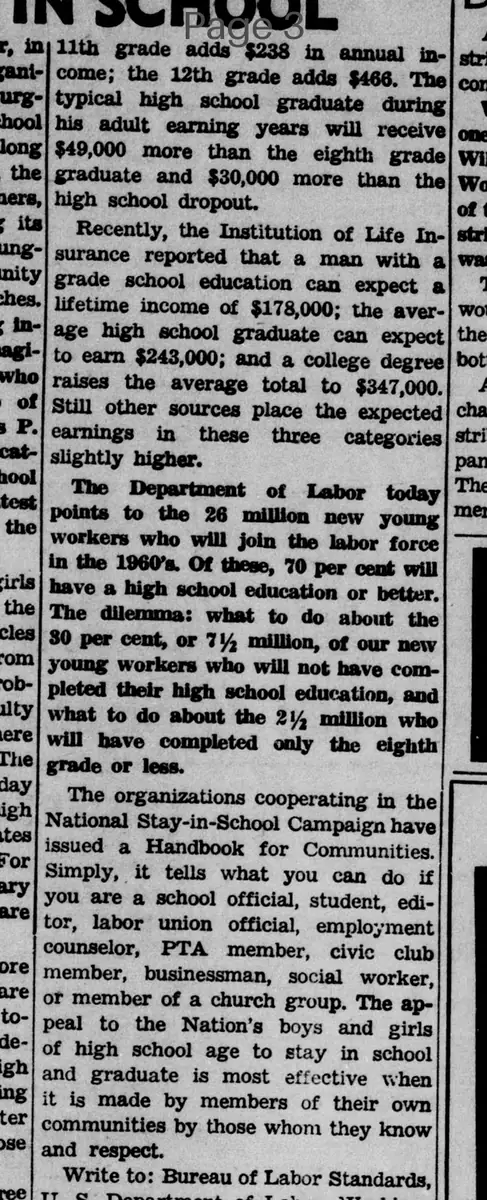
Recently, the Institution of Life Insurance reported that a man with a grade school education can expect a lifetime income of $178,000; the average high school graduate can expect to earn $243,000; and a college degree raises the average total to $347,000. Still other sources place the expected earnings in these three categories slightly higher.
The Department of Labor today points to the 26 million new young workers who will join the labor force in the 1960's. Of these, 70 per cent will have a high school education or better. The dilemma: what to do about the 30 per cent, or 7½ million, of our new young workers who will not have completed their high school education, and what to do about the 2½ million who will have completed only the eighth grade or less.
The organizations cooperating in the National Stay-in-School Campaign have issued a Handbook for Communities. Simply, it tells what you can do if you are a school official, student, editor, labor union official, employment counselor, PTA member, civic club member, businessman, social worker, or member of a church group. The appeal to the Nation's boys and girls of high school age to stay in school and graduate is most effective when it is made by members of their own communities by those whom they know and respect.
What sub-type of article is it?
What themes does it cover?
What keywords are associated?
Story Details
Event Date
1960's
Story Details
The text presents statistics on increased earnings from higher education levels, noting that high school graduates earn significantly more over their lifetimes than dropouts or eighth-grade completers. It highlights projections for the 1960s labor force, with 70% having high school or better, and calls for action on the 30% who won't. The National Stay-in-School Campaign provides a handbook for community members to encourage high school completion among youth.