Thank you for visiting SNEWPapers!
Sign up free
The National Intelligencer And Washington Advertiser
Washington, District Of Columbia
What is this article about?
Transcript of a December 23 House of Representatives debate on referring resolutions accusing Mississippi Territory Governor Winthrop Sargent of enacting unconstitutional laws and oppressive acts. Speakers including Randolph, Harper, and Claiborne argue over committee referral, potential impeachment, and investigation powers, ultimately appointing a committee to inquire into his conduct.
Merged-components note: These three components form a continuous narrative of the congressional debate on the Mississippi Territory governor, spanning pages 1-3 with sequential reading orders and direct text continuation.
Clippings
1 of 3
OCR Quality
Full Text
HOUSE OF REPRESENTATIVES.
MONDAY, DEC. 23.
MISSISSIPPI TERRITORY.
Debate concluded.
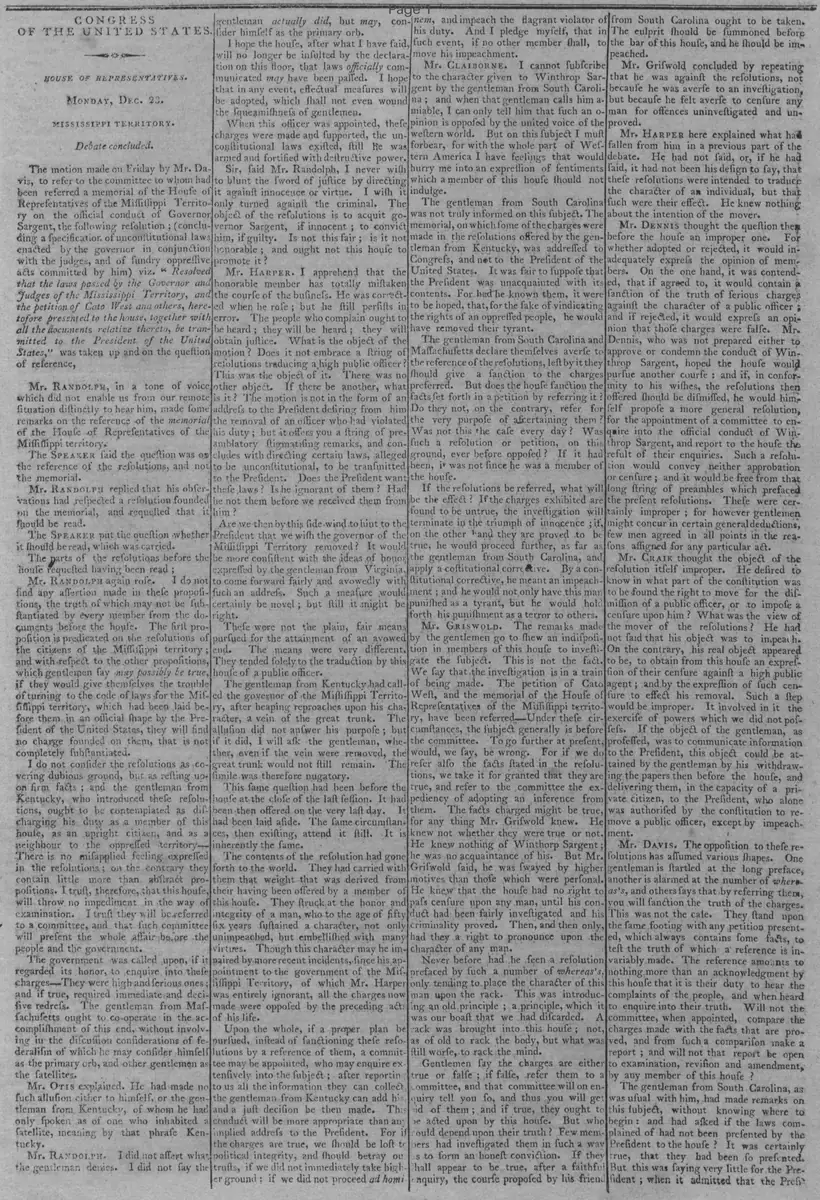
The motion made on Friday by Mr. Davis, to refer to the committee to whom had been referred a memorial of the House of Representatives of the Mississippi Territory on the official conduct of Governor Sargent, the following resolution; (concluding a specification of unconstitutional laws enacted by the governor in conjunction with the judges, and of sundry oppressive acts committed by him) viz. "Resolved that the laws passed by the Governor and Judges of the Mississippi Territory, and the petition of Cato West and others, heretofore presented to the house, together with all the documents relative thereto, be transmitted to the President of the United States," was taken up and on the question of reference,
Mr. Randolph, in a tone of voice which did not enable us from our remote situation distinctly to hear him, made some remarks on the reference of the memorial of the House of Representatives of the Mississippi territory.
The Speaker said the question was on the reference of the resolutions, and not the memorial.
Mr. Randolph replied that his observations had respected a resolution founded on the memorial, and requested that it should be read.
The Speaker put the question whether it should be read, which was carried.
The parts of the resolutions before the house requested having been read;
Mr. Randolph again rose. I do not find any assertion made in these propositions, the truth of which may not be substantiated by every member from the documents before the house. The first proposition is predicated on the resolutions of the citizens of the Mississippi territory; and with respect to the other propositions, which gentlemen say may possibly be true, if they would give themselves the trouble of turning to the code of laws for the Mississippi territory, which had been laid before them in an official shape by the President of the United States, they will find no charge founded on them, that is not completely substantiated.
I do not consider the resolutions as covering dubious ground, but as resting upon firm facts; and the gentleman from Kentucky, who introduced these resolutions, ought to be contemplated as discharging his duty as a member of this house, as an upright citizen, and as a neighbour to the oppressed territory--
There is no misapplied feeling expressed in the resolutions; on the contrary they contain little more than abstract propositions. I trust, therefore, that this house will throw no impediment in the way of examination. I trust they will be referred to a committee, and that such committee will present the whole affair before the people and the government.
The government was called upon, if it regarded its honor, to enquire into these charges--They were high and serious ones; and if true, required immediate and decisive redress. The gentleman from Massachusetts ought to co-operate in the accomplishment of this end, without involving in the discussion considerations of federalism of which he may consider himself as the primary orb, and other gentlemen as the satellites.
Mr. Otis explained. He had made no such allusion either to himself, or the gentleman from Kentucky, of whom he had only spoken as of one who inhabited a satellite, meaning by that phrase Kentucky.
Mr. Randolph. I did not assert what the gentleman denies. I did not say the gentleman actually did, but may, consider himself as the primary orb.
I hope the house, after what I have said, will no longer be insulted by the declaration on this floor, that laws officially communicated may have been passed. I hope that in any event, effectual measures will be adopted, which shall not even wound the squeamishness of gentlemen.
When this officer was appointed, these charges were made and supported, the unconstitutional laws existed, till he was armed and fortified with destructive power.
Sir, said Mr. Randolph, I never wish to blunt the word of justice by directing it against innocence or virtue. I wish it only turned against the criminal. The object of the resolutions is to acquit governor Sargent, if innocent; to convict him, if guilty. Is not this fair; is it not honorable; and ought not this house to promote it?
Mr. Harper. I apprehend that the honorable member has totally mistaken the course of the business. He was corrected when he rose; but he still persists in error. The people who complain ought to be heard; they will be heard; they will obtain justice. What is the object of the motion? Does it not embrace a string of resolutions traducing a high public officer?
This was the object of it. There was no other object. If there be another, what is it? The motion is not in the form of an address to the President desiring from him the removal of an officer who had violated his duty; but it offers you a string of preambulatory stigmatizing remarks, and concludes with directing certain laws, alleged to be unconstitutional, to be transmitted to the President. Does the President want these laws? Is he ignorant of them? Had he not them before we received them from him?
Are we then by this side wind to hint to the President that we wish the governor of the Mississippi Territory removed? It would be more consistent with the ideas of honor expressed by the gentleman from Virginia, to come forward fairly and avowedly with such an address. Such a measure would certainly be novel; but still it might be right.
These were not the plain, fair means pursued for the attainment of an avowed end. The means were very different. They tended solely to the traduction by this house of a public officer.
The gentleman from Kentucky had called the governor of the Mississippi Territory, after heaping reproaches upon his character, a vein of the great trunk. The allusion did not answer his purpose; but if it did, I will ask the gentleman, whether, even if the vein were removed, the great trunk would not still remain. The simile was therefore nugatory.
This same question had been before the house at the close of the last session. It had been then offered on the very last day. It had been laid aside. The same circumstances, then existing, attend it still. It is inherently the same.
The contents of the resolution had gone forth to the world. They had carried with them that weight that was derived from their having been offered by a member of this house. They struck at the honor and integrity of a man, who to the age of fifty six years sustained a character, not only unimpeached, but embellished with many virtues. Though this character may be impaired by more recent incidents, since his appointment to the government of the Mississippi Territory, of which Mr. Harper was entirely ignorant, all the charges now made were opposed by the preceding acts of his life.
Upon the whole, if a proper plan be pursued, instead of sanctioning these resolutions by a reference of them, a committee may be appointed, who may enquire extensively into the subject; after reporting to us all the information they can collect the gentleman from Kentucky can add his and a just decision be then made. This conduct will be more appropriate than an implied address to the President. For if the charges are true, we should be lost to political integrity, and should betray our trusts, if we did not immediately take higher ground; if we did not proceed ad hominem, and impeach the flagrant violator of his duty. And I pledge myself, that in such event, if no other member shall, that I will move his impeachment.
Mr. Claiborne. I cannot subscribe to the character given to Winthrop Sargent by the gentleman from South Carolina; and when that gentleman calls him amiable, I can only tell him that such an opinion is opposed by the united voice of the western world. But on this subject I must forbear, for with the whole part of Western America I have feelings that would hurry me into an expression of sentiments which a member of this house should not indulge.
The gentleman from South Carolina was not truly informed on this subject. The memorial, on which some of the charges were made in the resolutions offered by the gentleman from Kentucky, was addressed to Congress, and not to the President of the United States. It was fair to suppose that the President was unacquainted with its contents. For had he known them, it were to be hoped, that, for the sake of vindicating the rights of an oppressed people, he would have removed their tyrant.
The gentleman from South Carolina and Massachusetts declare themselves averse to the reference of the resolutions, lest by it they should give a sanction to the charges preferred. But does the house sanction the facts set forth in a petition by referring it? Do they not, on the contrary, refer for the very purpose of ascertaining them?
Was not this the case every day? Was such a resolution or petition, on this ground, ever before opposed? If it had been, it was not since he was a member of the house.
If the resolutions be referred, what will be the effect? If the charges exhibited are found to be untrue, the investigation will terminate in the triumph of innocence; if, on the other hand they are proved to be true, he would proceed further, as far as the gentleman from South Carolina, and apply a constitutional corrective. By a constitutional corrective, he meant an impeachment; and he would not only have this man punished as a tyrant, but he would hold forth his punishment as a terror to others.
Mr. Griswold. The remarks made by the gentlemen go to show an indisposition in members of this house to investigate the subject. This is not the fact. We say that the investigation is in a train of being made. The petition of Cato West, and the memorial of the House of Representatives of the Mississippi territory, have been referred. Under these circumstances, the subject generally is before the committee. To go further at present, would, we say, be wrong. For if we do refer also the facts stated in the resolutions, we take it for granted that they are true, and refer to the committee the expediency of adopting an inference from them. The facts charged might be true, for any thing Mr. Griswold knew. He knew not whether they were true or not. He knew nothing of Winthrop Sargent; he was no acquaintance of his. But Mr. Griswold said, he was swayed by higher motives than those which were personal.
He knew that the house had no right to pass censure upon any man, until his conduct had been fairly investigated and his criminality proved. Then, and then only, had they a right to pronounce upon the character of any man.
Never before had he seen a resolution prefaced by such a number of whereas's, only tending to place the character of this man upon the rack. This was introducing an old principle; a principle, which it was our boast that we had discarded. A rack was brought into this house; not, as of old to rack the body, but what was still worse, to rack the mind.
Gentlemen say the charges are either true or false; if false, refer them to a committee, and that committee will on enquiry tell you so, and thus you will get rid of them; and if true, they ought to be acted upon by this house. But who would depend upon their truth? Few members had investigated them in such a way as to form an honest conviction. If they shall appear to be true, after a faithful enquiry, the course proposed by his friend from South Carolina ought to be taken.
The culprit should be summoned before the bar of this house, and he should be impeached.
Mr. Griswold concluded by repeating that he was against the resolutions, not because he was averse to an investigation, but because he felt averse to censure any man for offences uninvesigated and unproved.
Mr. Harper here explained what had fallen from him in a previous part of the debate. He had not said, or, if he had said, it had not been his design to say, that these resolutions were intended to traduce the character of an individual, but that such were their effect. He knew nothing about the intention of the mover.
Mr. Dennis thought the question then before the house an improper one. For whether adopted or rejected, it would inadequately express the opinion of members. On the one hand, it was contended, that if agreed to, it would contain a sanction of the truth of serious charges against the character of a public officer; and if rejected, it would express an opinion that those charges were false. Mr. Dennis, who was not prepared either to approve or condemn the conduct of Winthrop Sargent, hoped the house would pursue another course: and if, in conformity to his wishes, the resolutions then offered should be dismissed, he would himself propose a more general resolution for the appointment of a committee to enquire into the official conduct of Winthrop Sargent, and report to the house the result of their enquiries. Such a resolution would convey neither approbation or censure; and it would be free from that long string of preambles which prefaced the present resolutions. These were certainly improper; for however gentlemen might concur in certain general deductions, few men agreed in all points in the reasons assigned for any particular act.
Mr. Craik thought the object of the resolution itself improper. He desired to know in what part of the constitution was to be found the right to move for the dismission of a public officer, or to impose a censure upon him? What was the view of the mover of the resolutions? He had not said that his object was to impeach. On the contrary, his real object appeared to be, to obtain from this house an expression of their censure against a high public agent; and by the expression of such censure to effect his removal. Such a step would be improper. It involved in it the exercise of powers which we did not possess. If the object of the gentleman, as professed, was to communicate information to the President, this object could be attained by the gentleman by his withdrawing the papers then before the house, and delivering them, in the capacity of a private citizen, to the President, who alone was authorized by the constitution to remove a public officer, except by impeachment.
Mr. Davis. The opposition to these resolutions has assumed various shapes. One gentleman is startled at the long preface, another is alarmed at the number of whereases, and others say that by referring them, you will sanction the truth of the charges. This was not the case. They stand upon the same footing with any petition presented, which always contains some facts, to test the truth of which a reference is invariably made. The reference amounts to nothing more than an acknowledgment by this house that it is their duty to hear the complaints of the people, and when heard to enquire into their truth. Will not the committee, when appointed, compare the charges made with the facts that are proved, and from such a comparison make a report; and will not that report be open to examination, revision and amendment, by any member of this house?
The gentleman from South Carolina, as was usual with him, had made remarks on this subject, without knowing where to begin: and had asked if the laws complained of had not been presented by the President to the house? It was certainly true, that they had been so presented. But this was saying very little for the President; when it admitted that the President had seen the laws, that violated the constitution, and oppressed the people, without checking the officer, who had usurped unconstitutional power, and exercised flagrant oppression.
The gentlemen from South Carolina had called the charges contained in the resolutions mere assertions. Mr. Davis denied the truth of the remark. There was not a charge made that was not proved. If he had told the house that he had laid hold of the threads of a conspiracy, he might have been charged with making mere assertions.
Mr. Davis was not acquainted with the early character of Winthrop Sargent. But he was acquainted, which was more material, with his late and present character. He did know that in his recent actions he had exhibited the character of a tyrant. It was very probable that before he was corrupted by power he was a virtuous man. But with him, as with many other men, no sooner had he got power than he assumed the character of the tyrant, and oppressed those whom he had been appointed to protect.
Mr. Davis cared but little for the present fate of his motion: for let the house decide as it would on this day, a proper decision would soon be had. The reign of terror in this country would soon reach its end.
Mr. Macon. The subject already referred does not embrace the contents of this resolution. The memorial from the House of Representatives of the Mississippi territory only relates to the election for Washington county, and the conduct of the governor in relation to it: whereas the charges on which this resolution is founded are numerous and dissimilar.
The subject had been, last session, introduced at a late day, and had from that circumstance been laid aside. He was then convinced, and still was convinced, that the charges are true. They are specifically stated and supported by a reference to their proofs. Can more be required? Why not then refer them? Will not a committee inquire into their truth? And should they be found untrue will not the committee say so? A reference presented the only course whereby justice could be done to those who complain, to the country at large, and to the individual criminated.
It appeared to Mr. Macon that it became that house to be the more attentive to these charges, as they came from a territory, unrepresented in our federal councils.
Gentlemen, impeach this officer, if guilty. Could there be a more appropriate mode of leading to this effect, than by the appointment of a committee, on whose reported statement of facts the house would be justified in acting?
This had been the uniform mode. It had been practiced in the case of the failure of the Western expedition under St. Clair. A committee had been appointed to inquire into the subject; though he granted that he did not recollect that the word whereas (so much objected to on this occasion) had been then used.
Nothing had been more common than to appoint a committee, and then give them certain instructions; this resolution was nothing more. But we are told from all quarters that we cannot pass the resolution without sanctioning the charges and staining the character of governor Sargent. It was not so. Gentlemen were mistaken. A reference involves no opinion, other than that a subject may be better investigated by a select committee than by this house.
Mr. Harper asked whether it was in order to amend the resolution.
The SPEAKER answered that it was.
Mr. HARPER. I then move to strike out the whole of the preamble, and so much of the resolution that follows, as to make it read (we are substantially though not verbally correct) "that a Committee be appointed to enquire into the official conduct of Winthrop Sargent, which shall be authorized to send for persons, papers, and records."
Mr. Harper declared his object was to bring about an impeachment of governor Sargent, if he appeared on investigation to be guilty.
Mr. CLAIBORNE said he admired the object avowed by the gentleman from Massachusetts; but he then rose to ask the Speaker whether the amendment was in order.
The SPEAKER said it was in order.
Mr. EGGLESTON. I hold in my hands the rules of the house, where I find it declared that a motion for commitment shall precede all amendment.
The SPEAKER, after some hesitation, said it certainly was so.
Mr. RUTLEDGE said gentlemen all seemed to agree as to the essence of the case but to differ on the mode. He thought the instance referred to by the gentleman from North Carolina fully in point, and committee had been appointed barely to inquire into "the causes of the Western expedition." The resolution had not been prefaced by a long preamble; it had reprehensible motives to general St. Clair.
The subject seemed to be entangled by the rules of the house. He approved the mode recommended by his colleague; and for the purpose of attaining that he would move the previous question.
The previous question was then put, viz. "Shall the main question be now put?" Which passed in the negative—Ayes 35. Noes 48.
Mr. HARPER then moved to strike out the preamble.
Mr. Macon moved a postponement of the question till to-morrow—Motion lost.
Mr. KIRCHELL moved an adjournment.
Mr. THATCHER. If we adjourn till to-morrow, when we meet then, what will be the question before the house? We have decided that the main question shall not be put. Can that then be the question? Where will it be? Where shall we find it?
Mr. HARPER called to order; on a motion to adjourn there could be no debate.
Motion for adjournment lost.
Mr. Davis moved a commitment of the amendment to a select committee.
The SPEAKER declared the motion not in order.
Mr. DENT asked if it was not in order to commit the motions of both the gentlemen from Kentucky and South Carolina to a committee.
The SPEAKER said a vote on the main question had just been put.
MR. EGGLESTON said the vote had been on the previous question, and not the main one.
The SPEAKER acknowledged that it was so, but declared the proposition of Mr. Dent out of order.
The question was taken on striking out the preamble, and carried, 48 members rising in the affirmative.
MR. HARPER then moved to amend the concluding resolution moved by Mr. Davis, by striking it out, and introducing in its room the motion already stated as made by Mr. Harper.
Mr. RANDOLPH desired to know, whether it was in order to move an amendment to the amendment of the gentleman from South Carolina.
The SPEAKER said it was in order.
Mr. RANDOLPH then moved the reference to the committee of the laws, documents, and other papers accompanying them.
The SPEAKER said that appeared to him to be the amount of the original resolution.
Mr. RANDOLPH replied that the original resolution was for the transmission of them to the President.
The SPEAKER acknowledged that it was so; and stated the motion of Mr. Randolph.
Mr. CHAMPLIN thought the motion out of order.
Mr. HARPER rose to call the gentleman to order. The Speaker had already decided on the motion to be in order.
The SPEAKER again pronounced the motion to be in order.
A desultory debate ensued between Mr. Randolph, Mr. Griswold, Mr. Harper and Mr. Nott.
Mr. Harper's motion under consideration:
Mr. RANDOLPH would say, however hazardous the remark, that the house had never been more idly employed than on this occasion. All the gentlemen, who have spoken against the original resolution of the gentleman from Kentucky, say they are agreed as to the thing, but they dispute with tenacity every mode that we point out for accomplishing it. Whichever way we proceed, their ingenuity meets us at every step; and thus they strive to baffle every motion, whose object is a fair and full investigation.
Mr. Randolph thought the direct point should be directly aimed at. The committee proposed to be appointed by the gentleman from S. Carolina, uninstructed as to what charges they are to investigate, may be as blind as the gentlemen themselves who had spoken.
He hoped, therefore, the house would compel them to take them into view.
Mr. RUTLEDGE was in this stage of the business opposed to the amendment of the gentleman from Virginia, though he had no objection to agree to it, after the motion of the gentleman from South Carolina was agreed to.
Mr. DAVIS appealed to gentlemen, whether they were serious in wishing to send for persons and papers? Could they expect to get them during the session from a country 1700 miles off?
The SPEAKER called to order. The main question was not before the house. Whatever was said must be on the amendment.
Then, said Mr. DAVIS, I will say nothing about it, and sit down.
The question on Mr. Randolph's motion was then put and lost—Ayes 29.
Mr. CLAIBORNE moved to strike out of the motion made by Mr. Harper, the words, "to send for persons, documents and papers." His motive was dictated by a desire to obtain speedy justice for this oppressed people. The necessary proofs were before the house. If the committee were tied up from making a report until a message had been sent to, and returned from, the Mississippi territory, he should despair of justice overtaking this man. The committee may certainly immediately inquire into the subject; and from the documents that would be laid before them, they would be able to act with effect without much delay or great expense. To test the sincerity of gentlemen he moved to strike out those words.
Mr. HARPER said that the motion carried an implication that his friend from Tennessee would not be willing to allow; either that a criminal might escape unpunished, or an innocent man be punished.
Suppose the committee think the charges insufficient for the object of removal or impeachment, and yet are of opinion that they are sufficient to justify strong suspicion and presumption of guilt; would it not be desirable to invest them with the right of making further enquiry? Suppose, on the other hand, that the charges appear to them true, had not the experience of ages justified the propriety of the maxim audi alteram partem? How can this dilemma be surmounted but by imparting to the committee all the powers required for making a full and fair enquiry? Unless this be done you may convict the governor without testimony, or dismiss him, though you think him criminal.
Mr. SMILIE. If extortion has been practiced by Winthrop Sargent, if unconstitutional laws have been passed, it is the duty of Congress to interpose its authority, and redress these great evils. In such cases delays are dangerous. He was, therefore, for those measures that provided the most immediate and effectual remedy.
MR. CLAIBORNE. The gentleman from South Carolina has done justice to my feelings in supposing that I would recoil at the idea of punishing an innocent man. I would recoil at such an idea. But the testimony upon which I stand forbids the indulgence of such a fear. Before the exhibition of the documents I had suspicions; but now I have convictions. The unconstitutional laws, officially communicated, are proofs whose authority I dare not resist. They are before the house. Any member may read them. I deny, pursuing the course we wish to pursue, that Winthrop Sargent can be punished unheard. The committee, after solemn enquiry, will report to us a statement of facts; on which an impeachment may be grounded; and when impeached, Winthrop Sargent will be heard in his defence, and your managers may be empowered to send for persons and papers.
Let gentlemen, who hesitate on this subject, recollect that a delay of justice is often equal to a denial of it.
Mr. Claiborne's last words were scarcely uttered, when a person in the gallery clapped.
Serjeant, said the SPEAKER, see to that man.
[The Serjeant went into the gallery and took the person out, without resistance. We understand that he was kept in confinement by the Serjeant for about two hours; in consequence of which, and the loss of his horse, which he had fastened to a shed near the Capitol, and which was not to be found when he was released, he that very day obtained a warrant from a Magistrate against the Serjeant at arms for illegal confinement.
Though these circumstances are stated upon, what is deemed by the Editor of the National Intelligencer, good authority, yet he declines a responsibility for their accuracy.]
MR. CRAIK wished a full enquiry to be made, and of course thought the committee ought to be empowered to send for persons and papers. This measure, in his opinion, so far from evidencing an indisposition to meet the subject, was the strongest evidence of the sincerity and adherence to justice of those who supported it.
MR. NOTT considered (as well as we could hear him) the point in dispute as of little, if any, importance.
MR. GRISWOLD hoped the words would not be struck out; for if they were struck out the effect would then be that the committee should not send for persons or papers. He was astonished at the ideas of some gentlemen. Could they expect this house to be governed by the opinion of any one member who tells them that in his opinion certain facts exist that criminate a high public officer? If the documents are thus decisive, the committee need go no farther. If not decisive, shall they substitute the opinion of the gentleman from Tennessee in the place of their own convictions? He hoped not. If gentlemen are serious in the expression of their wishes for a fair enquiry, let them give the committee full powers.
MR. Macon asked gentlemen in favor of retaining these words, to consider the distance to which they would have to send, which was 1700 miles, and to calculate the time occupied in going and returning from the Mississippi territory, and then to say whether a return would not be impracticable during this session. He thought it would, and from this and other reasons was for an immediate enquiry.
MR. BAYARD. Is it the intention of gentlemen that the committee, they wish appointed, shall be exclusively guided by those documents, which they, as accusers, hold in their own hands? Is this their idea of justice? If it were, he differed widely from them.
Not a proposition had been made by gentlemen who desired such an enquiry as justice prescribed, but had been clogged by the suggestion of imaginary difficulties, and tortured into the most perverse meaning.
It was strange that gentlemen of such talents should after wandering so long round a meander, not half an inch in diameter, come at last to the simple resolution, which appointed a common committee with common powers. He called them common; for every committee appointed on such a subject have similar powers.
It was presumption to suppose, as the arguments of gentlemen did suppose, that the committee about to be appointed will desire to exculpate Winthrop Sargent. Was it candid to imply that they would be corrupt? The supposition of a denial of justice went on the idea that they would violate their duty in screening from punishment criminals.
If the laws are unconstitutional the committee will say so. But having done this, there remains a duty still more important. They must go into the intentions of governor Sargent. How could these be ascertained but by that comprehensive investigation that would be derived from examining persons and papers. Why then deny this authority in the first instance, when it will ultimately be necessary?
The ideas on which it was opposed, such as the distance and the time it would require, were frivolous, such as he could neither admit as reasons, or argue from as premises.
Mr. RANDOLPH. The gentleman who has just set down, has impeached with unwarrantable acrimony, the purity of our motives and our candor, because we differ from him on the course proper to be taken on this subject. Mr. Randolph was truly sorry that the gentleman had suffered such an accumulation of rancour to collect in his mind, as he had just poured out upon his side of the house. Every imputation hurtful to a feeling mind had been lavished.
Since, then, said Mr. Randolph, the gentleman has become the censor morum and inquisitor of our hearts, permit me to draw the outlines of theirs.
The gentleman, after an unbroken silence during the whole debate, rises and tells this house, that they have spent their time most fruitlessly and idly, and that after wandering for hours round a meander not half an inch in diameter, they had got back to the very point from which they had started. Did that gentleman recollect that the half inch meander, of which he spoke, designated the understanding of those with whom he acted, who perpetually moving in a circle, after all their labors, arrived at the point from which they first set out?
Instead of uniting with us in an enquiry into those serious charges you have heard, instead of aiding us with their talents, instead of performing their duty, gentlemen satisfy themselves with holding up before us a mere ignis fatuus. Under the idea of desiring a substantial investigation, they are converting us into a jury on life and death; and they will not suffer us to take a single step to bring a criminal to justice, without previously possessing the most incontrovertible proofs of his guilt. It is in vain that we answer that we are an initiating body, and that our present measures lead to that stage of the business, in which legal testimony will be required, still, deaf to our reasons, they call up expedients that can only tend to defeat the measure, and have the boldness to tell us that we are moving in that very meander which they themselves occupy.
Gentlemen on this subject are unusually hard of hearing. They will not hear, or if they do hear, they will not regard the passage of laws putting money into the hands of the governor and judges; laws warranting various descriptions of extortion; laws violating the constitution of the territory. These grievances are sounded in their ears, they are informed of the necessity of immediate redress, of the danger of unredressed oppression: and they still continue to talk of justice, and yet recommend nothing but what will delay, and perhaps defeat it. They may talk then of justice and of their regard to the constitution, as they please: the people will consider a delay of justice as a denial of it; they will say that the present Congress intend to do nothing.
A motion was made to adjourn, and lost.
Mr. Claiborne's motion to strike out the words "to send for persons documents and papers" was then put and lost.
Mr. Randolph moved to postpone the question till the 3d day of March—Lost.
The question was then taken on Mr. Harper's amendment by yeas and nays, and carried, there being only 11 nays.
The resolution, as amended, was then agreed to, and referred to Messrs. Harper, Claiborne, C. Goodrich, Nott, Davis, Bird, and Otis.
Mr. Randolph moved that the laws passed in the Mississippi Territory, and the petition of Cato West and others, with the documents, be referred to the same committee—Agreed to.
Mr. Harper moved that the committee, to whom had been referred the memorial of the House of representatives of the Mississippi Territory be discharged, and that the memorial be referred to the committee appointed to enquire into the official conduct of Winthrop Sargent.
What sub-type of article is it?
What themes does it cover?
What keywords are associated?
What entities or persons were involved?
Where did it happen?
Story Details
Key Persons
Location
House Of Representatives, Washington
Event Date
Monday, Dec. 23
Story Details
Debate in the House on a motion by Mr. Davis to refer resolutions specifying unconstitutional laws and oppressive acts by Governor Winthrop Sargent of the Mississippi Territory to the President. Various members argue for and against referral to a committee, concerns over sanctioning charges without investigation, potential impeachment, and committee powers to summon persons and papers. Ultimately, a committee is appointed to inquire into Sargent's official conduct.