Thank you for visiting SNEWPapers!
Sign up free
Fowle's New Hampshire Gazette And General Advertiser
Portsmouth, Rockingham County, New Hampshire
What is this article about?
A citizen argues that New Hampshire's new law empowering justices of the peace to handle debts up to ten pounds without jury trials violates the state constitution's Bill of Rights, which guarantees jury trials in property disputes. The letter warns of legislative overreach threatening judicial independence and calls for public vigilance to protect constitutional principles.
Clipping
OCR Quality
Full Text
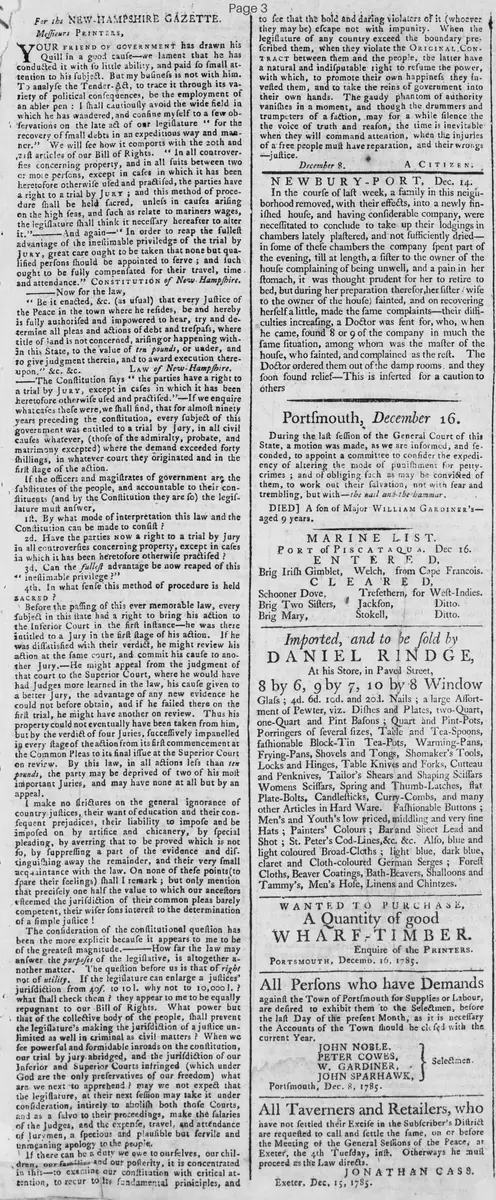
Messieurs Printers,
Your friend of government has drawn his Quill in a good cause—we lament that he has conducted it with so little ability, and paid so small attention to his subject. But my business is not with him. To analyse the Tender-Act, to trace it through its variety of political consequences, be the employment of an abler pen: I shall cautiously avoid the wide field in which he has wandered, and confine myself to a few Observations on the late act of our legislature "for the recovery of small debts in an expeditious way and manner." We will see how it comports with the 20th and 21st articles of our Bill of Rights. "In all controversies concerning property, and in all suits between two or more persons, except in cases in which it has been heretofore otherwise used and practiced, the parties have a right to a trial by Jury; and this method of procedure shall be held sacred, unless in causes arising on the high seas, and such as relate to mariners wages, the legislature shall think it necessary hereafter to alter it."
And again—"In order to reap the fullest advantage of the inestimable privileges of the trial by Jury, great care ought to be taken that none but qualified persons should be appointed to serve; and such ought to be fully compensated for their travel, time and attendance." Constitution of New-Hampshire.
Now for the law.
"Be it enacted, &c. (as usual) that every Justice of the Peace in the town where he resides, be and hereby is fully authorized and impowered to hear, try and determine all pleas and actions of debt and trespass, where title of land is not concerned, arising or happening within this State, to the value of ten pounds, or under, and to give judgment therein, and to award execution thereupon." &c. &c.
Law of New-Hampshire.
The Constitution says "the parties have a right to a trial by Jury, except in cases in which it has been heretofore otherwise used and practiced."—If we enquire what cases these were, we shall find, that for almost ninety years preceding the constitution, every subject of this government was entitled to a trial by Jury, in all civil causes whatever, (those of the admiralty, probate, and matrimony excepted) where the demand exceeded forty shillings, in whatever court they originated and in the first stage of the action.
If the officers and magistrates of government are the substitutes of the people, and accountable to their constituents (and by the Constitution they are so) the legislature must answer.
1st. By what mode of interpretation this law and the Constitution can be made to consist?
2d. Have the parties now a right to a trial by jury in all controversies concerning property, except in cases in which it has been heretofore otherwise practiced?
3d. Can the fullest advantage be now reaped of this inestimable privilege?
4th. In what sense this method of procedure is held SACRED?
Before the passing of this ever memorable law, every Subject in this state had a right to bring his action to the Inferior Court in the first instance—he was there intitled to a Jury in the first stage of his action. If he was dissatisfied with their verdict, he might review his action at the same court, and commit his cause to another Jury.—He might appeal from the judgment of that court to the Superior Court, where he would have had Judges more learned in the law, his cause given to a better Jury, the advantage of any new evidence he could not before obtain, and if he failed there on the first trial, he might have another on review. Thus his property could not eventually have been taken from him, but by the verdict of four Juries, successively impanelled in every stage of the action from its first commencement at the Common Pleas to its final issue at the Superior Court on review. By this law, in all actions less than ten pounds, the party may be deprived of two of his most important Juries, and may have none at all but by an appeal.
I make no strictures on the general ignorance of country justices, their want of education and their consequent prejudices, their liability to impose and be imposed on by artifice and chicanery, by special pleading, by averring that to be proved which is not so, by suppressing a part of the evidence and distinguishing away the remainder, and their very small acquaintance with the law. On none of these points (to spare their feelings) shall I remark; but only mention that precisely one half the value to which our ancestors esteemed the jurisdiction of their common pleas barely competent, their wiser ones interest to the determination of a simple justice!
The consideration of the constitutional question has been the more explicit because it appears to me to be of the greatest magnitude,—How far the law may answer the purposes of the legislative, is altogether another matter. The question before us is that of right not of utility. If the legislature can enlarge a justice's jurisdiction from 40s. to 10l. why not to 10,000l.? what shall check them? they appear to me to be equally repugnant to our Bill of Rights. What power but that of the collective body of the people, shall prevent the legislature's making the jurisdiction of a justice unlimited as well in criminal as civil matters? When we see powerful and formidable inroads on the constitution, our trial by jury abridged, and the jurisdiction of our Inferior and Superior Courts infringed (which under God are the only preservatives of our freedom) what are we next to apprehend; may we not expect that the legislature, at their next session may take it under consideration, intirely to abolish both those Courts, and as a salvo to their proceedings, make the salaries of the Judges, and the expence, travel, and attendance of Jurymen, a specious and plausible but servile and unmeaning apology to the people.
If there can be a duty we owe to ourselves, our children, our families, and our posterity, it is concentrated in this—to examine our constitution with critical attention, to recur to its fundamental principles, and to see that the bold and daring violaters of it (whoever they may be) escape not with impunity. When the legislature of any country exceed the boundary pre-scribed them, when they violate the Original Contract between them and the people, the latter have a natural and indisputable right to resume the power, with which, to promote their own happiness they invested them, and to take the reins of government into their own hands. The gaudy phantom of authority vanishes in a moment, and though the drummers and trumpeters of a faction, may for a while silence the voice of truth and reason, the time is inevitable when they will command attention, when the injuries of a free people must have reparation, and their wrongs justice.
December 8.
A CITIZEN.
What sub-type of article is it?
What themes does it cover?
What keywords are associated?
What entities or persons were involved?
Letter to Editor Details
Author
A Citizen.
Recipient
Messieurs Printers,
Main Argument
the new new hampshire law allowing justices of the peace to adjudicate debts up to ten pounds without jury trials violates the constitution's guarantee of jury trials in property controversies, except in historically established exceptions, and risks broader erosions of judicial rights and freedoms.
Notable Details