Thank you for visiting SNEWPapers!
Sign up free
The Potter Journal
Coudersport, Potter County, Pennsylvania
What is this article about?
The Soldiers' and Sailors' Convention in Pittsburgh convened on a Tuesday in 1866, with veterans organizing committees, adopting rules, and passing resolutions affirming Union victory, supporting Gen. John W. Geary for Governor, endorsing U.S. Grant and A.G. Curtin for 1868 presidential tickets, demanding traitor punishment, and protecting Reconstruction gains. Speeches emphasized loyalty and heroism.
Clipping
OCR Quality
Full Text
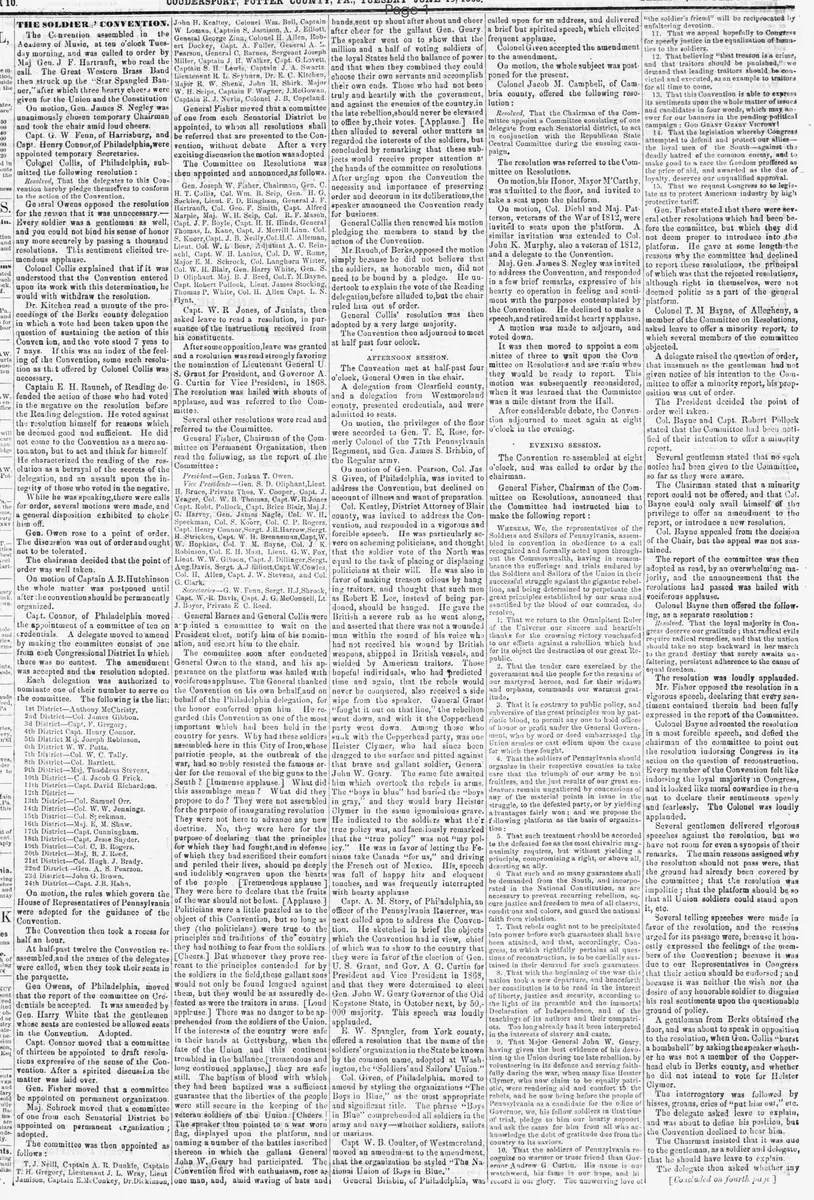
The Convention assembled in the Academy of Music, at ten o'clock Tuesday morning, and was called to order by Maj Gen. J F. Hartranft, who read the call. The Great Western Brass Band then struck up the "Star Spangled Banner," after which three hearty cheers were given for the Union and the Constitution
On motion, Gen. James S. Negley was unanimously chosen temporary Chairman and took the chair amid loud cheers.
Capt. G. W Fenn, of Harrisburg, and Capt. Henry Connor, of Philadelphia, were appointed temporary Secretaries.
Colonel Collis, of Philadelphia, submitted the following resolution:
Resolved, That the delegates to this Convention hereby pledge themselves to conform to the action of the Convention.
General Owens opposed the resolution for the reason that it was unnecessary.- Every soldier was a gentleman as well, and you could not bind his sense of honor any more securely by passing a thousand resolutions. This sentiment elicited tremendous applause.
Colonel Collis explained that if it was understood that the Convention entered upon its work with this determination, he would withdraw the resolution.
Dr. Kitchen read a minute of the proceedings of the Berks county delegation in which a vote had been taken upon the question of sustaining the action of this Convention, and the vote stood 7 yeas to 7 nays. If this was an index of the feeling of the Convention, some such resolution as that offered by Colonel Collis was necessary.
Captain E. H. Rauch, of Reading defended the action of those who had voted in the negative on the resolution before the Reading delegation. He voted against the resolution himself for reasons which he deemed good and sufficient. He did not come to the Convention as a mere automaton, but to act and think for himself He characterized the reading of the resolution as a betrayal of the secrets of the delegation, and an assault upon the integrity of those who voted in the negative.
While he was speaking, there were calls for order, several motions were made, and a general disposition exhibited to choke him off.
Gen. Owen rose to a point of order. The discussion was out of order and ought not to be tolerated.
The chairman decided that the point of order was well taken.
On motion of Captain A. B. Hutchinson the whole matter was postponed until after the convention should be permanently organized.
Capt. Connor, of Philadelphia moved the appointment of a committee of ten on credentials. A delegate moved to amend by making the committee consist of one from each Congressional District in which there was no contest. The amendment was accepted and the resolution adopted.
Each delegation was authorized to nominate one of their number to serve on the committee. The following is the list:
1st District-Anthony McChristy.
2nd District-Col. James Gibbon.
3d District-Capt. F. Gregory.
4th District Capt. Henry Connor.
5th District Maj. Joseph Robinson.
6th District W. W. Potts.
7th District-Col. W. C. Talley.
8th District-Col. Bartlett.
9th District-Maj. Thaddeus Stevens.
10th District-Col. Jacob G. Frick.
11th District-Capt. David Richardson.
12th District-
13th District-Col. Samuel Orr.
14th District-Col. W. W. Jennings.
15th District-Col. Sickel man.
16th District-Maj. E. M. Shaw.
17th District-Capt. Cunningham.
18th District-Capt. Jesse Snyder.
19th District-Col. C. B. Rogers.
20th District-Maj. B. J. Reed.
21st District-Col. Hugh. J. Brady.
22nd District..-Gen. A. S. Pearson.
23d District-John G. Brown,
24th District--Capt. J. B. Hahn.
On motion, the rules which govern the House of Representatives of Pennsylvania were adopted for the guidance of the Convention.
The Convention then took a recess for half an hour.
At half-past twelve the Convention re-assembled, and the names of the delegates were called, when they took their seats in the parquette.
Gen Owens, of Philadelphia, moved that the report of the committee on Credentials be accepted. It was amended by Gen. Harry White that the gentlemen whose seats are contested be allowed seats in the Convention. Adopted.
Capt. Connor moved that a committee of thirteen be appointed to draft resolutions expressive of the sense of the Convention. After a spirited discussion the matter was laid over.
Gen. Fisher moved that a committee be appointed on permanent organization.
Maj. Schrock moved that a committee of one from each Senatorial District be appointed on permanent organization; adopted.
The committee was then appointed as follows:
T. J. Neill, Captain A. R. Dunkle, Captain T. H. Gregory, Lieutenant J. L. Wray, Lieut Jamison, Captain E. McConkey, Dr. Dickinson,
John H. Keatley, Colonel Wm. Bell, Captain W Loman, Captain S. Jamison, A. J. Elliott General George Zinn, Colonel H. Allen, Robert Dockey, Capt. A. Fuller, General A. L. Pearson, General C. Barnes, Sergeant Joseph Miller, Captain J. H. Walker, Capt. G. Lovett, Captain S. H. Lewis. Captain J. A. Swartz. Lieutenant R. L. Seyburn, Dr. E. C. Kitchen, Major R. W. Shenk, John H. Shirk, Major W. H. Seips, Captain F. Wagner, J. McGowan, Captain R. J. Nevin, Colonel J. B. Copeland.
General Fisher moved that a committee of one from each Senatorial District be appointed, to whom all resolutions shall be referred that are presented to the Convention, without debate After a very exciting discussion the motion was adopted
The Committee on Resolutions was then appointed and announced, as follows.
Gen. Joseph W. Fisher, Chairman, Gen. C. H. T. Collis, Col. Wm. B. Seip, Gen. H. G. Sickles, Lieut. F. D. Bingham, General J. F. Hartranft, Col. Geo. F. Smith, Capt. Alfred Marple, Maj. W. H. Seip, Col. R. F. Mason, Capt. J. F. Boyle. Capt. H. H. Hinds. General Thomas L. Kane, Capt. J. Merrill Linn. Col. S. Knorr, Capt. J. B. Neilly, Col. H. C. Alleman, Lieut. Col. W. L Bear, Adjutant A. C. Reinachl, Capt. W. H. Lanius, Col. D. W. Rome, Major E. M. Schrock. Col. Langhorn Wister, Col. W. H. Blair, Gen. Harry White, Gen. S. D Oliphant. Maj. B. J. Reed. Col. T. M. Bayne. Capt. Robert Pollock, Lieut. James Stocking, Thomas P. White, Col. H. Allen Capt. L. N. Flynt..
Capt. W. R Jones, of Juniata, then asked leave to read a resolution, in pursuance of the instructions received from his constituents.
After some opposition, leave was granted and a resolution was read strongly favoring the nomination of Lieutenant General U. S. Grant for President. and Governor A. G. Curtin for Vice President, in 1868.
The resolution was hailed with shouts of applause, and was referred to the Committee.
Several other resolutions were read and referred to the Committee.
General Fisher, Chairman of the Committee on Permanent Organization, then read the following, as the report of the Committee :
President-Gen. Joshua T. Owen.
Vice Presidents-Gen. S. D. Oliphant, Lieut. H. Bruce. Private Thos. V. Cooper, Capt. J. Yeager, Col. W. B. Thomas, Capt. W. R. Jones Capt. Robt. Pollock, Capt, Brice Blair, Maj. J. C. Harvey, Gen. James Nagle, Col. W. H. Speekman, Col. S. Knorr, Col. C. P. Rogers, Capt. Henry Connor, Sergt. J. R. Harrow, Sergt. H. Stricken, Capt. W. H. Brenneman, Capt. W. W. Hopkins, Col. T. M. Bayne, Col. J K. Robinson, Col. E. H. Mast, Lieut. G. W. Fox, Lieut. W. W. Gibson, Capt. J. Dillinger, Sergt. Aug. Davis. Sergt. A. J Elliott, Capt. W. Cowles. Col. H. Allen, Capt. J. W. Stevens, and Col. G. Clark.
Secretaries-G. W. Fenn, Sergt. H. J. Shrock. Capt. W. R. Davis. Capt. J. G. McConnell, Lt. J. Bover, Private E C. Reed.
General Barnes and General Collis were appointed a committee to wait on the President elect, notify him of his nomination, and escort him to the chair.
The committee soon after conducted General Owen to the stand, and his appearance on the platform was hailed with vociferous applause. The General thanked the Convention on his own behalf, and on behalf of the Philadelphia delegation, for the honor conferred upon him He regarded this Convention as one of the most important which had been held in the country for years. Why had these soldiers assembled here in this City of Iron, whose patriotic people, at the outbreak of the war, had so nobly resisted the famous order for the removal of the big guns to the South? [Immense applause.] What did this assemblage mean? What did they propose to do? They were not assembled for the purpose of inaugurating revolution They were not here to advance any new doctrine. No, they were here for the purpose of declaring that the principles for which they had fought, and in defense of which they had sacrificed their comfort and periled their lives, should be deeply and indelibly engraven upon the hearts of the people [Tremendous applause They were here to declare that the fruits of the war should not be lost. Applause. Politicians were a little puzzled as to the object of this Convention, but so long as they (the politicians) were true to the principles and traditions of the country they had nothing to fear from the soldiers. [Cheers.] But whenever they prove recreant to the principles contended for by the soldiers in the field, these gallant sons would not only be found leagued against them, but they would be as assuredly defeated as were the traitors in arms. [Loud applause.] There was no danger to be apprehended from the soldiers of the Union. If the interests of the country were safe in their hands at Gettysburg, when the fate of the Union and this continent trembled in the balance. [tremendous and long continued applause,] they are safe still. The baptism of blood with which they had been baptized was a sufficient guarantee that the liberties of the people were still secure in the keeping of the veteran soldiers of the Union. [Cheers.]
The speaker then pointed to a war worn flag, displayed upon the platform, and naming a number of the battles inscribed thereon in which the gallant General John W. Geary had participated. The Convention fired with enthusiasm, rose as one man, and, amid waving of hats and hands, sent up shout after shout and cheer after cheer for the gallant Gen. Geary
The speaker went on to show that the million and a half of voting soldiers of the loyal States held the balance of power and that when they combined they could choose their own servants and accomplish their own ends. Those who had not been truly and heartily with the government, and against the enemies of the country, in the late rebellion, should never be elevated to office by their votes. [Applause.] He then alluded to several other matters as regarded the interests of the soldiers, but concluded by remarking that these subjects would receive proper attention at the hands of the committee on resolutions
After urging upon the Convention the necessity and importance of preserving order and decorum in its deliberations, the speaker announced the Convention ready for business.
General Collis then renewed his motion pledging the members to stand by the action of the Convention.
Mr. Rauch, of Berks, opposed the motion simply because he did not believe that the soldiers, as honorable men, did not need to be bound by a pledge. He undertook to explain the vote of the Reading delegation, before alluded to, but the chair ruled him out of order.
General Collis' resolution was then adopted by a very large majority.
The Convention then adjourned to meet at half past four o'clock.
AFTERNOON SESSION.
The Convention met at half-past four o'clock, General Owen in the chair.
A delegation from Clearfield county. and a delegation from Westmoreland county, presented credentials, and were admitted to seats.
On motion, the privileges of the floor were accorded to Gen. T. E. Rose, formerly Colonel of the 77th Pennsylvania Regiment, and Gen. James S. Brisbin, of the Regular army.
On motion of Gen. Pearson, Col. Jas S Given, of Philadelphia, was invited to address the Convention. but declined on account of illness and want of preparation.
Col. Keatley, District Attorney of Blair county, was invited to address the Convention, and responded in a vigorous and forcible speech. He was particularly severe on scheming politicians, and thought that the soldier vote of the North was equal to the task of placing or displacing politicians at their will. He was also in favor of making treason odious by hanging traitors, and thought that such men as Robert E. Lee, instead of being pardoned, should be hanged. He gave the British a severe rub as he went along, and asserted that there was not a wounded man within the sound of his voice who had not received his wound by British weapons, shipped in British vessels, and wielded by American traitors. Those hopeful individuals, who had predicted time and again, that the rebels would never be conquered, also received a side wipe from the speaker. General Grant "fought it out on that line," the rebellion went down, and with it the Copperhead party went down. Among those who sunk with the Copperhead party, was one Heister Clymer, who had since been dragged to the surface and pitted against that brave and gallant soldier, General John W. Geary. The same fate awaited him which overtook the rebels in arms. The "boys in blue" had buried the "boys in gray," and they would bury Heister Clymer in the same ignominious grave. He indicated to the soldiers what their true policy was, and facetiously remarked that the "true policy" was not "my policy." He was in favor of letting the Fenians take Canada "for us," and driving the French out of Mexico. His speech was full of happy hits and eloquent touches, and was frequently interrupted with hearty applause
Capt. A. M. Story, of Philadelphia, an officer of the Pennsylvania Reserves, was next called upon to address the Convention. He sketched in brief the objects which the Convention had in view, chief of which was to show to the country that they were in favor of the election of Gen. U. S. Grant, and Gov. A. G. Curtin for President and Vice President in 1868, and that they were determined to elect Gen. John W. Geary Governor of the Old Keystone State, in October next, by 50,000 majority. This speech was loudly applauded.
E. W. Spangler, from York county, offered a resolution that the name of the soldiers' organization in the State be known by the common name, adopted at Washington, the "Soldiers' and Sailors' Union."
Col. Given, of Philadelphia. moved to amend by styling the organizations "The Boys in Blue," as the most appropriate and significant title. The phrase "Boys in Blue" comprehended all soldiers in the army and navy-whether soldiers, sailors or marines.
Capt W. B. Coulter, of Westmoreland moved an amendment to the amendment. that the organization be styled "The National Union of Boys in Blue."
(General Brisbin of Philadelphia, was called upon for an address, and delivered a brief but spirited speech, which elicited frequent applause.
Colonel Given accepted the amendment to the amendment.
On motion, the whole subject was postponed for the present.
Colonel Jacob M. Campbell, of Cambria county, offered the following resolution:
Resolved, That the Chairman of the Committee appoint a Committee consisting of one delegate from each Senatorial district, to act in conjunction with the Republican State Central Committee during the ensuing campaign.
The resolution was referred to the Committee on Resolutions.
On motion, his Honor, Mayor McCarthy was admitted to the floor, and invited to take a seat upon the platform.
On motion, Col. Diehl and Maj. Patterson, veterans of the War of 1812, were invited to seats upon the platform. A similar invitation was extended to Col. John K. Murphy, also a veteran of 1812, and a delegate to the Convention
Maj. Gen. James S. Negley was invited to address the Convention, and responded in a few brief remarks. expressive of his hearty co operation in feeling and sentiment with the purposes contemplated by the Convention. He declined to make a speech, and retired amidst hearty applause.
A motion was made to adjourn, and voted down.
It was then moved to appoint a committee of three to wait upon the Committee on Resolutions and ascertain when they would be ready to report. This motion was subsequently reconsidered, when it was learned that the Committee was a mile distant from the Hall.
After considerable debate. the Convention adjourned to meet again at eight o'clock in the evening.
EVENING SESSION.
The Convention re-assembled at eight o'clock, and was called to order by the chairman.
General Fisher, Chairman of the Committee on Resolutions, announced that the Committee had instructed him to make the following report:
WHEREAS, We, the representatives of the Soldiers and Sailors of Pennsylvania, assembled in convention in obedience to a call recognized and formally acted upon throughout the Commonwealth, having in remembrance the sufferings and trials endured by the Soldiers and Sailors of the Union in their successful struggle against the gigantic rebellion, and being determined to perpetuate the great principles established by our arms and sanctified by the blood of our comrades, do resolve,
1: That we return to the Omnipotent Ruler of the Universe our sincere and heartfelt thanks for the crowning victory vouchsafed to our efforts against a rebellion which had for its object the destruction of our great Republic.
2. That the tender care exercised by the government and the people for the remains of our martyred heroes. and for their widows and orphans, commands our warmest gratitude,
3. That it is contrary to public policy, and subversive of the great principles won by patriotic blood. to permit any one to hold offices of honor or profit under the General Government, who by word or deed embarrassed the Union armies or cast odium upon the cause for which they fought,
4. That the soldiers of Pennsylvania should organize in their respective counties to take care that the triumph of our army be not fruitless. and the just results of our great endeavors remain ungathered by concessions of any of the material points in issue in the struggle, to the defeated party, or by yielding advantages fairly won; and we propose the following platform as the basis of organization :
5. That such treatment should be accorded to the defeated foe as the most chivalric magnanimity requires, but without yielding a principle, compromising a right, or above all, deserting an ally.
6 That such and so many guarantees shall be demanded from the South, and incorporated in the National Constitution, as are necessary to prevent recurring rebellion, secure justice and freedom to men of all classes. conditions and colors, and guard the national faith from violation.
7. That rebels ought not to be precipitated into power before such guarantees shall have been attained, and that, accordingly, Congress, to which rightfully pertains all questions of reconstruction. is to be cordially sustained in their demand for such guarantees
8. That with the beginning of the war this nation took a new departure, and henceforth her constitution is to be read in the interest of liberty, justice and security, according to the light of its preamble and the immortal Declaration of Independence, and of the teachings of its authors and their compatriots. Too long already has it been interpreted in the interests of slavery and caste.
9. That Major General John W. Geary having given the best evidence of his devotion to the Union during the late rebellion. by volunteering in its defence and serving faithfully during the war, when many like Heister Clymer. who now claim to be equally patriotic, were rendering aid and comfort to the rebels. and he now being before the people of Pennsylvania as a candidate for the office of Governor. we, his fellow soldiers in that time of trial, pledge to him our hearty support and ask the same for him from all who acknowledge the debt of gratitude due from the country to its saviors.
10. That the soldiers of Pennsylvania recognize no warmer or truer friend than Governor Andrew G. Curtin. His name is our watchword, his fame is our hope, and his record is our glory. The unswerving love of "the soldier's friend" will be reciprocated by unfaltering devotion.
11. That we appeal hopefully to Congress for speedy justice in the equalization of bounties to the soldiers.
12. That believing "that treason is a crime. and that traitors should be punished," we demand that leading traitors should be convicted and executed, as an example to traitors for all time to come.
13. That this Convention is able to express its sentiments upon the whole matter of issues and candidates in four words, which may answer for our banners in the pending political campaign : God Grant Geary Victory!
14. That the legislation whereby Congress attempted to defend and protect our allies- the loyal men of the South-against the deadly hatred of the common enemy, and to make good to a race the freedom proffered as the price of aid, and awarded as the due of loyalty, deserves our unqualified approval.
15. That we request Congress so to legislate as to protect American industry by high protective tariff.
Gen. Fisher stated that there were several other resolutions which had been before the committee, but which they did not deem proper to introduce into the platform. He gave at some length the reasons why the committee had declined to report these resolutions, the principal of which was that the rejected resolutions. although right in themselves, were not deemed politic as a part of the general platform.
Colonel T. M Bayne, of Allegheny, a member of the Committee on Resolutions, asked leave to offer a minority report, to which several members of the committee objected.
A delegate raised the question of order, that inasmuch as the gentleman had not given notice of his intention to the Committee to offer a minority report, his proposition was out of order.
The President decided the point of order well taken.
Col. Bayne and Capt. Robert Pollock stated that the Committee had been notified of their intention to offer a minority report.
Several gentlemen stated that no such notice had been given to the Committee, so far as they were aware.
The Chairman stated that a minority report could not be offered, and that Col. Bayne could only avail himself of the privilege to offer an amendment to the report, or introduce a new resolution.
Col. Bayne appealed from the decision of the Chair, but the appeal was not sustained.
The report of the committee was then adopted as read, by an overwhelming majority, and the announcement that the resolutions had passed was hailed with vociferous applause.
Colonel Bayne then offered the following, as a separate resolution:
Resolved. That the loyal majority in Congress deserve our gratitude ; that radical evils require radical remedies. and that the nation should take no step backward in her march to the grand destiny that surely awaits unfaltering, persistent adherence to the cause of equal freedom.
The resolution was loudly applauded.
Mr. Fisher opposed the resolution in a vigorous speech, declaring that every sentiment contained therein had been fully expressed in the report of the Committee.
Colonel Bayne advocated the resolution in a most forcible speech, and defied the chairman of the committee to point out the resolution indorsing Congress in its action on the question of reconstruction.
Every member of the Convention felt like indorsing the loyal majority in Congress, and it looked like moral cowardice in them not to declare their sentiments openly and fearlessly. The Colonel was loudly applauded.
Several gentlemen delivered vigorous speeches against the resolution, but we have not room for even a synopsis of their remarks. The main reasons assigned why the resolution should not pass were, that the ground had already been covered by the committee; that the resolution was impolitic ; that the platform should be so that all Union soldiers could stand upon it, etc.
Several telling speeches were made in favor of the resolution, and the reasons urged for its passage were, because it honestly expressed the feelings of the members of the Convention; because it was due to our Representatives in Congress that their action should be endorsed : and because it was neither the wish nor the desire of any honorable soldier to disguise his real sentiments upon the questionable ground of policy.
A gentleman from Berks obtained the floor, and was about to speak in opposition to the resolution, when Gen. Collis "burst a bombshell" by asking the speaker whether he was not a member of the Copperhead club in Berks county, and whether he did not intend to vote for Heister Clymer.
The interrogatory was followed by hisses, groans, cries of "put him out," etc.
The delegate asked leave to explain, and was about to define his position, but the Convention declined to hear him.
The Chairman insisted that it was due to the gentleman, as a soldier and delegate, that he should have leave to explain.
The delegate then asked whether any
[Concluded on fourth page]
What sub-type of article is it?
What themes does it cover?
What keywords are associated?
What entities or persons were involved?
Where did it happen?
Story Details
Key Persons
Location
Academy Of Music, Pittsburgh
Event Date
Tuesday Morning
Story Details
Pennsylvania soldiers and sailors' convention assembles, appoints committees on credentials, organization, and resolutions; adopts platform thanking God for Union victory, supporting Geary for governor, Grant and Curtin for president and vice president in 1868, demanding punishment for traitors, Reconstruction guarantees, and protective tariff; debates and speeches emphasize loyalty, heroism, and political influence.