Thank you for visiting SNEWPapers!
Sign up free
Editorial
November 2, 1786
Fowle's New Hampshire Gazette And General Advertiser
Portsmouth, Rockingham County, New Hampshire
What is this article about?
This editorial excerpt from Mr. Bowdoin's treatise promotes agriculture as beneficial to individuals and society, emphasizing its moral and practical virtues. It cites historical figures like Scipio, Cyrus, and Lysander, and praises George Washington's retirement to farming at Mount Vernon after the Revolutionary War.
Merged-components note: Continuation of Mr. Bowdoin's treatise on practical husbandry across page 1 to page 2.
Clippings
1 of 2
OCR Quality
98%
Excellent
Full Text
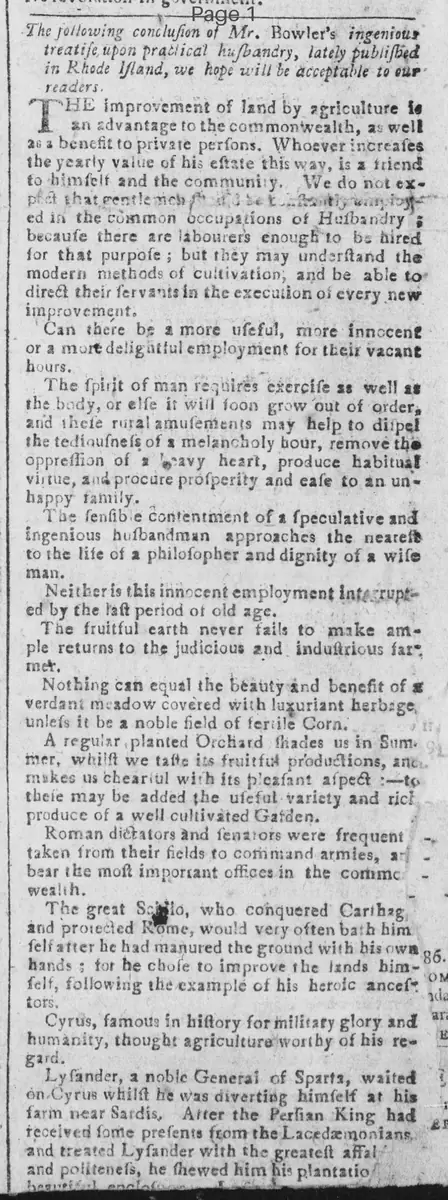
The following conclusion of Mr. Bowdoin's ingenious treatise upon practical husbandry, lately published in Rhode Island, we hope will be acceptable to our readers.
THE improvement of land by agriculture is an advantage to the commonwealth, as well as a benefit to private persons. Whoever increases the yearly value of his estate this way, is a friend to himself and the community. We do not expect that gentlemen should be thought unworthy of being engaged in the common occupations of Husbandry because there are labourers enough to be hired for that purpose; but they may understand the modern methods of cultivation; and be able to direct their servants in the execution of every new improvement.
Can there be a more useful, more innocent or a more delightful employment for their vacant hours.
The spirit of man requires exercise as well as the body, or else it will soon grow out of order. And these rural amusements may help to dispel the tediousness of a melancholy hour, remove the oppression of a heavy heart, produce habitual virtue, and procure prosperity and ease to an unhappy family.
The sensible Contentment of a speculative and ingenious husbandman approaches the nearest to the life of a philosopher and dignity of a wise man.
Neither is this innocent employment interrupted by the last period of old age.
The fruitful earth never fails to make ample returns to the judicious and industrious farmer.
Nothing can equal the beauty and benefit of a verdant meadow covered with luxuriant herbage unless it be a noble field of fertile Corn.
A regular planted Orchard Shades us in Summer, whilst we taste its fruitful productions, and makes us cheerful with its pleasant aspect:--to these may be added the useful variety and rich produce of a well cultivated Garden.
Roman dictators and senators were frequently taken from their fields to command armies, or bear the most important offices in the commonwealth.
The great Scipio, who conquered Carthage and protected Rome, would very often bathe himself after he had manured the ground with his own hands: for he chose to improve the lands himself, following the example of his heroic ancestors.
Cyrus, famous in history for military glory and humanity, thought agriculture worthy of his regard.
Lysander, a noble General of Sparta, waited on Cyrus whilst he was diverting himself at his farm near Sardis. After the Persian King had received some presents from the Lacedamonians, and treated Lysander with the greatest affability and politeness, he shewed him his plantation with the flourishing condition of the trees, which were planted in the most regular order, the land perfectly cultivated, and covered with sweet smelling flowers, and nature appeared adorned with the greatest art. Transported with this beautiful sight, Lysander could not help commending the exact dimensions and ingenious disposition of every part of the farm. Then Cyrus acquainted him, that the plan and disposition was contrived by himself, that many of the trees were planted with his own hands, and every thing performed under his own inspection. Lysander, viewing the splendor of his garments, adorned with gold and precious stones, said "O Cyrus the world may truly pronounce you happy, because you have so many virtues joined to your fortune."
Have we not that shining example illustrated in the person of our late Commander in Chief? who, being called forth from his domestic retirement, drew his sword in the defence of his country's invaded rights! after having conducted the great military contest with wisdom, fortitude and perseverance, until these United States have been enabled to close the war in freedom, safety and independence! like the heroes of old, resigned all military employments, and retired to his rural seat at Mount Vernon, on the Potowmack, with the blessings of his fellow-citizens; and where he still continues to shed his beneficial influence by the promotion of agriculture, and patronage of the arts and sciences.
Now can any man despise that way of passing his time, which has delighted such great men, and which the most celebrated wits have so highly extolled. For it is well known from their own immortal writings, that Cicero, Virgil and Horace, were extremely fond of a country life, and retired to their farms whenever business would permit them, preferring rural amusement to the noise, splendor of a court.
THE improvement of land by agriculture is an advantage to the commonwealth, as well as a benefit to private persons. Whoever increases the yearly value of his estate this way, is a friend to himself and the community. We do not expect that gentlemen should be thought unworthy of being engaged in the common occupations of Husbandry because there are labourers enough to be hired for that purpose; but they may understand the modern methods of cultivation; and be able to direct their servants in the execution of every new improvement.
Can there be a more useful, more innocent or a more delightful employment for their vacant hours.
The spirit of man requires exercise as well as the body, or else it will soon grow out of order. And these rural amusements may help to dispel the tediousness of a melancholy hour, remove the oppression of a heavy heart, produce habitual virtue, and procure prosperity and ease to an unhappy family.
The sensible Contentment of a speculative and ingenious husbandman approaches the nearest to the life of a philosopher and dignity of a wise man.
Neither is this innocent employment interrupted by the last period of old age.
The fruitful earth never fails to make ample returns to the judicious and industrious farmer.
Nothing can equal the beauty and benefit of a verdant meadow covered with luxuriant herbage unless it be a noble field of fertile Corn.
A regular planted Orchard Shades us in Summer, whilst we taste its fruitful productions, and makes us cheerful with its pleasant aspect:--to these may be added the useful variety and rich produce of a well cultivated Garden.
Roman dictators and senators were frequently taken from their fields to command armies, or bear the most important offices in the commonwealth.
The great Scipio, who conquered Carthage and protected Rome, would very often bathe himself after he had manured the ground with his own hands: for he chose to improve the lands himself, following the example of his heroic ancestors.
Cyrus, famous in history for military glory and humanity, thought agriculture worthy of his regard.
Lysander, a noble General of Sparta, waited on Cyrus whilst he was diverting himself at his farm near Sardis. After the Persian King had received some presents from the Lacedamonians, and treated Lysander with the greatest affability and politeness, he shewed him his plantation with the flourishing condition of the trees, which were planted in the most regular order, the land perfectly cultivated, and covered with sweet smelling flowers, and nature appeared adorned with the greatest art. Transported with this beautiful sight, Lysander could not help commending the exact dimensions and ingenious disposition of every part of the farm. Then Cyrus acquainted him, that the plan and disposition was contrived by himself, that many of the trees were planted with his own hands, and every thing performed under his own inspection. Lysander, viewing the splendor of his garments, adorned with gold and precious stones, said "O Cyrus the world may truly pronounce you happy, because you have so many virtues joined to your fortune."
Have we not that shining example illustrated in the person of our late Commander in Chief? who, being called forth from his domestic retirement, drew his sword in the defence of his country's invaded rights! after having conducted the great military contest with wisdom, fortitude and perseverance, until these United States have been enabled to close the war in freedom, safety and independence! like the heroes of old, resigned all military employments, and retired to his rural seat at Mount Vernon, on the Potowmack, with the blessings of his fellow-citizens; and where he still continues to shed his beneficial influence by the promotion of agriculture, and patronage of the arts and sciences.
Now can any man despise that way of passing his time, which has delighted such great men, and which the most celebrated wits have so highly extolled. For it is well known from their own immortal writings, that Cicero, Virgil and Horace, were extremely fond of a country life, and retired to their farms whenever business would permit them, preferring rural amusement to the noise, splendor of a court.
What sub-type of article is it?
Agriculture
Moral Or Religious
Social Reform
What keywords are associated?
Agriculture
Husbandry
Rural Life
Historical Examples
Moral Virtue
George Washington
What entities or persons were involved?
Mr. Bowdoin
Scipio
Cyrus
Lysander
George Washington
Cicero
Virgil
Horace
Editorial Details
Primary Topic
Promotion Of Practical Husbandry And Rural Life
Stance / Tone
Strongly Supportive And Laudatory
Key Figures
Mr. Bowdoin
Scipio
Cyrus
Lysander
George Washington
Cicero
Virgil
Horace
Key Arguments
Agriculture Benefits Individuals And The Community
Gentlemen Should Engage In Husbandry To Direct Improvements
Rural Pursuits Provide Exercise For Mind And Body, Promoting Virtue And Contentment
Historical Leaders Like Scipio And Cyrus Practiced Farming
George Washington Exemplifies Returning To Agriculture After Military Service
Classical Authors Praised Country Life