Thank you for visiting SNEWPapers!
Sign up free
The Virginia Gazette
Richmond, Williamsburg, Richmond County, Virginia
What is this article about?
A letter from Philadelphia dated September 4, 1778, addressed to British commissioners Earl of Carlisle, Sir Henry Clinton, and William Eden, refuting their assertions on the timing and sincerity of British conciliatory propositions amid the American Revolution. It argues that Britain's offers stem from necessity, not generosity, and defends the Franco-American alliance while affirming commitment to independence.
Merged-components note: This is a single continuous letter to the editor spanning pages 1 and 2, indicated by '[Continued from our last.]' in the first part and seamless text flow into the second part, with sequential reading orders.
Clippings
1 of 2
OCR Quality
Full Text
[Continued from our last.]
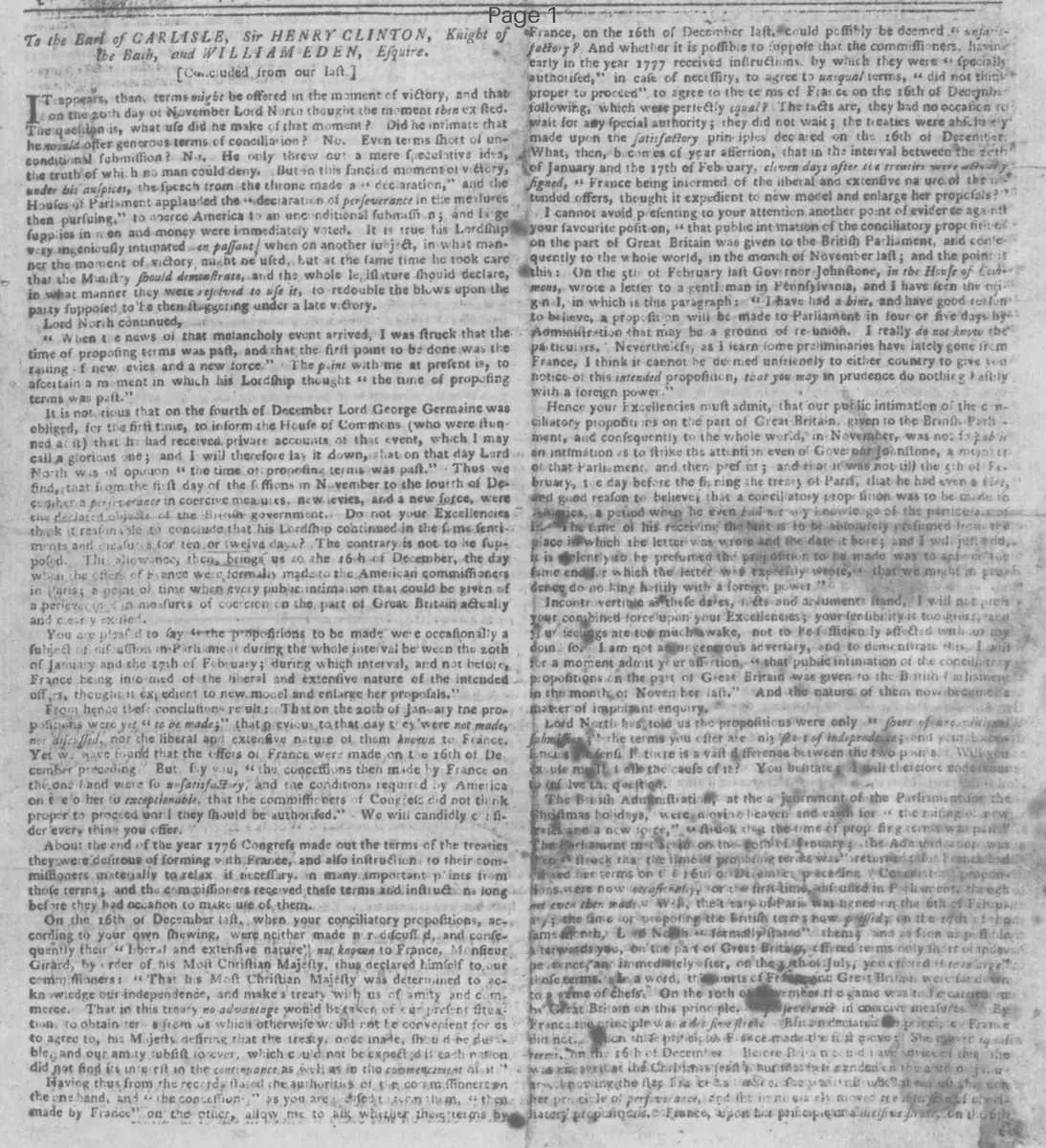
It appears, then, terms might be offered in the moment of victory, and that the question is, what use did he make of that moment? Did he intimate that on the 20th day of November Lord North thought the moment then existed. conditional submission? No. He only threw out a mere speculative idea, he would offer generous terms of conciliation? No. Even terms short of unconditional submission? the truth of which no man could deny. But in this fancied moment of victory, under his auspices, the speech from the throne made a declaration, and the Houses of Parliament applauded the declaration of perseverance in the measures very ingeniously intimated on point when on another subject, in what manner supplies in men and money were immediately voted. It is true his Lordship then pursuing, to force America to an unconditional submission; and large near the moment of victory, might ensue, but at the same time he took care that the Ministry would demonstrate, and the whole legislature should declare, in what manner they were resolved to use it, to redouble the blows upon the party opposed to be then staggering under a late victory.
Lord North continued, "When the news of that melancholy event arrived, I was struck that the raising new levies and a new force." The point with me at present is, to time of proposing terms was past, and that the first point to be done was the ascertain a moment in which his Lordship thought the time of proposing terms was past.
It is notorious that on the fourth of December Lord George Germaine was obliged, for the first time, to inform the House of Commons (who were stunned at it) that he had received private accounts of that event, which I may call a glorious one; and I will therefore lay it down, that on that day Lord North was of opinion the time of proposing terms was past. Thus we find, that from the first day of the session in November to the fourth of December a perseverance in coercive measures, new levies, and a new force, were the declared object of the British government. Do not your Excellencies think it reasonable to conclude that his Lordship continued in the same intents and views for ten or twelve days? The contrary is not to be supposed. This allowance, then, brings us to the 16th of December, the day when advances were formally made to the American commissioners in Paris; a point of time when every public intimation that could be given of a perseverance in measures of coercion on the part of Great Britain actually and necessarily existed.
You are pleased to say that the propositions to be made were occasionally a subject of discussion in Parliament during the whole interval between the 20th of January and the 17th of February; during which interval, and not before France being informed of the liberal and extensive nature of the intended offers, thought it expedient to new model and enlarge her proposals.
From hence these conclusions result: That on the 20th of January the propositions were yet to be made that previous to that day they were not made, nor digested, nor the liberal and extensive nature of them known to France. Yet we have found that the offers of France were made on the 16th of December preceding But you, the concessions then made by France on the one hand were so unsatisfactory, and the conditions required by America on the other so exceptionable, that the commissioners of Congress did not think proper to proceed until they should be authorized. We will candidly consider every thing you offer.
About the end of the year 1776 Congress made out the terms of the treaties they were desirous of forming with France, and also instructions to their commissioners materially to relax if necessary in many important points from those terms; and the commissioners received these terms and instructions long before they had occasion to make use of them.
On the 16th of December last, when your conciliatory propositions, according to your own showing, were neither made nor digested, and consequently their liberal and extensive nature not known to France, Monsieur Girard, by order of his Most Christian Majesty, thus declared himself to your commissioners: That his Most Christian Majesty was determined to acknowledge our independence, and make a treaty with us of amity and commerce. That in this treaty no advantage would be taken of our present situation to obtain terms from us which otherwise would not be convenient for us to agree to. His Majesty desiring that the treaty, once made, should be durable and our amity subsist forever, which could not be expected if each nation did not find its interest in the continuance as well as in the commencement of it.
Having thus from the record stated the authorities of your commissioners on the one hand, and the concessions you are pleased to them on the other, allow me to ask whether the concessions by France, on the 16th of December last, could possibly be deemed unsatisfactory? And whether it is possible to suppose that the commissioners, having early in the year 1777 received instructions by which they were specially authorized, in case of necessity, to agree to unequal terms, did not think proper to proceed to agree to the terms of France on the 16th of December following, which were perfectly equal? The facts are, they had no occasion to wait for any special authority; they did not wait; the treaties were absolutely made upon the satisfactory principles declared on the 16th of December.
What, then, becomes of your assertion, that in the interval between the 20th of January and the 17th of February, eleven days after the treaties were securely signed, France being informed of the liberal and extensive nature of the intended offers, thought it expedient to new model and enlarge her proposals?
I cannot avoid presenting to your attention another point of evidence against your favourite position, that public intimation of the conciliatory propositions on the part of Great Britain was given to the British Parliament, and consequently to the whole world, in the month of November last; and the point is this: On the 5th of February last Governor Johnstone, in the House of Commons, wrote a letter to a gentleman in Pennsylvania, and I have seen the original, in which is this paragraph: "I have had a hint, and have good reason to believe, a proposition will be made to Parliament in four or five days by Administration that may be a ground of re-union. I really do not know the particulars. Nevertheless, as I learn some preliminaries have lately gone from France, I think it cannot be deemed unfriendly to either country to give you notice of this intended proposition, that you may in prudence do nothing hastily with a foreign power."
Hence your Excellencies must admit, that our public intimation of the conciliatory propositions on the part of Great Britain, given to the British Parliament, and consequently to the whole world, in November, was not so absolute an intimation as to strike the attention even of Governor Johnstone, a member of that Parliament and then present; and that it was not till the 5th of February, the day before the signing the treaty at Paris, that he had even a hint, and good reason to believe that a conciliatory proposition was to be made to America, a period when he even had not any knowledge of the particulars. The time of his receiving the hint is to be absolutely presumed from the place in which the letter was wrote and the date it bore; and I will just add, it is evidently to be presumed the proposition to be made was to answer the same end for which the letter was expressly wrote, that we might in prudence do nothing hastily with a foreign power.
Incontrovertible as these facts and arguments stand, I will not press your combined force upon your Excellencies; your sensibility is too great, and your feelings are too much awake, not to be sufficiently affected with my doing so. I am not an ungenerous adversary, and to demonstrate this, I will for a moment admit your assertion,- that public intimation of the conciliatory propositions on the part of Great Britain was given to the British Parliament in the month of November last. And the nature of them now becomes a matter of important enquiry.
Lord North has told us the propositions were only short of unconditional submission the terms you offer are only short of independence and you Excellencies. In this there is a vast difference between the two plans. But you explain me I ask the cause of it? You hesitate I will therefore endeavour to resolve the question.
The British Administration, at the adjournment of the Parliament for the Christmas holidays, were moving heaven and earth for the raising of powers an new force, such that the time of proposing terms was past be the remembrance more strong on the continent; the Administration was so struck that the time of proposing terms was returned again France had it ed her terms but to from our preceding Conciliatory propositions. were now certainly, or the similar kind, due in Parliament, through mer even then made. u w-, thet earp oo Paris was signed on the 6th of February; the time of proposing the British terms how passed; en the tych t-hod amenth, L North s formally at do Athe mgnd o Sen ab p le terwards you, on the part of Great Britain, offered terms only short of indeva pe. eence an- immediately after, on the 8th July, you offered e cein arze tae terms. In a word, th courts cf France Great Britain were cla dun co a game of chess On the 20th ye mboo ti e game wus tole cararo n bye eat Britain cn this princ ple. jeveranck in comcave measures By Fronca the orineiple u a adet ve rohe Rluoncectareid pircip e Frane did nct.lon che pti eiple F.ece-made to gicve; She reve tgmlin rerms. Tn th: 16 h of Decem'er Beicre ia n e u d i ave wavice ci the tho sxavt at th Chiis esn nurai znden ah o j. u hrm kpovingthe Nep Ta be ds adr e. e uauck ukg on t hig oon her prncile o zerfvarance, dnd sht innn ea ehy roove ato afe f core. hator/ propiqcs. e France, vupon dat pritcapear a deife rokt, on .c 6th
On the 6th of February, moved the treaty of Paris. Germain heard of this, and on the 7th of this month this moved before all of Congress representatives. I hope games of his can be as easily played when the players are at a distance as when they are present; the whole difference in the two cases consists in the effect of time more if by for playing the game. Already, France seems to have reduced Britain to a state of coalition, whether she must give up the game as too desperate to be recovered. From this plain figure, it is demonstrated that the motions of France caused the variance between us but not our demand of independence. Governor Johnstone, in his declaration of the 26th of August, is pleased to reproach Congress for allying with France "after all their just claims are gratified." Your Excellencies ordered the transmission of this reproach; you are thereby partners in making it; and therefore I am justified in taking some notice of it to you.
In consequence of the offers you have made, you say all our just claims are gratified. You then admit that when you began the war we had just claims. You must admit, that notwithstanding our most humble petition in behalf of our just claims you refused to grant these claims. You must also admit, that for three years you have by force of arms, and all the horrors of war, endeavored to reduce us to unconditional submission, notwithstanding we had just claims. Upon those points, then, there is no mistake or doubt; nor can there be any upon these. The just claims of America ought to have been granted when they were made, and you were desired to give redress. You denied us common justice, by refusing to grant us redress upon those just claims. You enormously added to that injustice, by letting loose upon us all the calamities of war, to oblige us to abandon those our just claims. And we have now a just claim to receive satisfaction for all the damage which we, through your injustice, have received, in supporting our just claims. Your injustice has ruined thousands of our families. You have unjustly burned our towns and ravaged our country. Fathers, mothers, brothers, and friends, mourn the loss of their children, brothers and friends, by your injustice slain in the field of battle, scalped in their peaceable dwellings, murdered in your horrible prisons.
America, by your injustice, has lost thousands of her best citizens, and has been obliged to expend millions of her treasure. Nor is the loss her youth have sustained by your injustice, in the loss of the important years for the improvement of their understandings, which they can never regain, the least she has sustained. Look at this short list of damages, and say whether you have ever offered to gratify America in all her just claims! Say, is it in the nature of things possible for you to gratify America in all her just claims? There was a time when you might easily have done so. You threw it away; you must be struck that the time of proposing terms is past, never to return.
Your Excellencies wish to move our gratitude. You speak of your conciliatory propositions as the generous measures of Great Britain. Your Excellencies are rather unfortunate in the means you use to touch the passions. Louis the Sixteenth, the protector of the rights of mankind, has from time to time spoken of the generous measures of France, generous, because just and noble. He magnanimously declared, that in forming a treaty with us he did "not pretend that he acted wholly for our sakes, since besides his real good will to us and to our cause; it was manifestly the interest of France that the power of England should be diminished by our separation from it." But can Britain say her offers proceed from "real good will to us and to our cause?" Can she say she wished "to promote and establish the liberties, peace, opulence, increase, security, and permanent happiness, of the inhabitants of this continent?" No. Her whole system of government since the year 1763 has operated, her laws have been enacted, her arms have been used for the very contrary purposes.
Her Ministers and Parliaments have long oppressed in order to plunder us. When we were unarmed, she ungenerously drew her sword upon us. She treated our most humble petition for "peace, liberty, and safety," with silent contempt. Her Minister, Lord North, declared he was fighting for substantial revenue; he would lay America prostrate, and drag her to his feet. In the ideal "moment of victory," her Ministers and legislature declared they would redouble their blows upon America, supposed to be staggering under a late victory. Her veterans unjustly burned our towns, ravaged our country, and slaughtered our citizens. She let loose her Indian allies to massacre the unarmed, the aged, the sick, the infant, the matron, wife, and virgin. Her Generals and Admirals, in cold blood, in their prisons and prison ships, murdered our countrymen by suffocation, filth, hunger, and nakedness, refusing to them the food and raiment provided for their necessities by public authority and private affection; with gold and food tempting the virtuous citizens, in the agonies of misery and despair, to dip their hands in the blood of their country. Behold "the generous measures of Great Britain."
Your Excellencies have unwarily touched a string that already trembles throughout America, a subject that rouses the indignation, and calls forth the vengeance, of the people. America has experienced too much to be surprised at anything; she therefore cannot be surprised at your decorating yours with the title, "the generous measures of Great Britain." Generous measures proceed from magnanimity, not cruelty; from choice, not necessity.
Already have I met your assertions with Lord North's speech; allow me once more to have recourse to it. His Lordship proceeded,
"The resistance of America is greater, and the war has lasted longer, than was at first apprehended. In the present situation of affairs, only three propositions can be made:
1. To strengthen our force, and continue the war upon the present plan.
2. To offer terms of depopulation to her.
3. To reunite Great Britain and America. And
The first proposal attends with too great expense of men and money. The second is to yield to the independence of America. The third seems to me to be the best and wisest."
Your Excellencies will be so good as to glance your eyes over the third and last proposition, and believe that prior to the 17th of February last, conciliation was not the "present plan." And if you look upon his Lordship's reflections upon the third proposition, you must remain convinced that he chose the last proposition from "necessity, not choice; he closed with it because he could no longer prosecute the war." Tell me, now; in what consists the boasted generosity of these present measures of Great Britain?
And have your Excellencies so unfavorable an opinion of the understandings of the Americans as to think you can induce them, by your reasonings and negotiations, to yield that independence which they declared after the most mature reflection, and which they have purchased with their heart's blood, and at every risk? Are you so much in the dark, with respect to their inclinations and determination, as to have an idea that if you proved to them, as clear as the meridian sun, that the offers of France were only the consequence of your conciliatory propositions, that therefore they would renounce their precious independence? Is it possible you have forgotten that on the 22d of April last, when Congress were utterly ignorant that a treaty had been signed by their commissioners, nay, that a treaty with France even had been, was, or was expected to be in agitation, that on that very 22d of April Congress absolutely refused your conciliatory acts of Parliament? Are you now, let the hint come, to be assured that the people throughout the United States, with one voice, applauded and rejoiced in that decisive refusal? It was not on account of the treaties with France that Congress took "the decisive part," of which you so much complain; nor was this decisive part taken as you suppose it was, "without previously consulting the Assemblies of their different" states. The members of Congress individually knew the sense of their respective assemblies before they came to Congress. The present members of Congress were sent by their several Assemblies, at every hazard, remaining tainted out of direct America, I solemnly assure you, upon this great point, should any members of Congress be so imprudent as to move to accept your propositions, ready to make atonement with his head, or why you or tongue. They have no power on themselves; their power arises from the support of the people.
So long as they possess this support, they hold the reins of government; the moment they lose it, that moment they cease to direct the fate of the continent. As long, therefore, as you keep them at the head of as American empire, be convinced they are supported and obeyed by the people, in every measure tending to the establishment of their independence. Deceive act only yourselves by continuing to nourish the vain idea that Congress have "some to the decisive part which they have taken." Your Excellencies have it in your power to make a faithful representation of the utter improbability of your acquiring, in any degree, the subjection of America by your arms or your negotiations, to save your country by making such a representation, and thus, deserving your names from infamy, render them respectfully immortal. That such may be your conduct and reward, is the wish of
W. H. D.
PHILADELPHIA, September 4, 1778.
What sub-type of article is it?
What themes does it cover?
What keywords are associated?
What entities or persons were involved?
Letter to Editor Details
Author
W. H. D.
Recipient
To The Earl Of Carlisle; Sir Henry Clinton, Knight Of The Bath, And William Eden, Esquire.
Main Argument
the letter refutes british claims that conciliatory propositions were timely and generous, arguing they arose from necessity after french alliance, not goodwill, and that america will not abandon independence secured through struggle and supported by the people.
Notable Details