Thank you for visiting SNEWPapers!
Sign up free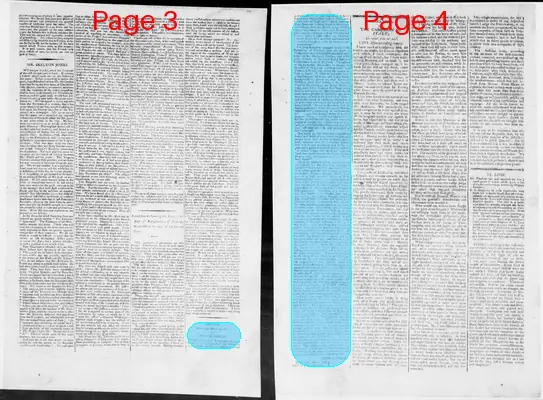
The Recorder, Or, Lady's And Gentleman's Miscellany
Richmond, Virginia
What is this article about?
In 1802 Boston, newspaper editor John S. Lillie was fined $100 and imprisoned for three months for publishing a libelous article accusing Judge Dana of corruption, written by John Vinal who was later acquitted. Lillie details the court proceedings and his defense.
Merged-components note: The notice introduces a continuous personal narrative account of the editor's libel case and imprisonment, best classified as a single story.
Clippings
1 of 2
OCR Quality
Full Text
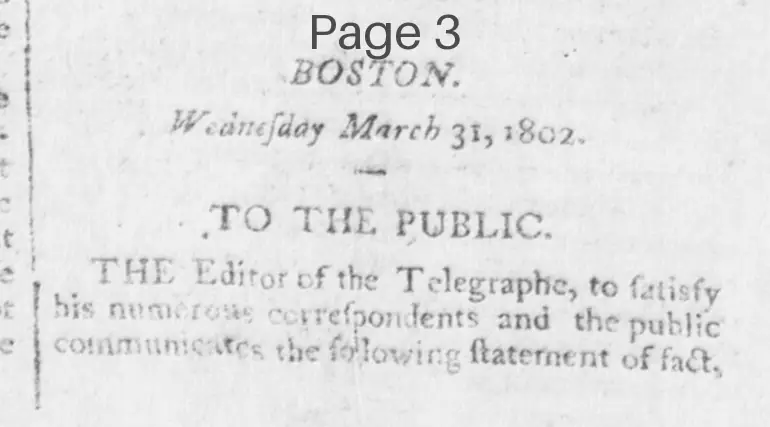
Wednesday March 31, 1802.
TO THE PUBLIC.
THE Editor of the Telegraphe, to satisfy
his numerous correspondents and the public
communicates the following statement of fact.
as it respects his fine and imprisonment, for a Libel on the "Lord Chief Justice of the Common Law of England."--At the opening of the Supreme Judicial Court in this town in February last, his Honor, Judge Dana, after giving charge to the Grand Jury in his usual manner, observed to them "that he had in his hand, a paper called the Constitutional Telegraphe, in which was contained the following piece under the head of communications."
"A little dirty piece appeared in the chaste Palladium, of Tuesday 22d ult. dated at Washington, but undoubtedly fabricated here, either by the illuminati Doctor, one of the pious Editors, or the Lord Chief Justice of the Common Law of England. The author of the paragraph endeavours to blacken the character of that great and benevolent man Thomas Jefferson, Esq. whom the people delight to honor. It likewise attempts to degrade Governor M'Kean, and Judge Breckenridge--Now, know ye, that Governor M'Kean, when chief Justice of the Supreme Court in Pennsylvania, nor Judge Breckenridge, now Chief Judge of that State, never set aside the Verdict of a Jury of twelve honest men, upon a promise of receiving one thousand acres of land in the province of Maine-- and endeavoured to obtain an impeachment of an attorney general, for disclosing such corrupt conduct. Know ye therefore, that the very lengthy piece in the first page of said immaculate paper, containing as much matter as two non-law-Judge's charge to a grand jury, on libels, is artfully designed to reconcile the mind of the citizens, to that execrable engine of tyrants, the common law of England, in criminal prosecutions; and that they may rest day under it, and embrace it as their birthright."
But, know ye, that whenever a republican senate and house of representatives convene, purged from those locusts to society, aristocratic lawyers; then this ten handed monster will be slain, and its remains sink in the unfathomable gulph of everlasting forgetfulness: and tyrant judges will weep and wail, and gnash their teeth, because their reign of terror is at an end, such tyrants exclaim; "het te mali babet!"
Here his honor, it is said, exclaimed very emphatically (at the same time pointing to himself) "that means ME gentlemen."-- The editor presumes with as much propriety as the Rev. Doctors Dwight, Morse, Tappin, or in fact, any other doctor in N. E. would, had they been in court at that moment. They might join inly and severally, have likewise vociferated, that the illuminati doctor meant them, or 'that means ME,' that means ME gentlemen.' This libel, as it was called, was handed to the Grand Jury, who, after a long and arduous struggle, found a Bill, which when the editor had notice of he absented himself, not knowing who the author was, and being unprepared at that time, to answer to his responsibility, and resist the vengeance of the Judiciary, it being in the height of the reign of terror --He, however, took this step, more by the advice of his friends, than from his own inclination; being conscious of his own rectitude of heart, he was ready to meet any thing that impartial justice could inflict, for his own inadvertency in giving publicity to the supposed libel. At the opening of the Supreme Court last August, the editor was summoned to appear, and was arraigned before the bar, to answer to an indictment for the above libel, as it is called.--- He applied to George Blake, Esq. as his counsel, who pleaded in his behalf guilty of publishing, and consequently, threw himself upon the lenity of the court. A few days previous to the rising of the court, he was arraigned before the bar, as he then thought, to receive the judgement of their honors; when his Honor, Judge Bradbury, after making his remarks on the heinousness of the crime observed that the court would indulge me till next term, in order that I might have an opportunity to discover the authors. In the mean time the original manuscript was handed round to different persons, who said they could recognise it as the hand writing of JOHN VINAL, Esquire. Accordingly at the meeting of the Grand Jury a complaint was entered against him as the author of the supposed libel. The Grand Jury, after a comparison of hands were fully satisfied of Mr. Vinal being the author, and were nearly unanimous in finding a bill against him. This gentleman, was therefore arraigned, and pleaded not guilty he was tried, and from a comparison of hands not being legal evidence, was acquitted. The editor and his Friends then expected that the honor as well as justice the court would be satisfied with a severe reprimand for his inadvertency, and indiscretion, particularly at the present period, when those malicious, and scandalous libels are continually issuing from the federal presses against the president and government of the United States: instead of which, a fine of one hundred dollars and three months imprisonment, was the award of the court. The above, to the editor's best recollection, is a true and faithful statement of the facts which he cheerfully submits for the consideration of his friends and the public.
JOHN S. LILLIE.
Boston Gazette, March 9th,
6th day of imprisonment.
What sub-type of article is it?
What themes does it cover?
What keywords are associated?
What entities or persons were involved?
Where did it happen?
Story Details
Key Persons
Location
Boston
Event Date
1802
Story Details
Editor John S. Lillie publishes a libelous article accusing Judge Dana of corruption; he is indicted, pleads guilty to publishing, seeks author John Vinal who is acquitted; Lillie is fined $100 and imprisoned for three months despite expectations of leniency.