Thank you for visiting SNEWPapers!
Sign up free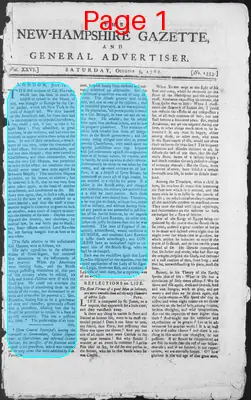
The New Hampshire Gazette And General Advertiser
Portsmouth, Exeter, Rockingham County, New Hampshire
What is this article about?
Report from London on the execution of American Col. Haynes by British forces in Charlestown during the Revolutionary War. Haynes, protected then coerced into service, took up arms again and was captured and killed without trial, sparking debate in the House of Commons.
Clipping
OCR Quality
Full Text
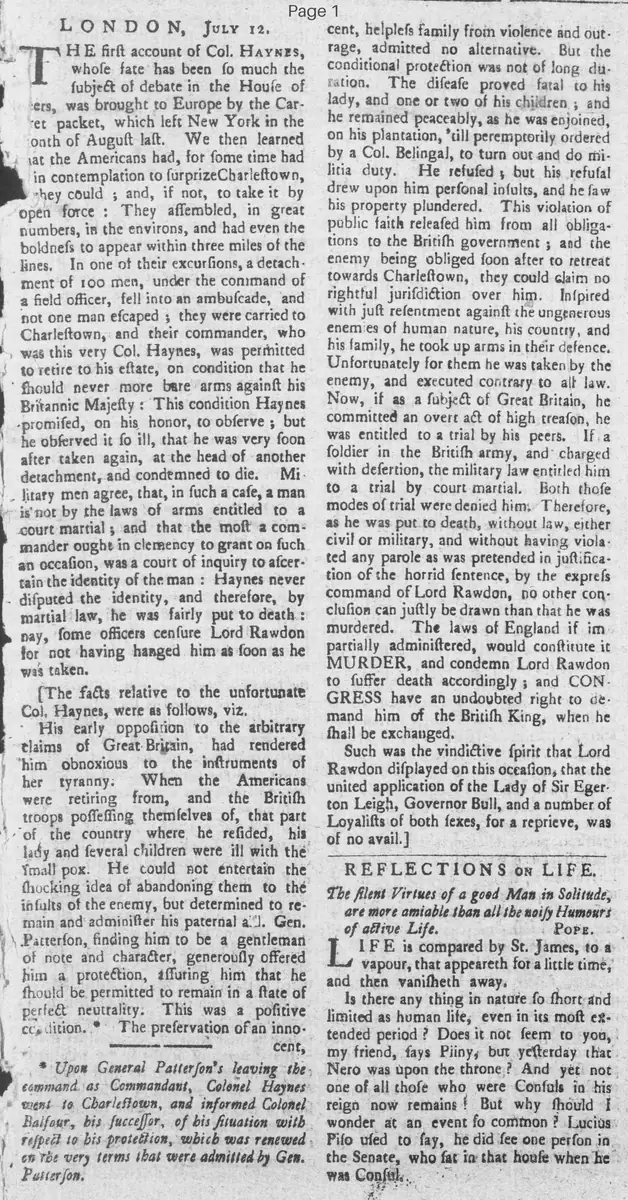
The first account of Col. Haynes, whose fate has been so much the subject of debate in the House of Commons, was brought to Europe by the Carteret packet, which left New York in the month of August last. We then learned that the Americans had, for some time past, had in contemplation to surprise Charlestown, if they could; and, if not, to take it by open force. They assembled, in great numbers, in the environs, and had even the boldness to appear within three miles of the lines. In one of their excursions, a detachment of 100 men, under the command of a field officer, fell into an ambuscade, and not one man escaped; they were carried to Charlestown, and their commander, who was this very Col. Haynes, was permitted to retire to his estate, on condition that he should never more bear arms against his Britannic Majesty. This condition Haynes promised, on his honor, to observe; but he observed it so ill, that he was very soon after taken again, at the head of another detachment, and condemned to die. Military men agree, that, in such a case, a man is not, by the laws of arms, entitled to a court martial; and that the most a commander ought, in clemency, to grant on such an occasion, was a court of inquiry to ascertain the identity of the man. Haynes never disputed the identity, and therefore, by martial law, he was fairly put to death; nay, some officers censure Lord Rawdon for not having hanged him as soon as he was taken.
The facts relative to the unfortunate Col. Haynes, were as follows, viz.
His early opposition to the arbitrary claims of Great Britain, had rendered him obnoxious to the instruments of her tyranny.
When the Americans were retiring from, and the British troops possessing themselves of, that part of the country where he resided, his lady and several children were ill with the small pox. He could not entertain the shocking idea of abandoning them to the insults of the enemy, but determined to remain and administer his paternal aid. Gen. Patterson, finding him to be a gentleman of note and character, generously offered him a protection, assuring him that he should be permitted to remain in a state of perfect neutrality. This was a positive citation. The preservation of an innocent, helpless family from violence and outrage, admitted no alternative. But the conditional protection was not of long duration. The disease proved fatal to his lady, and one or two of his children; and he remained peaceably, as he was enjoined, on his plantation, 'till peremptorily ordered by a Col. Bellingall, to turn out and do militia duty. He refused; but his refusal drew upon him personal insults, and he saw his property plundered. This violation of public faith released him from all obligations to the British government; and the enemy being obliged soon after to retreat towards Charlestown, they could claim no rightful jurisdiction over him. Inspired with just resentment against the ungenerous enemies of human nature, his country, and his family, he took up arms in their defence. Unfortunately for them he was taken by the enemy, and executed contrary to all law.
Now, if as a subject of Great Britain, he committed an overt act of high treason, he was entitled to a trial by his peers. If a soldier in the British army, and charged with desertion, the military law entitled him to a trial by court martial. Both those modes of trial were denied him. Therefore, as he was put to death, without law, either civil or military, and without having violated any parole as was pretended in justification of the horrid sentence, by the express command of Lord Rawdon, no other conclusion can justly be drawn than that he was murdered. The laws of England, if impartially administered, would constitute it MURDER, and condemn Lord Rawdon to suffer death accordingly; and CONGRESS have an undoubted right to demand him of the British King, when he shall be exchanged.
Such was the vindictive spirit that Lord Rawdon displayed on this occasion, that the united application of the Lady of Sir Egerton Leigh, Governor Bull, and a number of Loyalists of both sexes, for a reprieve, was of no avail.
* Upon General Patterson's leaving the command as Commandant of Charlestown, and informed Colonel Balfour, his successor, of his situation with respect to his protection, which was renewed on the very terms that were admitted by Gen. Patterson.
What sub-type of article is it?
What keywords are associated?
What entities or persons were involved?
Where did it happen?
Foreign News Details
Primary Location
Charlestown
Event Date
Month Of August Last
Key Persons
Outcome
col. haynes executed without trial; detachment of 100 men killed in ambuscade; haynes' wife and one or two children died of smallpox
Event Details
American forces attempted to surprise or attack Charlestown; Col. Haynes' detachment ambushed, all killed; Haynes paroled but rejoined Americans after British violations, recaptured and executed by Lord Rawdon's order despite pleas for reprieve.