Thank you for visiting SNEWPapers!
Sign up free
Letter to Editor
December 20, 1787
The Daily Advertiser
New York, New York County, New York
What is this article about?
A public creditor addresses Brutus and Cato with 17 queries challenging the legislature's constitutional powers to deprive citizens of property without consent, including through currency depreciation, ex post facto laws, and land title repeals, arguing these undermine liberty and public morals.
Clipping
OCR Quality
98%
Excellent
Full Text
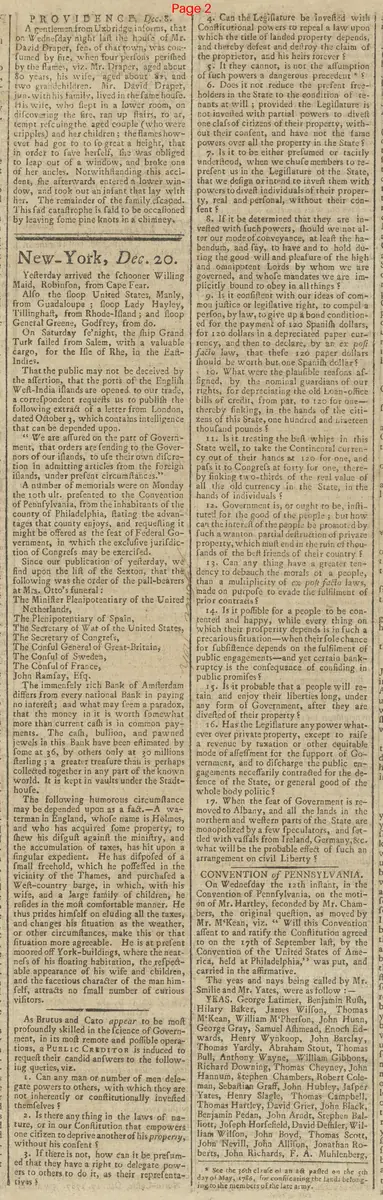
As Brutus and Cato appear to be most profoundly skilled in the science of Government, in its most remote and possible operations, a Public Creditor is induced to request their candid answers to the following queries, viz.
1. Can any man or number of men delegate powers to others, with which they are not inherently or constitutionally invested themselves?
2. Is there any thing in the laws of nature, or in our Constitution that empowers one citizen to deprive another of his property, without his consent?
3. If there is not, how can it be presumed that they have a right to delegate powers to others to do it, as their representatives?
4. Can the Legislature be invested with Constitutional powers to repeal a law upon which the title of landed property depends, and thereby defeat and destroy the claim of the proprietor, and his heirs forever?
5. If they cannot, is not the assumption of such powers a dangerous precedent?
6. Does it not reduce the present freeholders in the State to the condition of tenants at will; provided the Legislature is not invested with partial powers to divest one class of citizens of their property, without their consent, and have not the same powers over all the property in the State?
7. Is it to be either presumed or tacitly understood, when we chuse members to represent us in the Legislature of the State, that we design or intend to invest them with powers to divest individuals of their property, real and personal, without their consent?
8. If it be determined that they are invested with such powers, should we not alter our mode of conveyance, at least the habendum, and say, to have and to hold during the good will and pleasure of the high and omnipotent Lords by whom we are governed, and whose mandates we are implicitly bound to obey in all things?
9. Is it consistent with our ideas of common justice or legislative right, to compel a person, by law, to give up a bond conditioned for the payment of 120 Spanish dollars, for 10 dollars in a depreciated paper currency, and then to declare, by an ex post facto law, that these 120 paper dollars should be worth but one Spanish dollar?
10. What were the plausible reasons assigned, by the nominal guardians of our rights; for depreciating the old Loan-office bills of credit, from par, to 120 for one; thereby sinking, in the hands of the citizens of this State, one hundred and nineteen thousand pounds?
11. Is it treating the best whigs in this State well, to take the Continental currency out of their hands at 120 for one, and pass it to Congress at forty for one, thereby sinking two-thirds of the real value of all the old currency in the State, in the hands of individuals?
12. Government is, or ought to be, instituted for the good of the people; but how can the interest of the people be promoted by such a wanton partial destruction of private property, which must end in the ruin of thousands of the best friends of their country?
13. Can any thing have a greater tendency to debauch the morals of a people, than a multiplicity of ex post facto laws, made on purpose to evade the fulfilment of prior contracts?
14. Is it possible for a people to be contented and happy, while every thing on which their prosperity depends is in such a precarious situation—when their sole chance for subsistence depends on the fulfilment of public engagements—and yet certain bankruptcy is the consequence of confiding in public promises?
15. Is it probable that a people will retain and enjoy their liberties long, under any form of Government, after they are divested of their property?
16. Has the Legislature any power whatever over private property, except to raise a revenue by taxation or other equitable mode of assessment for the support of Government, and to discharge the public engagements necessarily contracted for the defence of the State, or general good of the whole body politic?
17. When the seat of Government is removed to Albany, and all the lands in the northern and western parts of the State are monopolized by a few speculators, and settled with vassals from Ireland, Germany, &c. what will be the probable effect of such an arrangement on civil Liberty?
1. Can any man or number of men delegate powers to others, with which they are not inherently or constitutionally invested themselves?
2. Is there any thing in the laws of nature, or in our Constitution that empowers one citizen to deprive another of his property, without his consent?
3. If there is not, how can it be presumed that they have a right to delegate powers to others to do it, as their representatives?
4. Can the Legislature be invested with Constitutional powers to repeal a law upon which the title of landed property depends, and thereby defeat and destroy the claim of the proprietor, and his heirs forever?
5. If they cannot, is not the assumption of such powers a dangerous precedent?
6. Does it not reduce the present freeholders in the State to the condition of tenants at will; provided the Legislature is not invested with partial powers to divest one class of citizens of their property, without their consent, and have not the same powers over all the property in the State?
7. Is it to be either presumed or tacitly understood, when we chuse members to represent us in the Legislature of the State, that we design or intend to invest them with powers to divest individuals of their property, real and personal, without their consent?
8. If it be determined that they are invested with such powers, should we not alter our mode of conveyance, at least the habendum, and say, to have and to hold during the good will and pleasure of the high and omnipotent Lords by whom we are governed, and whose mandates we are implicitly bound to obey in all things?
9. Is it consistent with our ideas of common justice or legislative right, to compel a person, by law, to give up a bond conditioned for the payment of 120 Spanish dollars, for 10 dollars in a depreciated paper currency, and then to declare, by an ex post facto law, that these 120 paper dollars should be worth but one Spanish dollar?
10. What were the plausible reasons assigned, by the nominal guardians of our rights; for depreciating the old Loan-office bills of credit, from par, to 120 for one; thereby sinking, in the hands of the citizens of this State, one hundred and nineteen thousand pounds?
11. Is it treating the best whigs in this State well, to take the Continental currency out of their hands at 120 for one, and pass it to Congress at forty for one, thereby sinking two-thirds of the real value of all the old currency in the State, in the hands of individuals?
12. Government is, or ought to be, instituted for the good of the people; but how can the interest of the people be promoted by such a wanton partial destruction of private property, which must end in the ruin of thousands of the best friends of their country?
13. Can any thing have a greater tendency to debauch the morals of a people, than a multiplicity of ex post facto laws, made on purpose to evade the fulfilment of prior contracts?
14. Is it possible for a people to be contented and happy, while every thing on which their prosperity depends is in such a precarious situation—when their sole chance for subsistence depends on the fulfilment of public engagements—and yet certain bankruptcy is the consequence of confiding in public promises?
15. Is it probable that a people will retain and enjoy their liberties long, under any form of Government, after they are divested of their property?
16. Has the Legislature any power whatever over private property, except to raise a revenue by taxation or other equitable mode of assessment for the support of Government, and to discharge the public engagements necessarily contracted for the defence of the State, or general good of the whole body politic?
17. When the seat of Government is removed to Albany, and all the lands in the northern and western parts of the State are monopolized by a few speculators, and settled with vassals from Ireland, Germany, &c. what will be the probable effect of such an arrangement on civil Liberty?
What sub-type of article is it?
Persuasive
Political
Philosophical
What themes does it cover?
Constitutional Rights
Economic Policy
Politics
What keywords are associated?
Property Rights
Legislative Powers
Currency Depreciation
Ex Post Facto Laws
Constitutional Limits
Civil Liberty
Public Debt
What entities or persons were involved?
Public Creditor
Brutus And Cato
Letter to Editor Details
Author
Public Creditor
Recipient
Brutus And Cato
Main Argument
the legislature lacks constitutional authority to deprive citizens of property without consent through measures like currency depreciation and ex post facto laws, which threaten liberty, morals, and public trust.
Notable Details
Series Of 17 Rhetorical Queries Challenging Government Powers
References To Natural Law And State Constitution
Criticism Of Depreciating Loan Office Bills And Continental Currency
Warning About Land Monopolies And Removal Of Government Seat To Albany