Thank you for visiting SNEWPapers!
Sign up free
Alexandria Gazette & Daily Advertiser
Alexandria, Virginia
What is this article about?
In the French Chamber of Deputies, opposition members like Benjamin Constant and Manuel denounced the ministry's tyrannical handling of Paris riots, press control, and use of troops over national guard. Reports of attacks on deputies and civilians; session ended in confusion and adjournment; calmer proceedings on Thursday. (248 characters)
Clipping
OCR Quality
Full Text
FRANCE.
Debate in the Chamber of Deputies-Continued.
Mr. Manuel follows in an address of considerable length, and much severity. He states, that serious disturbances had taken place, endangering the public safety of the members; that the conduct of ministers was partial, deceptive and tyrannical. He inveighs particularly against the arbitrary control of the press.
Mr. Laine follows on the side of the ministry; accuses the opposition of virulence, and presumes there is no further serious cause for fear.
Mr. Demarcay represents the royal guard as having mixed with the crowd in citizens dresses, armed with pointed canes, joining in the excesses, encouraging the insults to the deputies, and aiding the soldiers of the police, who arrested only the advocates of the constitution, though the ministerial party were the aggressors.
Mr. Benjamin Constant, after many interruptions and much confusion, proceeds at considerable length on the disturbed state of affairs, which he attributes to the partiality and tyranny of the ministry. Among the mob the ministerialists raised the cry of down with the charter--let us avenge the blood of the duke of Berri, in the blood of the liberals.
After much confusion and frequent calls for the vote, and for adjournment, and much mutual recrimination, the session closed at 7 o'clock, the principal members of the opposition having refused to join in the decision, and left their seats.
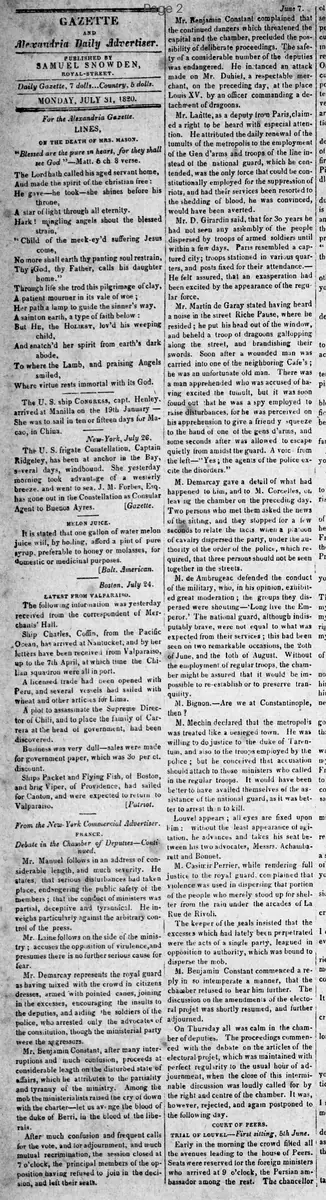
Mr. Benjamin Constant complained that the continued dangers which threatened the capital and the chamber, precluded the possibility of deliberate proceedings. The safety of a considerable number of the deputies was endangered. He instanced an attack made on Mr. Duhamel, a respectable merchant, on the preceding day, at the place Louis XV. by an officer commanding a detachment of dragoons.
Mr. Lafitte, as a deputy from Paris, claimed a right to be heard with especial attention. He attributed the daily renewal of the tumults of the metropolis to the employment of the Gens d'arms and troops of the line instead of the national guard, which he contended, was the only force that could be constitutionally employed for the suppression of riots, and had their services been resorted to the shedding of blood, he was convinced, would have been averted.
Mr. D. Girardin said, that for 30 years he had not seen any assembly of the people dispersed by troops of armed soldiers until within a few days. Paris resembled a captured city; troops stationed in various quarters, and posts fixed for their attendance. He felt assured, that an exasperation had been excited by the appearance of the regular force.
Mr. Martin de Garay stated having heard a noise in the street Richelieu, where he resided; he put his head out of the window, and beheld a troop of dragoons gallopping along the street, and brandishing their swords. Soon after a wounded man was carried into one of the neighboring Cafe's; he was an unfortunate old man. There was a man apprehended who was accused of having excited the tumult, but it was soon found out that he was a spy employed to raise disturbances, for he was perceived on his apprehension to give a friendly squeeze to the hand of one of the gens d'arms, and some seconds after was allowed to escape quietly from amidst the guard. A voice from the left-"Yes; the agents of the police excite the disorders."
M. Demarcay gave a detail of what had happened to him, and to M. Corcelles, on leaving the chamber on the preceding day. Two persons who met them asked the news of the sitting, and they stopped for a few seconds to relate the facts, when a platoon of cavalry dispersed the party, under the authority of the order of the police, which required, that three persons should not be seen together in the streets.
M. de Ambrugeac defended the conduct of the military, who, in his opinion, exhibited great moderation; the groups they dispersed were shouting-'Long live the Emperor.' The national guard, although indisputably brave, were not equal to what was expected from their services; this had been seen on two remarkable occasions, the 20th of June, and the 10th of August. Without the employment of regular troops, the chamber might be assured that it would be impossible to re-establish or to preserve tranquility.
M. Bignon.-Are we at Constantinople, then?
M. Mechin declared that the metropolis was treated like a besieged town. He was willing to do justice to the duke of Tarentum, and also to the troops employed by the police; but he conceived that accusation should attach to those ministers who called in the regular troops. It would have been better to have availed themselves of the assistance of the national guard, as it was better to arrest than to kill.
Louvel appears; all eyes are fixed upon him: without the least appearance of agitation, he advances and takes his seat between his two advocates, Messrs. Aucherbaudet and Bonnet.
M. Casimir Perrier, while rendering full justice to the royal guard, complained that violence was used in dispersing that portion of the people who merely stood up for shelter from the rain under the arcades of La Rue de Rivoli.
The keeper of the seals insisted that the excesses which had lately been perpetrated were the acts of a single party, leagued in opposition to authority, which was bound to disperse the mob.
M. Benjamin Constant commenced a reply in so intemperate a manner, that the chamber refused to hear him further. The discussion on the amendments of the electoral projet was shortly resumed, and further adjourned.
On Thursday all was calm in the chamber of deputies. The proceedings commenced with the debate on the articles of the electoral projet, which was maintained with perfect regularity to the usual hour of adjournment, when the close of this interminable discussion was loudly called for by the right and centre of the chamber. It was, however, rejected, and again postponed to the following day.
What sub-type of article is it?
What keywords are associated?
What entities or persons were involved?
Where did it happen?
Foreign News Details
Primary Location
Paris
Key Persons
Outcome
disturbances endangered deputies' safety; wounded man reported; attack on mr. duhamel; session closed in confusion with opposition refusing to vote; debate adjourned; calm on thursday.
Event Details
Debate in the Chamber of Deputies continued with speeches criticizing ministerial conduct, partiality, tyranny, and arbitrary press control. Opposition accused ministry of inciting riots via royal guard and police; reports of troops dispersing crowds, arrests of constitutional advocates, and cries against the charter. Incidents included dragoons attacking civilians and spies provoking tumults. Discussion on electoral projet adjourned amid interruptions.