Thank you for visiting SNEWPapers!
Sign up free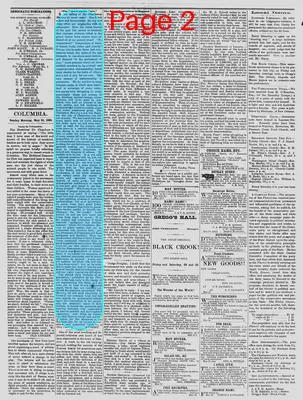
Letter to Editor
May 24, 1868
The Daily Phoenix
Columbia, Richland County, South Carolina
What is this article about?
A letter from 'Agonist' criticizes the Charleston Mercury's intransigent stance against compromise in post-Civil War South Carolina, advocating for broad statesmanship, unity with the Democratic party, and practical economic recovery to address poverty and unemployment.
Clipping

OCR Quality
95%
Excellent
Full Text
"The State--I am the State."
Is the railing of the Charleston Mercury to never cease? Has it but sneers and denunciation for any and every effort not originating with its adherents? Have the bitter lessons of the past but served to intensify that extreme violence, which is the grand centre from whence have radiated all of our present woes? "No compromise!" Compromise of what; of honor, truth, virtue and charity? Not so; but to make those just concessions which the spirit of the age demands to rise above mere faction, and demand "in the parliament of man," those precious boons we have entitled ourselves to, by a broad and comprehensive statesmanship, based upon charity for the faults of others, and a rod of iron for our own. The very essence of statesmanship is concession. We do not live in some Utopian realm, in which each individual is sovereign of every other, but among men struggling in every conceivable phase and avenue of life, thinking, sentient beings, whose opinions and views must be consulted; who hold an interest in the body politic, and will vindicate it, irrespective of would-be oracles, come they under whatsoever guise. The Charleston Mercury is not the State, nor the city of Charleston, nor the low country. We had hoped that sectional spirit, with its awful lessons still fresh upon us, had been exorcised at least for the present, and given place to a resolute determination, strong in its very want of passion, to make the best use possible of every means left to us. The moral sympathies of our fellow-men must be concentrated into an active power, working for our deliverance; the very agencies seeking our annihilation must be rendered innocuous, or turned into weapons of offence. To hesitate is to be lost. It is not only a national question with us, but one of far greater moment in a local sense, entering into our very households. It is not a mere matter of opinion with us. The great States of the North, with their vast preponderance of the white element, may calmly await the course of events, and speculate upon the chances of mere party; but will philosophical indifference to results on our part give bread to our famishing people? Will it take from the number of pauper criminals, who are thronging our jails? It is well for those who feel not grim want, to deal in hair-splitting niceties of political machiavelism; but as of the people, we speak from their great heart, when we demand that there be peace. Have we the capital to furnish employment for the needy? Look around us and see how many are living from hand to mouth. It is the capital and enterprise of those identical "malignant and devilish enemies," which the Charleston Mercury so glibly assails, that are to recuperate this desolate land. Are the utterances of Fessenden and Ross malignant and devilish? Were the transcendent abilities of Chief Justice Chase employed otherwise than to strict impartiality and justice? Should it not be our firm resolve to enfold with the Democratic party every great and good man, regardless of antecedents, if he became the champion of our cardinal principles, and let minor differences be ignored. A man cannot unlearn his whole life, and who is free from error? Let us be satisfied to make the best of him for our mutual benefit, that his independence and our right conception will allow. The almost daily "bulletin of organization," published by the Phoenix, is the best reply to the charge of not representing the State; and we have yet to hear of any influential paper, which has not cordially endorsed the platform enunciated. The Mercury, we will meet cheerfully, to forward our common weal; but will ever oppose its unwarranted attacks upon the Convention of the people, and the measures taken in their wisdom, to banish the jealousies and warring interests, ever engendered by narrow-minded and short-sighted legislation. And while we believe that this State is not all, and anxiously watch for the streamers in the Northern sky, let us be true to ourselves, and remember "Aide toi, et Dieu t'aidera."
AGONIST.
Is the railing of the Charleston Mercury to never cease? Has it but sneers and denunciation for any and every effort not originating with its adherents? Have the bitter lessons of the past but served to intensify that extreme violence, which is the grand centre from whence have radiated all of our present woes? "No compromise!" Compromise of what; of honor, truth, virtue and charity? Not so; but to make those just concessions which the spirit of the age demands to rise above mere faction, and demand "in the parliament of man," those precious boons we have entitled ourselves to, by a broad and comprehensive statesmanship, based upon charity for the faults of others, and a rod of iron for our own. The very essence of statesmanship is concession. We do not live in some Utopian realm, in which each individual is sovereign of every other, but among men struggling in every conceivable phase and avenue of life, thinking, sentient beings, whose opinions and views must be consulted; who hold an interest in the body politic, and will vindicate it, irrespective of would-be oracles, come they under whatsoever guise. The Charleston Mercury is not the State, nor the city of Charleston, nor the low country. We had hoped that sectional spirit, with its awful lessons still fresh upon us, had been exorcised at least for the present, and given place to a resolute determination, strong in its very want of passion, to make the best use possible of every means left to us. The moral sympathies of our fellow-men must be concentrated into an active power, working for our deliverance; the very agencies seeking our annihilation must be rendered innocuous, or turned into weapons of offence. To hesitate is to be lost. It is not only a national question with us, but one of far greater moment in a local sense, entering into our very households. It is not a mere matter of opinion with us. The great States of the North, with their vast preponderance of the white element, may calmly await the course of events, and speculate upon the chances of mere party; but will philosophical indifference to results on our part give bread to our famishing people? Will it take from the number of pauper criminals, who are thronging our jails? It is well for those who feel not grim want, to deal in hair-splitting niceties of political machiavelism; but as of the people, we speak from their great heart, when we demand that there be peace. Have we the capital to furnish employment for the needy? Look around us and see how many are living from hand to mouth. It is the capital and enterprise of those identical "malignant and devilish enemies," which the Charleston Mercury so glibly assails, that are to recuperate this desolate land. Are the utterances of Fessenden and Ross malignant and devilish? Were the transcendent abilities of Chief Justice Chase employed otherwise than to strict impartiality and justice? Should it not be our firm resolve to enfold with the Democratic party every great and good man, regardless of antecedents, if he became the champion of our cardinal principles, and let minor differences be ignored. A man cannot unlearn his whole life, and who is free from error? Let us be satisfied to make the best of him for our mutual benefit, that his independence and our right conception will allow. The almost daily "bulletin of organization," published by the Phoenix, is the best reply to the charge of not representing the State; and we have yet to hear of any influential paper, which has not cordially endorsed the platform enunciated. The Mercury, we will meet cheerfully, to forward our common weal; but will ever oppose its unwarranted attacks upon the Convention of the people, and the measures taken in their wisdom, to banish the jealousies and warring interests, ever engendered by narrow-minded and short-sighted legislation. And while we believe that this State is not all, and anxiously watch for the streamers in the Northern sky, let us be true to ourselves, and remember "Aide toi, et Dieu t'aidera."
AGONIST.
What sub-type of article is it?
Persuasive
Political
Reflective
What themes does it cover?
Politics
Economic Policy
Social Issues
What keywords are associated?
Reconstruction
Compromise
Charleston Mercury
Statesmanship
Democratic Party
South Carolina
Economic Recovery
Poverty
Sectionalism
What entities or persons were involved?
Agonist.
Letter to Editor Details
Author
Agonist.
Main Argument
the letter urges compromise and broad statesmanship in post-war reconstruction, criticizing the charleston mercury's sectional intransigence and advocating unity with the democratic party to focus on economic recovery, employment, and alleviating poverty rather than continued bitterness.
Notable Details
Quotes 'The State I Am The State.'
References 'No Compromise!'
Mentions Fessenden, Ross, Chief Justice Chase
Cites Phoenix Newspaper's 'Bulletin Of Organization'
Ends With French Proverb 'Aide Toi, Et Dieu T'aidera.'