Thank you for visiting SNEWPapers!
Sign up free
Marshall County Republican
Plymouth, Marshall County, Indiana
What is this article about?
In a U.S. Senate debate on December 3, 1856, in Washington, Judge Trumbull refuted Gen. Cass's views on the Missouri Compromise by citing Chief Justice Marshall's Supreme Court decision affirming Congress's broad powers over territories, including to exclude slavery, leaving Cass without reply.
Clipping
OCR Quality
Full Text
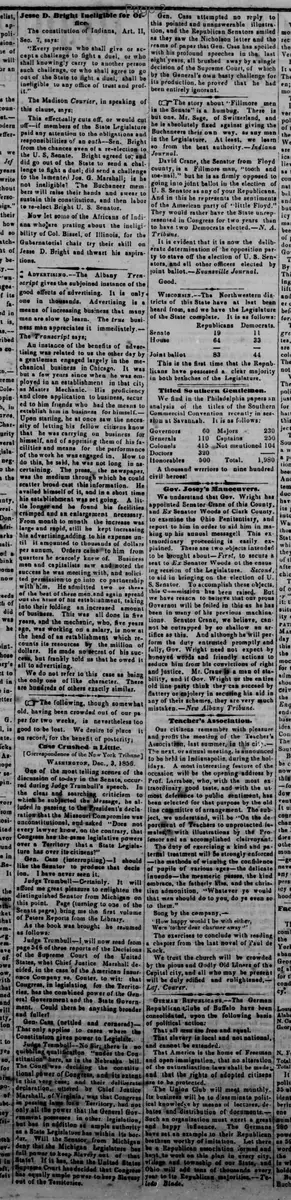
Cass Crushed a Little.
[Correspondence of the New York Tribune]
WASHINGTON, Dec. 3, 1856.
One of the most telling scenes of the discussion of to-day in the Senate, occurred during Judge Trumbull's speech. In the clear and searching criticism to which he subjected the Message, he alluded in passing to the President's declaration that the Missouri Compromise was unconstitutional, and asked "Does not every lawyer know, on the contrary, that Congress has the same legislative powers over a Territory that a State Legislature has over its citizens?"
Gen. Cass (interrupting)—I should like the Senator to produce that decision. I have never seen it.
Judge Trumbull—Certainly. It will afford me great pleasure to enlighten the distinguished Senator from Michigan on this point. Page (turning to one of the Senate pages) bring me the first volume of Peters Reports from the Library.
As the book was brought he resumed as follows:
Judge Trumbull—I will now read from page 546 of these reports of the Decisions of the Supreme Court of the United States, what Chief Justice Marshall decided, in the case of the American Insurance Company vs. Canter, to wit: that Congress, in legislating for the Territories, has the combined power of the General Government and the State Government. Could there be anything broader and fuller?
Gen. Cass (nettled and confused)—That only applies to cases where the Constitution gives power to Legislate.
Judge Trumbull—No Sir; there is no quibbling qualification "under the Constitution" here, as in the Nebraska bill. The Court was deciding the constitutional power of Congress, and its extent in this very case; and their deliberate declaration, uttered by Chief Justice Marshall, of Virginia, was that Congress in passing laws for a Territory, had not only all the power that the General Government possesses in other legislation, but has in addition as ample authority as a State Legislature has within its borders. Will the Senator from Michigan deny that the Michigan Legislature has full power to keep Slavery out of that State? If it has, then the United States Supreme Court has decided that Congress has equally ample power to keep Slavery out of the Territories.
Gen. Cass attempted no reply to this pointed and unanswerable illustration, and the Republican Senators smiled as they saw the Nicholson letter and the reams of paper that Gen. Cass has spoiled with his profound speeches in the last eight years, all brushed away by a single decision of the Supreme Court, of which by the General's own hasty challenge for its production, he proved that he had been entirely ignorant.
What sub-type of article is it?
What keywords are associated?
What entities or persons were involved?
Where did it happen?
Domestic News Details
Primary Location
Washington
Event Date
Dec. 3, 1856
Key Persons
Outcome
gen. cass attempted no reply to this pointed and unanswerable illustration, and the republican senators smiled as they saw the nicholson letter and the reams of paper that gen. cass has spoiled with his profound speeches in the last eight years, all brushed away by a single decision of the supreme court, of which by the general's own hasty challenge for its production, he proved that he had been entirely ignorant.
Event Details
One of the most telling scenes of the discussion of to-day in the Senate, occurred during Judge Trumbull's speech. In the clear and searching criticism to which he subjected the Message, he alluded in passing to the President's declaration that the Missouri Compromise was unconstitutional, and asked "Does not every lawyer know, on the contrary, that Congress has the same legislative powers over a Territory that a State Legislature has over its citizens?" Gen. Cass interrupted asking for the decision. Judge Trumbull had a page bring the first volume of Peters Reports and read from page 546 the decision in the case of the American Insurance Company vs. Canter, where Chief Justice Marshall decided that Congress, in legislating for the Territories, has the combined power of the General Government and the State Government. Gen. Cass responded that it only applies to cases where the Constitution gives power to Legislate. Judge Trumbull refuted this, stating there is no such qualification, and explained that Congress has ample power to keep Slavery out of the Territories, as the Michigan Legislature has for the State.