Thank you for visiting SNEWPapers!
Sign up free
Southport Telegraph
Kenosha, Southport, Kenosha County, Wisconsin
What is this article about?
Graphic accounts from Dresden, December 1813, describe the horrific return of frost-bitten French soldiers from the retreat from Moscow, with a regiment reduced to 70 men, sparking anti-French rage among locals and fueling national uprising against Napoleon.
Clipping
OCR Quality
Full Text
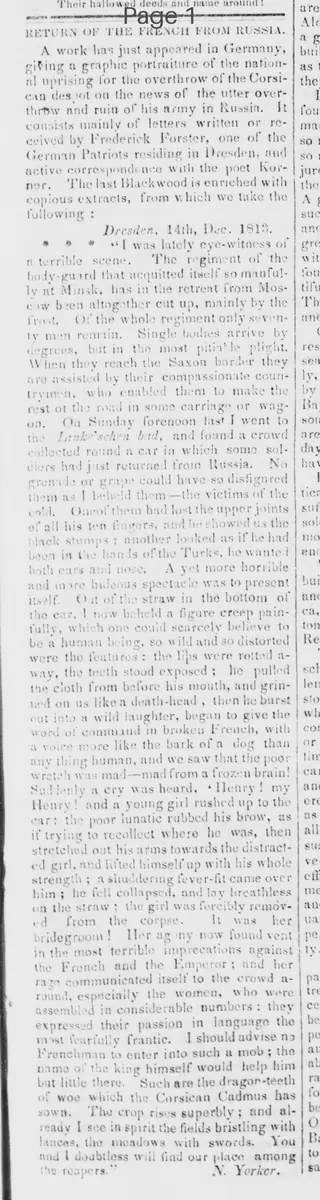
A work has just appeared in Germany, giving a graphic portraiture of the national uprising for the overthrow of the Corsican despot on the news of the utter overthrow and ruin of his army in Russia. It consists mainly of letters written or received by Frederick Forster, one of the German Patriots residing in Dresden, and active correspondence with the poet Korner. The last Blackwood is enriched with copious extracts, from which we take the following :
Dresden, 14th, Dec. 1813,
"I was lately eye-witness of a terrible scene. The regiment of the body-guard that acquitted itself so manfully at Minsk, has in the retreat from Moscow been altogether cut up, mainly by the frost. Of the whole regiment only seventy men remain. Single bodies arrive by degrees, but in the most pitiable plight. When they reach the Saxon border they are assisted by their compassionate countrymen, who enabled them to make the rest of the road in some carriage or wagon. On Sunday forenoon last I went to the Leipsiger strasse, and found a crowd collected round a car in which some soldiers had just returned from Russia. No grape or canister could have so disfigured them as I beheld them -the victims of the cold. One of them had lost the upper joints of all his ten fingers, and showed us the black stumps ; another looked as if he had been in the hands of the Turks, he wanted both ears and nose. A yet more horrible and more hideous spectacle was to present itself (Out of the straw in the bottom of the car. I now beheld a figure creep painfully, which one could scarcely believe to be a human being. so wild and so distorted were the features : the lips were rotted away, the teeth stood exposed ; he pulled the cloth from before his mouth, and grinned on us like a death-head , then he burst out into a wild laughter, began to give the word of command in broken French, with a voice more like the bark of a dog than any thing human, and we saw that the poor wretch was mad-mad from a frozen brain! Suddenly a cry was heard, Henry! my Henry ! and a young girl rushed up to the car: the poor lunatic rubbed his brow, as if trying to recollect where he was, then stretched out his arms towards the distracted girl, and lifted himself up with his whole strength ; a shuddering fever-fit came over him ; he fell collapsed, and lay breathless on the straw : the girl was forcibly removed from the corpse. It was her bridegroom! Her agony now found vent in the most terrible imprecations against the French and the Emperor; and her rage communicated itself to the crowd around, especially the women, who were assembled in considerable numbers : they expressed their passion in language the most fearfully frantic. I should advise no Frenchman to enter into such a mob ; the name of the king himself would help him but little there. Such are the dragon-teeth of woe which the Corsican Cadmus has sown. The crop rises superbly; and already I see in spirit the fields bristling with lances, the meadows with swords. You and I doubtless will find our place among the reapers.
N. Yorker.
What sub-type of article is it?
What keywords are associated?
What entities or persons were involved?
Where did it happen?
Foreign News Details
Primary Location
Dresden
Event Date
14th Dec. 1813
Key Persons
Outcome
regiment of the body-guard cut up by frost, only seventy men remain; one soldier mad and dies upon recognizing his bride.
Event Details
Eyewitness account of returning French soldiers in pitiable plight: lost fingers, ears, nose; one mad soldier resembling a death-head who dies in his bride's arms, inciting crowd's fury against the French and Emperor.