Thank you for visiting SNEWPapers!
Sign up free
Story
June 26, 1848
The Evansville Daily Journal
Evansville, Vanderburgh County, Indiana
What is this article about?
The Richmond Republican satirizes the Washington Union's lament over the Whig party's sidelining of Henry Clay, Winfield Scott, and Daniel Webster in favor of Zachary Taylor's nomination, exposing Democratic hypocrisy after past slanders against them during elections.
Clipping
OCR Quality
95%
Excellent
Full Text
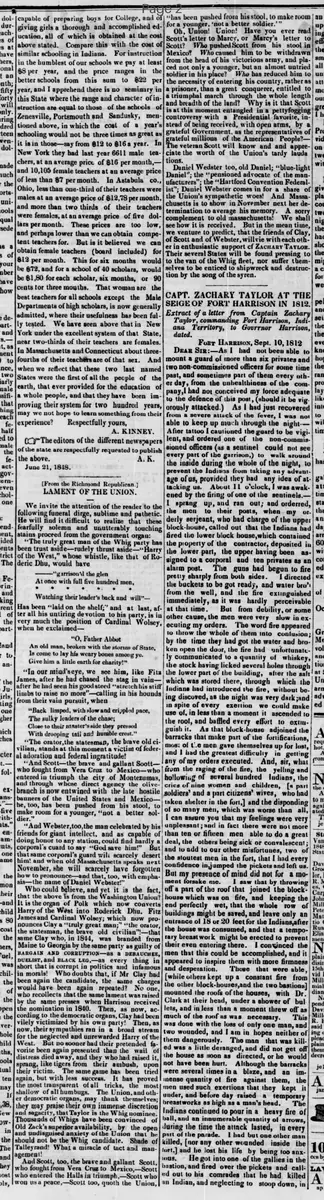
[From the Richmond Republican.]
LAMENT OF THE UNION.
We invite the attention of the reader to the following funeral dirge, sublime and pathetic. He will find it difficult to realize that these fearfully solemn and unutterably touching strains proceed from the government organ:
"The truly great man of the Whig party has been thrust aside--rudely thrust aside" Harry of the West." whose whistle, like that of Roderick Dhu, would have
"garrison'd the glen
At once with full five hundred men,
Watching their leader's back and will"--
Has been "laid on the shelf;" and at last, after all his untiring devotion to his party, is in very much the position of Cardinal Wolsey, when he exclaimed--
"O, Father Abbot
An old man, broken with the storms of State,
Is come to lay his weary bones among ye.
Give him a little earth for charity!"
"In our mind's eye, we see him, like Fitz James, after he had chased the stag in vain-- after he had seen his good steed "stretch his stiff limbs to raise no more"--calling in his hounds from their vain pursuit, when
"Back limped, with slow and crippled pace,
The sulky leaders of the chase:
Close to their master's side they pressed
With drooping tail and humble crest."
"The orator, the statesman, the brave old civilian, stands at this moment a victim of federal adoration and federal ingratitude!
"And Scott--the brave and gallant Scott-- who fought from Vera Cruz to Mexico--who entered in triumph the city of Montezuma's. and through whose direct agency the olive-branch is now entwined with the late hostile banners of the United States and Mexico-- he, too, has been pushed from his stool, to make room
for a younger, "not a better soldier."
"And Webster, too, the man celebrated by his friends for giant intellect, and as capable of doing honor to any station, could find hardly a corporal's guard to say "God save him!" But that same corporal's guard will scarcely desert him! and when old Massachusetts speaks next November, she will scarcely have forgotten how to pronounce--and that too, with emphasis--the name of Daniel Webster!"
Who could believe, and yet it is the fact, that the above is from the Washington Union? It is the organ of Polk which now converts Harry of the West into Roderick Dhu, Fitz James and Cardinal Wolsey; which now pronounces Clay a "truly great man;" "the orator, the statesman, the brave old civilian"!--that same Clay who, in 1844, was branded from Maine to Georgia by the same party as guilty of BARGAIN AND CORRUPTION--as a DEBAUCHEE, DUELIST, and BLACK LEG,--as every thing in short that is corrupt in politics and infamous in morals! Who doubts that, if Mr. Clay had been again the candidate, the same charges would have been again repeated? No one, who recollects that the same lament was raised by the same presses when Harrison received the nomination in 1840. Then, as now, according to the democratic organs, Clay had been vilely victimized by his own party! Then, as now, their sympathies ran in a broad stream for the neglected and unrewarded Harry of the West. But no sooner had their pretended favorite been again presented than the wail of distress died away, and they who had raised it, sprang, like tigers from their ambush, upon their victim. The same game has been tried again, but with less success. It has proved the most transparent of all tricks, the most shallow of all humbugs. The Union, and other democratic organs, may thank themselves; they may praise their own immense discretion and sagacity, that Taylor is the Whig nominee. Thousands of Whigs have been convinced of Old Zack's superior availability, by the open and undisguised anxiety of the Union that he should not be the Whig candidate. Shade of Talleyrand! What a miracle of tact and management!
And Scott, too, the brave and gallant Scott, who fought from Vera Cruz to Mexico,--Scott who entered the Halls in triumph,--Scott who won us a peace,--Scott too, quoth the Union,
"has been pushed from his stool, to make room for a younger, 'not a better soldier.'"
Oh, Union! Union! Have you ever read Scott's letter to Marcy, or Marcy's letter to Scott? Who pushed Scott from his stool in Mexico? Who caused him to be withdrawn from the head of his victorious army, and placed not only a younger, but an almost untried soldier in his place? Who has reduced him to the necessity of entering his country, rather as a prisoner, than a great conqueror, entitled to a triumphant march through the whole length and breadth of the land? Why is it that Scott is at this moment entangled in a petty fogging controversy with a Presidential favorite, instead of being received, with open arms, by a grateful Government, as the representative of grateful millions of the American People?--
The veteran Scott will know and appreciate the worth of the Union's tardy laudations.
Daniel Webster too, old Daniel; "blue-light Daniel"; the "pensioned advocate of the manufacturers": the "Hartford Convention Federalist"; Daniel Webster comes in for a share of the Union's sympathetic woes! And Massachusetts is to show in November next her determination to avenge his memory. A sorry compliment to old Massachusetts! We shall see how it is received. But in the mean time, we venture to predict, that the friends of Clay, of Scott and of Webster, will vie with each other in enthusiastic support of Zachary Taylor. Their several States will be found pressing to the van of the Whig fleet, nor suffer themselves to be enticed to shipwreck and destruction by the song of the syren.
LAMENT OF THE UNION.
We invite the attention of the reader to the following funeral dirge, sublime and pathetic. He will find it difficult to realize that these fearfully solemn and unutterably touching strains proceed from the government organ:
"The truly great man of the Whig party has been thrust aside--rudely thrust aside" Harry of the West." whose whistle, like that of Roderick Dhu, would have
"garrison'd the glen
At once with full five hundred men,
Watching their leader's back and will"--
Has been "laid on the shelf;" and at last, after all his untiring devotion to his party, is in very much the position of Cardinal Wolsey, when he exclaimed--
"O, Father Abbot
An old man, broken with the storms of State,
Is come to lay his weary bones among ye.
Give him a little earth for charity!"
"In our mind's eye, we see him, like Fitz James, after he had chased the stag in vain-- after he had seen his good steed "stretch his stiff limbs to raise no more"--calling in his hounds from their vain pursuit, when
"Back limped, with slow and crippled pace,
The sulky leaders of the chase:
Close to their master's side they pressed
With drooping tail and humble crest."
"The orator, the statesman, the brave old civilian, stands at this moment a victim of federal adoration and federal ingratitude!
"And Scott--the brave and gallant Scott-- who fought from Vera Cruz to Mexico--who entered in triumph the city of Montezuma's. and through whose direct agency the olive-branch is now entwined with the late hostile banners of the United States and Mexico-- he, too, has been pushed from his stool, to make room
for a younger, "not a better soldier."
"And Webster, too, the man celebrated by his friends for giant intellect, and as capable of doing honor to any station, could find hardly a corporal's guard to say "God save him!" But that same corporal's guard will scarcely desert him! and when old Massachusetts speaks next November, she will scarcely have forgotten how to pronounce--and that too, with emphasis--the name of Daniel Webster!"
Who could believe, and yet it is the fact, that the above is from the Washington Union? It is the organ of Polk which now converts Harry of the West into Roderick Dhu, Fitz James and Cardinal Wolsey; which now pronounces Clay a "truly great man;" "the orator, the statesman, the brave old civilian"!--that same Clay who, in 1844, was branded from Maine to Georgia by the same party as guilty of BARGAIN AND CORRUPTION--as a DEBAUCHEE, DUELIST, and BLACK LEG,--as every thing in short that is corrupt in politics and infamous in morals! Who doubts that, if Mr. Clay had been again the candidate, the same charges would have been again repeated? No one, who recollects that the same lament was raised by the same presses when Harrison received the nomination in 1840. Then, as now, according to the democratic organs, Clay had been vilely victimized by his own party! Then, as now, their sympathies ran in a broad stream for the neglected and unrewarded Harry of the West. But no sooner had their pretended favorite been again presented than the wail of distress died away, and they who had raised it, sprang, like tigers from their ambush, upon their victim. The same game has been tried again, but with less success. It has proved the most transparent of all tricks, the most shallow of all humbugs. The Union, and other democratic organs, may thank themselves; they may praise their own immense discretion and sagacity, that Taylor is the Whig nominee. Thousands of Whigs have been convinced of Old Zack's superior availability, by the open and undisguised anxiety of the Union that he should not be the Whig candidate. Shade of Talleyrand! What a miracle of tact and management!
And Scott, too, the brave and gallant Scott, who fought from Vera Cruz to Mexico,--Scott who entered the Halls in triumph,--Scott who won us a peace,--Scott too, quoth the Union,
"has been pushed from his stool, to make room for a younger, 'not a better soldier.'"
Oh, Union! Union! Have you ever read Scott's letter to Marcy, or Marcy's letter to Scott? Who pushed Scott from his stool in Mexico? Who caused him to be withdrawn from the head of his victorious army, and placed not only a younger, but an almost untried soldier in his place? Who has reduced him to the necessity of entering his country, rather as a prisoner, than a great conqueror, entitled to a triumphant march through the whole length and breadth of the land? Why is it that Scott is at this moment entangled in a petty fogging controversy with a Presidential favorite, instead of being received, with open arms, by a grateful Government, as the representative of grateful millions of the American People?--
The veteran Scott will know and appreciate the worth of the Union's tardy laudations.
Daniel Webster too, old Daniel; "blue-light Daniel"; the "pensioned advocate of the manufacturers": the "Hartford Convention Federalist"; Daniel Webster comes in for a share of the Union's sympathetic woes! And Massachusetts is to show in November next her determination to avenge his memory. A sorry compliment to old Massachusetts! We shall see how it is received. But in the mean time, we venture to predict, that the friends of Clay, of Scott and of Webster, will vie with each other in enthusiastic support of Zachary Taylor. Their several States will be found pressing to the van of the Whig fleet, nor suffer themselves to be enticed to shipwreck and destruction by the song of the syren.
What sub-type of article is it?
Historical Event
Deception Fraud
Biography
What themes does it cover?
Deception
Fortune Reversal
Justice
What keywords are associated?
Whig Nomination
Democratic Hypocrisy
Henry Clay
Winfield Scott
Daniel Webster
Zachary Taylor
Washington Union
Mexican War
What entities or persons were involved?
Henry Clay
Winfield Scott
Daniel Webster
Zachary Taylor
James K. Polk
Story Details
Key Persons
Henry Clay
Winfield Scott
Daniel Webster
Zachary Taylor
James K. Polk
Event Date
1848
Story Details
The article mocks the Washington Union's sympathetic portrayal of sidelined Whig leaders Henry Clay, Winfield Scott, and Daniel Webster, contrasting it with Democratic slanders in past elections and predicting unified Whig support for Taylor's nomination.