Thank you for visiting SNEWPapers!
Sign up free
Literary
March 25, 1928
Douglas Daily Dispatch
Douglas, Cochise County, Arizona
What is this article about?
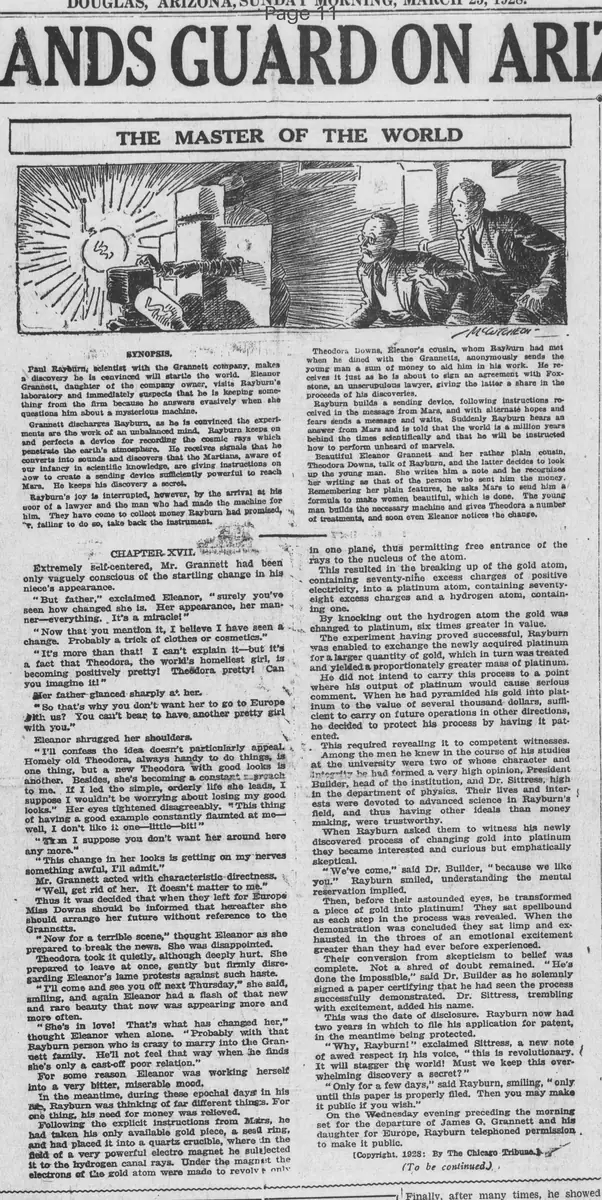
In this chapter, scientist Paul Rayburn communicates with Martians via cosmic rays, invents a beauty treatment for Theodora Downs, and transmutes gold to platinum for funding. Meanwhile, Eleanor Grannett grows jealous of Theodora's transformation and decides to exclude her from a Europe trip.
Clipping
OCR Quality
95%
Excellent
Full Text
ENDS GUARD ON THE MASTER OF THE WORLD
CHAPTER XVII.
Paul Rayburn, scientist with the Grannett company, makes a discovery he is convinced will startle the world. Eleanor Grannett, daughter of the company owner, visits Rayburn's laboratory and immediately suspects that he is keeping something from the firm because he answers evasively when she questions him about a mysterious machine.
Grannett discharges Rayburn, as he is convinced the experiments are the work of an unbalanced mind. Rayburn keeps on and perfects a device for recording the cosmic rays which converts into sounds and discovers that the Martians, aware of our infancy in scientific knowledge, are giving instructions on how to create a sending device sufficiently powerful to reach Mars. He keeps his discovery a secret.
Rayburn's joy is interrupted, however, by the arrival at his door of a lawyer and the man who had made the machine for him. They have come to collect money Rayburn had promised, and failing to do so, take back the instrument.
Theodora Downs, Eleanor's cousin, whom Rayburn had met when he dined with the Grannetts, anonymously sends the young man a sum of money to aid him in his work. He receives it just as he is about to sign an agreement with Foxstone, an unscrupulous lawyer, giving the latter a share in the proceeds of his discoveries.
Rayburn builds a sending device, following instructions received in the message from Mars, and with alternate hopes and fears sends a message and waits. Suddenly Rayburn hears an answer from Mars and is told that the world is a million years behind the times scientifically and that he will be instructed how to perform unheard of marvels.
Beautiful Eleanor Grannett and her rather plain cousin, Theodora Downs, talk of Rayburn, and the latter decides to look up the young man. She writes him a note and he recognizes her writing as that of the person who sent him the money.
Remembering her plain features, he asks Mars to send him a formula to make women beautiful, which is done. The young man builds the necessary machine and gives Theodora a number of treatments, and soon even Eleanor notices the change.
Extremely Self-centered, Mr. Grannett had been only vaguely conscious of the startling change in his niece's appearance.
"But father," exclaimed Eleanor, "surely you've seen how changed she is. Her appearance, her manner—everything. It's a miracle!"
"Now that you mention it, I believe I have seen a change. Probably a trick of clothes or cosmetics."
"It's more than that! I can't explain it—but it's becoming positively pretty! Theodora pretty! Can you imagine it!"
Her father glanced sharply at her.
"So that's why you don't want her to go to Europe with us? You can't bear to have another pretty girl with you."
Eleanor shrugged her shoulders.
"I'll confess the idea doesn't particularly appeal. Homely old Theodora, always handy to do things, is one thing, but a new Theodora with good looks is another. Besides, she's becoming a constant reproach to me. If I led the simple, orderly life she leads, I suppose I wouldn't be worrying about losing my good looks." Her eyes tightened disagreeably. "This thing of having a good example constantly flaunted at me—well, I don't like it one little bit!"
"I suppose you don't want her around here any more."
"This change in her looks is getting on my nerves something awful, I'll admit."
Mr. Grannett acted with characteristic directness.
"Well, get rid of her. It doesn't matter to me."
Thus it was decided that when they left for Europe Miss Downs should be informed that hereafter she should arrange her future without reference to the Grannetts.
Eleanor prepared to break the news. She was disappointed.
"Now for a terrible scene," thought Eleanor as she prepared to leave at once, gently but firmly disregarding Eleanor's lame protests against such haste.
Theodora took it quietly, although deeply hurt.
"I'll come and see you off next Thursday," she said, smiling, and again Eleanor had a flash of that new and rare beauty that now was appearing more and more often.
"She's in love! That's what has changed her," thought Eleanor when alone. "Probably with that Rayburn person who is crazy to marry into the Grannett family. He'll not feel that way when he finds she's only a cast-off poor relation."
For some reason Eleanor was working herself into a very bitter, miserable mood.
In the meantime, during these epochal days in his laboratory, Rayburn was thinking of far different things. For one thing, his need for money was relieved.
Following the explicit instructions from Mars, he had taken his only available gold piece, a small ring, and had placed it into a quartz crucible, where in the field of a very powerful electro magnet he subjected it to the hydrogen canal rays. Under the magnet the electrons of the gold atom were made to revolve only in one plane, thus permitting free entrance of the rays to the nucleus of the atom.
This resulted in the breaking up of the gold atom, containing seventy-nine excess charges of positive electricity, into a platinum atom, containing seventy-eight excess charges and a hydrogen atom, containing one.
By knocking out the hydrogen atom the gold was changed to platinum, six times greater in value.
The experiment having proved successful, Rayburn was enabled to exchange the newly acquired platinum for a larger quantity of gold, which in turn was treated and yielded a proportionately greater mass of platinum.
He did not intend to carry this process to a point where his output of platinum would cause serious comment. When he had pyramided his gold into platinum to the value of several thousand dollars, sufficient to carry on future operations in other directions, he decided to protect his process by having it patented.
This required revealing it to competent witnesses.
Among the men he knew in the course of his studies at the university were two of whose character and integrity he had formed a very high opinion, President Builder, head of the institution, and Dr. Sittress, high in the department of physics. Their lives and interests were devoted to advanced science in Rayburn's field, and thus having other ideals than money making, were trustworthy.
When Rayburn asked them to witness his newly discovered process of changing gold into platinum they became interested and curious but emphatically skeptical.
"We've come," said Dr. Builder, "because we like you."
Rayburn smiled, understanding the mental reservation implied.
Then, before their astounded eyes, he transformed a piece of gold into platinum! They sat spellbound as each step in the process was revealed. When the demonstration was concluded they sat limp and exhausted in the throes of an emotional excitement greater than they had ever before experienced.
Their conversion from skepticism to belief was complete. Not a shred of doubt remained. "He's done the impossible," said Dr. Builder as he solemnly signed a paper certifying that he had seen the process successfully demonstrated. Dr. Sittress, trembling with excitement, added his name.
This was the date of disclosure. Rayburn now had two years in which to file his application for patent, in the meantime being protected.
"Why, Rayburn!" exclaimed Sittress, a new note of awed respect in his voice, "this is revolutionary. It will stagger the world! Must we keep this overwhelming discovery a secret?"
"Only for a few days," said Rayburn, smiling, "only until this paper is properly filed. Then you may make it public if you wish."
On the Wednesday evening preceding the morning set for the departure of James G. Grannett and his daughter for Europe, Rayburn telephoned permission to make it public.
Copyright, 1928, by The Chicago Tribune.
(To be continued)
CHAPTER XVII.
Paul Rayburn, scientist with the Grannett company, makes a discovery he is convinced will startle the world. Eleanor Grannett, daughter of the company owner, visits Rayburn's laboratory and immediately suspects that he is keeping something from the firm because he answers evasively when she questions him about a mysterious machine.
Grannett discharges Rayburn, as he is convinced the experiments are the work of an unbalanced mind. Rayburn keeps on and perfects a device for recording the cosmic rays which converts into sounds and discovers that the Martians, aware of our infancy in scientific knowledge, are giving instructions on how to create a sending device sufficiently powerful to reach Mars. He keeps his discovery a secret.
Rayburn's joy is interrupted, however, by the arrival at his door of a lawyer and the man who had made the machine for him. They have come to collect money Rayburn had promised, and failing to do so, take back the instrument.
Theodora Downs, Eleanor's cousin, whom Rayburn had met when he dined with the Grannetts, anonymously sends the young man a sum of money to aid him in his work. He receives it just as he is about to sign an agreement with Foxstone, an unscrupulous lawyer, giving the latter a share in the proceeds of his discoveries.
Rayburn builds a sending device, following instructions received in the message from Mars, and with alternate hopes and fears sends a message and waits. Suddenly Rayburn hears an answer from Mars and is told that the world is a million years behind the times scientifically and that he will be instructed how to perform unheard of marvels.
Beautiful Eleanor Grannett and her rather plain cousin, Theodora Downs, talk of Rayburn, and the latter decides to look up the young man. She writes him a note and he recognizes her writing as that of the person who sent him the money.
Remembering her plain features, he asks Mars to send him a formula to make women beautiful, which is done. The young man builds the necessary machine and gives Theodora a number of treatments, and soon even Eleanor notices the change.
Extremely Self-centered, Mr. Grannett had been only vaguely conscious of the startling change in his niece's appearance.
"But father," exclaimed Eleanor, "surely you've seen how changed she is. Her appearance, her manner—everything. It's a miracle!"
"Now that you mention it, I believe I have seen a change. Probably a trick of clothes or cosmetics."
"It's more than that! I can't explain it—but it's becoming positively pretty! Theodora pretty! Can you imagine it!"
Her father glanced sharply at her.
"So that's why you don't want her to go to Europe with us? You can't bear to have another pretty girl with you."
Eleanor shrugged her shoulders.
"I'll confess the idea doesn't particularly appeal. Homely old Theodora, always handy to do things, is one thing, but a new Theodora with good looks is another. Besides, she's becoming a constant reproach to me. If I led the simple, orderly life she leads, I suppose I wouldn't be worrying about losing my good looks." Her eyes tightened disagreeably. "This thing of having a good example constantly flaunted at me—well, I don't like it one little bit!"
"I suppose you don't want her around here any more."
"This change in her looks is getting on my nerves something awful, I'll admit."
Mr. Grannett acted with characteristic directness.
"Well, get rid of her. It doesn't matter to me."
Thus it was decided that when they left for Europe Miss Downs should be informed that hereafter she should arrange her future without reference to the Grannetts.
Eleanor prepared to break the news. She was disappointed.
"Now for a terrible scene," thought Eleanor as she prepared to leave at once, gently but firmly disregarding Eleanor's lame protests against such haste.
Theodora took it quietly, although deeply hurt.
"I'll come and see you off next Thursday," she said, smiling, and again Eleanor had a flash of that new and rare beauty that now was appearing more and more often.
"She's in love! That's what has changed her," thought Eleanor when alone. "Probably with that Rayburn person who is crazy to marry into the Grannett family. He'll not feel that way when he finds she's only a cast-off poor relation."
For some reason Eleanor was working herself into a very bitter, miserable mood.
In the meantime, during these epochal days in his laboratory, Rayburn was thinking of far different things. For one thing, his need for money was relieved.
Following the explicit instructions from Mars, he had taken his only available gold piece, a small ring, and had placed it into a quartz crucible, where in the field of a very powerful electro magnet he subjected it to the hydrogen canal rays. Under the magnet the electrons of the gold atom were made to revolve only in one plane, thus permitting free entrance of the rays to the nucleus of the atom.
This resulted in the breaking up of the gold atom, containing seventy-nine excess charges of positive electricity, into a platinum atom, containing seventy-eight excess charges and a hydrogen atom, containing one.
By knocking out the hydrogen atom the gold was changed to platinum, six times greater in value.
The experiment having proved successful, Rayburn was enabled to exchange the newly acquired platinum for a larger quantity of gold, which in turn was treated and yielded a proportionately greater mass of platinum.
He did not intend to carry this process to a point where his output of platinum would cause serious comment. When he had pyramided his gold into platinum to the value of several thousand dollars, sufficient to carry on future operations in other directions, he decided to protect his process by having it patented.
This required revealing it to competent witnesses.
Among the men he knew in the course of his studies at the university were two of whose character and integrity he had formed a very high opinion, President Builder, head of the institution, and Dr. Sittress, high in the department of physics. Their lives and interests were devoted to advanced science in Rayburn's field, and thus having other ideals than money making, were trustworthy.
When Rayburn asked them to witness his newly discovered process of changing gold into platinum they became interested and curious but emphatically skeptical.
"We've come," said Dr. Builder, "because we like you."
Rayburn smiled, understanding the mental reservation implied.
Then, before their astounded eyes, he transformed a piece of gold into platinum! They sat spellbound as each step in the process was revealed. When the demonstration was concluded they sat limp and exhausted in the throes of an emotional excitement greater than they had ever before experienced.
Their conversion from skepticism to belief was complete. Not a shred of doubt remained. "He's done the impossible," said Dr. Builder as he solemnly signed a paper certifying that he had seen the process successfully demonstrated. Dr. Sittress, trembling with excitement, added his name.
This was the date of disclosure. Rayburn now had two years in which to file his application for patent, in the meantime being protected.
"Why, Rayburn!" exclaimed Sittress, a new note of awed respect in his voice, "this is revolutionary. It will stagger the world! Must we keep this overwhelming discovery a secret?"
"Only for a few days," said Rayburn, smiling, "only until this paper is properly filed. Then you may make it public if you wish."
On the Wednesday evening preceding the morning set for the departure of James G. Grannett and his daughter for Europe, Rayburn telephoned permission to make it public.
Copyright, 1928, by The Chicago Tribune.
(To be continued)
What sub-type of article is it?
Prose Fiction
What themes does it cover?
Commerce Trade
Social Manners
What keywords are associated?
Martian Instructions
Platinum Transmutation
Family Rivalry
Scientific Invention
Beauty Treatment
Literary Details
Title
Chapter Xvii.
Key Lines
"But Father," Exclaimed Eleanor, "Surely You've Seen How Changed She Is. Her Appearance, Her Manner—Everything. It's A Miracle!"
"So That's Why You Don't Want Her To Go To Europe With Us? You Can't Bear To Have Another Pretty Girl With You."
This Resulted In The Breaking Up Of The Gold Atom, Containing Seventy Nine Excess Charges Of Positive Electricity, Into A Platinum Atom, Containing Seventy Eight Excess Charges And A Hydrogen Atom, Containing One.
"He's Done The Impossible," Said Dr. Builder As He Solemnly Signed A Paper Certifying That He Had Seen The Process Successfully Demonstrated.