Thank you for visiting SNEWPapers!
Sign up free
Literary
March 21, 1840
The North Carolinian
Fayetteville, Cumberland County, North Carolina
What is this article about?
A positive review of The Democratic Review, praising its elegant literature and eloquent defense of democratic principles fought for by forefathers like Jefferson and Madison. It contrasts these with opposition ridicule and quotes a concluding passage on democracy's inevitable triumph, aided by purified Christianity, emphasizing human progress, equality, and dignity.
Clipping
OCR Quality
95%
Excellent
Full Text
The Democratic Review
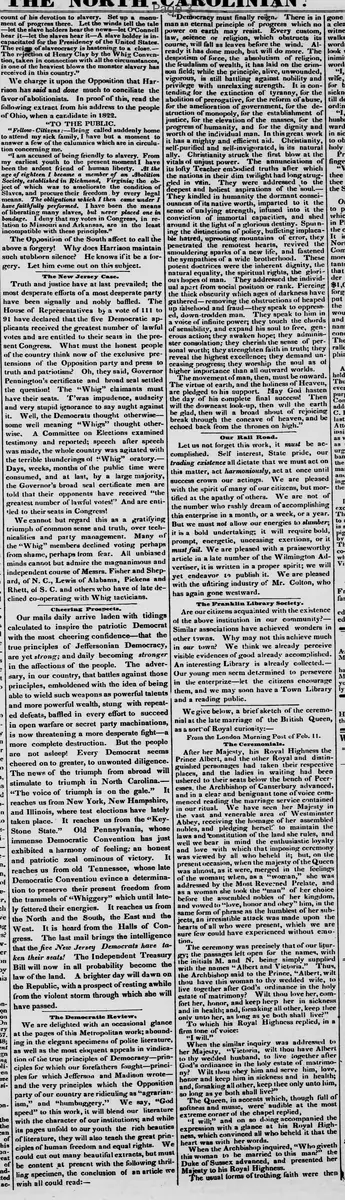
We are delighted with an occasional glance at the pages of this Metropolitan work; abounding in the elegant specimens of polite literature, as well as the most eloquent appeals in vindication of the true principles of Democracy—principles of which our forefathers fought—principles of which Jefferson and Madison wrote—and the very principles which the Opposition party of our country are ridiculing as "agrarianism," and "humbuggery."
We say, "God speed" to this work, it will blend our literature with the character of our institutions; and while its pages unfold to our youth the rich beauties of literature, they will also teach the great principles of human freedom and equal rights. We could cut out many beautiful extracts, but must be content at present with the following thrilling specimen, the conclusion of an article we wish all could read:—
"Democracy must finally reign—There is in man an eternal principle of progress which no power on earth may resist. Every custom, law, science or religion, which obstructs its course, will fall as leaves before the wind. Already it has done much, but will do more. The despotism of force, the absolutism of religion, the feudalism of wealth, it has laid on the crimson field; while the principle, alive, unwounded, vigorous, is still battling against nobility and privilege with unrelaxing strength. It is contending for the extinction of tyranny; for the abolition of prerogative, or the reform of abuse, for the amelioration of government, for the destruction of monopoly, for the establishment of justice, for the elevation of the masses, for the progress of humanity, and for the dignity and worth of the individual man. In this great work it has a mighty and efficient aid. Christianity, self-purified and self-invigorated, is its natural ally. Christianity struck the first blow at the vitals of unjust power. The annunciations of its lofty Teacher embodied truths after which the nations in their dim twilight had long struggled in vain. They were addressed to the deepest and holiest aspirations of the soul.—They kindled in humanity the dormant consciousness of its native worth, imparted to it the sense of undying strength, infused into it the conviction of immortal capacities, and shed around it the light of a glorious destiny. Spurning the distinctions of policy, buffeting implacable hatred, uprooting mountains of error, they penetrated the remotest hearts, revived the smouldering sparks of a new life, and fastened the sympathies of a wide brotherhood. These potent doctrines were the inherent dignity, the natural equality, the spiritual rights, the glorious hopes of man. They addressed the individual apart from social position or rank. Piercing the thick obscurity which ages of darkness have gathered—removing the obstructions of heaped up falsehood and fraud—they speak to oppressed, down-trodden man. They speak to him in a voice of infinite power; they touch the chords of sensibility, and expand his soul to free, generous action; they awaken hope; they administer consolation; they cherish the sense of personal worth; they strengthen faith in truth; they reveal the highest excellence; they demand unceasing progress; they worship the soul as of higher importance than all outward worlds.
The movement of man, then, must be onward. The virtue of earth, and the holiness of Heaven, are pledged to his support. May God hasten the day of his complete final success! Then will the downcast look up, then will the earth be glad, then will a broad shout of rejoicing break through the concave of heaven, and be echoed back from the thrones on high."
We are delighted with an occasional glance at the pages of this Metropolitan work; abounding in the elegant specimens of polite literature, as well as the most eloquent appeals in vindication of the true principles of Democracy—principles of which our forefathers fought—principles of which Jefferson and Madison wrote—and the very principles which the Opposition party of our country are ridiculing as "agrarianism," and "humbuggery."
We say, "God speed" to this work, it will blend our literature with the character of our institutions; and while its pages unfold to our youth the rich beauties of literature, they will also teach the great principles of human freedom and equal rights. We could cut out many beautiful extracts, but must be content at present with the following thrilling specimen, the conclusion of an article we wish all could read:—
"Democracy must finally reign—There is in man an eternal principle of progress which no power on earth may resist. Every custom, law, science or religion, which obstructs its course, will fall as leaves before the wind. Already it has done much, but will do more. The despotism of force, the absolutism of religion, the feudalism of wealth, it has laid on the crimson field; while the principle, alive, unwounded, vigorous, is still battling against nobility and privilege with unrelaxing strength. It is contending for the extinction of tyranny; for the abolition of prerogative, or the reform of abuse, for the amelioration of government, for the destruction of monopoly, for the establishment of justice, for the elevation of the masses, for the progress of humanity, and for the dignity and worth of the individual man. In this great work it has a mighty and efficient aid. Christianity, self-purified and self-invigorated, is its natural ally. Christianity struck the first blow at the vitals of unjust power. The annunciations of its lofty Teacher embodied truths after which the nations in their dim twilight had long struggled in vain. They were addressed to the deepest and holiest aspirations of the soul.—They kindled in humanity the dormant consciousness of its native worth, imparted to it the sense of undying strength, infused into it the conviction of immortal capacities, and shed around it the light of a glorious destiny. Spurning the distinctions of policy, buffeting implacable hatred, uprooting mountains of error, they penetrated the remotest hearts, revived the smouldering sparks of a new life, and fastened the sympathies of a wide brotherhood. These potent doctrines were the inherent dignity, the natural equality, the spiritual rights, the glorious hopes of man. They addressed the individual apart from social position or rank. Piercing the thick obscurity which ages of darkness have gathered—removing the obstructions of heaped up falsehood and fraud—they speak to oppressed, down-trodden man. They speak to him in a voice of infinite power; they touch the chords of sensibility, and expand his soul to free, generous action; they awaken hope; they administer consolation; they cherish the sense of personal worth; they strengthen faith in truth; they reveal the highest excellence; they demand unceasing progress; they worship the soul as of higher importance than all outward worlds.
The movement of man, then, must be onward. The virtue of earth, and the holiness of Heaven, are pledged to his support. May God hasten the day of his complete final success! Then will the downcast look up, then will the earth be glad, then will a broad shout of rejoicing break through the concave of heaven, and be echoed back from the thrones on high."
What sub-type of article is it?
Essay
What themes does it cover?
Liberty Freedom
Political
Religious
What keywords are associated?
Democracy
Progress
Liberty
Equality
Christianity
Human Dignity
Political Principles
Literary Details
Title
The Democratic Review
Subject
Vindication Of The True Principles Of Democracy
Form / Style
Prose Review With Quoted Excerpt
Key Lines
Democracy Must Finally Reign—There Is In Man An Eternal Principle Of Progress Which No Power On Earth May Resist.
Christianity, Self Purified And Self Invigorated, Is Its Natural Ally.
The Movement Of Man, Then, Must Be Onward. The Virtue Of Earth, And The Holiness Of Heaven, Are Pledged To His Support.