Thank you for visiting SNEWPapers!
Sign up free
Literary
August 14, 1824
Concord Register
Concord, Merrimack County, New Hampshire
What is this article about?
Memoirs of Rev. George Whitefield (1714-1770), abstracted from British Review, detail his early life, Methodist origins with Wesleys, ordination, preaching tours in England and America, open-air sermons, Calvinist controversies, orphan house in Georgia, and zealous ministry marked by immense crowds and conversions.
Clipping
OCR Quality
95%
Excellent
Full Text
Biography.
MEMOIRS OF THE LATE REV. GEORGE WHITEFIELD.
[Abstracted from the British Review.]
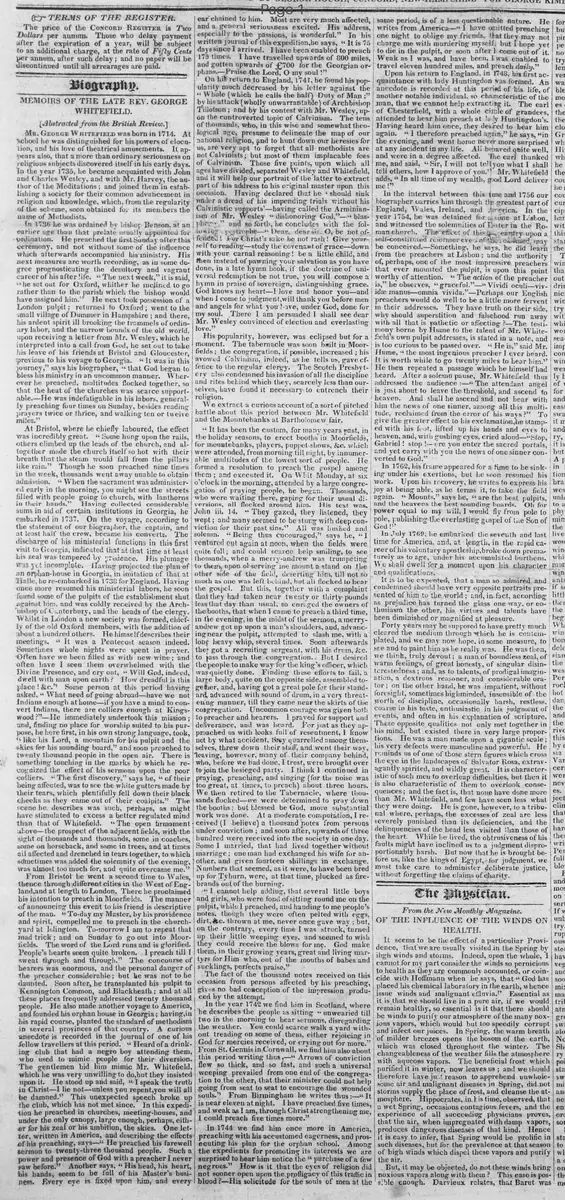
Mr. George Whitefield was born in 1714. At school he was distinguished for his powers of elocution, and his love of theatrical amusements. It appears also, that a more than ordinary seriousness on religious subjects discovered itself in his early days. In the year 1735, he became acquainted with John and Charles Wesley, and with Mr. Harvey, the author of the Meditations; and joined them in establishing a society for their common advancement in religion and knowledge, which, from the regularity of the scheme, soon obtained for its members the name of Methodists. In 1736 he was ordained by bishop Benson, at an earlier age than that prelate usually appointed for ordination. He preached the first Sunday after this ceremony, and not without some of the influence which afterwards accompanied his ministry. His next measures are worth recording, as in some degree prognosticating the desultory and vagrant career of his after life. "The next week," it is said, "he set out for Oxford, whither he inclined to go rather than to the parish which the bishop would have assigned him." He next took possession of a London pulpit; returned to Oxford; went to the small village of Dummer in Hampshire; and there, his ardent spirit ill brooking the trammels of ordinary labor, and the narrow bounds of the old world, upon receiving a letter from Mr. Wesley, which he interpreted into a call from God, he set out to take his leave of his friends at Bristol and Gloucester, previous to his voyage to Georgia. "It was in this journey," says his biographer, "that God began to bless his ministry in an uncommon manner. Wherever he preached, multitudes flocked together, so that the heat of the churches was scarce supportable.-He was indefatigable in his labors, generally preaching four times on Sunday, besides reading prayers twice or thrice, and walking ten or twelve miles." At Bristol, where he chiefly laboured, the effect was incredibly great. "Some hung upon the rails. others climbed up the leads of the church, and altogether made the church itself so hot with their breath that the steam would fall from the pillars like rain." Though he soon preached nine times in the week, thousands went away unable to obtain admission. "When the sacrament was administered early in the morning, you might see the streets filled with people going to church, with lanthorns in their hands." Having collected considerable sums in aid of certain institutions in Georgia, he embarked in 1737. On the voyage, according to the statement of our biographer, the captain, and at least half the crew, became his converts. The discharge of his ministerial functions in this first visit to Georgia, indicated that at that time at least his zeal was tempered by prudence. His plumage was yet incomplete. Having projected the plan of an orphan-house in Georgia, in imitation of that at Halle, he re-embarked in 1738 for England. Having once more resumed his ministerial labors, he soon found some of the pulpits of the establishment shut against him, and was coldly received by the Archbishop of Canterbury, and the heads of the clergy. Whilst in London a new society was formed, chiefly of the old Oxford members, with the addition of about a hundred others. He himself describes their meetings. "It was a Pentecost season indeed. Sometimes whole nights were spent in prayer. Often have we been filled as with new wine; and often have I seen them overwhelmed with the Divine Presence, and cry out, "Will God, indeed, dwell with man upon earth? How dreadful is this place! &c." Some person at this period having asked, "What need of going abroad have we not Indians enough at home—if you have a mind to convert Indians, there are colliers enough at Kingswood?"—He immediately undertook this mission; and, finding no place for worship suited to his purpose, he here first, in his own strong language, took, like his Lord, a mountain for his pulpit and the skies for his sounding board," and soon preached to twenty thousand people in the open air. There is something touching in the marks by which he recognized the effect of his sermons upon the poor colliers. "The first discovery," says he, "of their being affected, was to see the white gutters made by their tears, which plentifully fell down their black cheeks as they came out of their coalpits." The scene he describes was such, perhaps, as might have stimulated to excess a better regulated mind than that of Whitefield. "The open firmament above--the prospect of the adjacent fields, with the sight of thousands and thousands, some in coaches, some on horseback, and some in trees, and at times all affected and drenched in tears together, to which sometimes was added the solemnity of the evening, was almost too much for, and quite overcame me." From Bristol he went a second time to Wales, thence through different cities in the West of England, and at length to London. There he proclaimed his intention to preach in Moorfields. The manner of announcing this event to his friend is descriptive of the man. "To-day my Master, by his providence and spirit, compelled me to preach in the church-yard at Islington. To-morrow I am to repeat that mad trick: and on Sunday to go out into Moorfields. The word of the Lord runs and is glorified. People's hearts seem quite broken. I preach till I sweat through and through." The concourse of bearers was enormous, and the personal danger of the preacher considerable; but he was not to be daunted. Soon after, he transplanted his pulpit to Kennington Common, and Blackheath; and at all these places frequently addressed twenty thousand people. He also made another voyage to America, and founded his orphan house in Georgia: having, in his rapid course, planted the standard of methodism in several provinces of that country. A curious anecdote is recorded in the journal of one of his fellow travellers at this period. "Heard of a drinking club that had a negro boy attending them, who used to mimic people for their diversion. The gentlemen bid him mimic Mr. Whitefield. which he was very unwilling to do, but they insisted upon it. He stood up and said, "I speak the truth in Christ--I lie not--unless you repent, you will all be damned." This unexpected speech broke up the club, which has not met since." In this expedition he preached in churches, meeting-houses, and under the only canopy, large enough, perhaps, either for his zeal or his ambition, the skies. One letter, written in America, and describing the effects of his preaching, says--"He preached his farewell sermon to twenty-three thousand people. Such a power and presence of God with a preacher I never saw before." Another says, "His head, his heart, his hands, seem to be full of his Master's business. Every eye is fixed upon him, and every ear chained to him. Most are very much affected. and a general seriousness excited. His address, especially to the passions, is wonderful." In his written journal of this expedition, he says, "It is 75 days since I arrived. I have been enabled to preach 175 times. I have travelled upwards of 800 miles, and gotten upwards of £700 for the Georgian orphans.-Praise the Lord, O my soul!" On his return to England, 1741, he found his popularity much decreased by his letter against the "Whole (which he calls the half) Duty of Man;" by his attack (wholly unwarrantable) of Archbishop Tillotson; and by his contest with Mr. Wesley, upon the controverted topic of Calvinism. The tens of thousands, who, in this wise and somewhat theological age, presume to delineate the map of our national religion, and to hunt down our heresies for us, are very apt to forget that all methodists are not Calvinists; but most of them implacable foes of Calvinism. Those five points, upon which all ages have divided, separated Wesley and Whitefield, and it will help our portrait of the latter to extract part of his address to his original master upon this occasion. Having declared that he should sink under a dread of his impending trials without his Calvinistic supports'—having called the Arminianism of Mr. Wesley "dishonoring God," "blasphemy," and so forth, he concludes with the following peroration--"Dear, dear sir. O, be not offended! For Christ's sake be not rash! Give yourself to reading--study the covenant of grace--down with your carnal reasoning! be a little child, and then instead of pawning your salvation as you have done, in a late hymn book, if the doctrine of universal redemption be not true, you will compose a hymn in praise of sovereign, distinguishing grace. God knows my heart--I love and honor you--and when I come to judgment, will thank you before men and angels for what you have, under God, done for my soul. There I am persuaded I shall see dear Mr. Wesley convinced of election and everlasting love." His popularity, however, was eclipsed but for a moment. The tabernacle was soon built in Moorfields; the congregation, if possible, increased; his avowed Calvinism, indeed, as he tells us, gave offence to the regular clergy. The Scotch Presbytery also condemned his invasion of all the discipline and rites behind which they, scarcely less than ourselves, have found it necessary to entrench their religion. We extract a curious account of a sort of pitched battle about this period between Mr. Whitefield and the Mountebanks at Bartholomew fair. "It has been the custom, for many years past, in the holiday seasons, to erect booths in Moorfields, for mountebanks, players, puppet-shows, &c. which were attended, from morning till night, by innumerable multitudes of the lowest sort of people. He formed a resolution to preach the gospel among them: and executed it. On Whit Monday, at six o'clock in the morning, attended by a large congregation of praying people, he began. Thousands, who were waiting there, gaping for their usual diversions, all flocked around him. His text was, John iii. 14. "They gazed, they listened, they wept; and many seemed to be stung with deep conviction for their past sins." All was hushed and solemn. "Being thus encouraged," says he, "I ventured out again at noon, when the fields were quite full; and could scarce help smiling, to see thousands, when a merry-andrew was trumpeting to them, upon observing me mount a stand on the other side of the field, deserting him, till not so much as one was left behind, but all flocked to hear the gospel. But this, together with a complaint that they had taken near twenty or thirty pounds less that day than usual, so enraged the owners of the booths, that when I came to preach a third time, in the evening, in the midst of the sermon, a merry-andrew got up upon a man's shoulders, and, advancing near the pulpit, attempted to slash me, with a long heavy whip, several times. Soon afterwards they got a recruiting sergeant, with his drum, &c. to pass through the congregation. But I desired the people to make way for the king's officer, which was quietly done. Finding these efforts to fail, a large body, quite on the opposite side, assembled together, and, having got a great pole for their standard advanced with sound of drum, in a very threatening manner, till they came near the skirts of the congregation. Uncommon courage was given both to preacher and hearers. I prayed for support and deliverance, and was heard. For just as they approached us with looks full of resentment, I know not by what accident, they quarrelled among themselves, threw down their staff, and went their way, leaving, however, many of their company behind, who, before we had done, I trust, were brought over to join the besieged party. I think I continued in praying, preaching, and singing (for the noise was too great, at times, to preach) about three hours. We then retired to the Tabernacle, where thousands flocked--we were determined to pray down the booths; but blessed be God, more substantial work was done. At a moderate computation, I received (I believe) a thousand notes from persons under conviction; and soon after, upwards of three hundred were received into the society in one day. Some I married, that had lived together without marriage; one man had exchanged his wife for another, and given fourteen shillings in exchange. Numbers that seemed, as it were, to have been bred up for Tyburn, were, at that time, plucked as firebrands out of the burning. "I cannot help adding, that several little boys and girls, who were fond of sitting round me on the pulpit, while I preached, and handing to me people's notes, though they were often pelted with eggs, dirt, &c. thrown at me, never once gave way; but, on the contrary, every time I was struck, turned up their little weeping eyes, and seemed to wish they could receive the blows for me. God make them, in their growing years, great and living martyrs for Him who, out of the mouths of babes and sucklings, perfects praise." The fact of the thousand notes received on this occasion from persons affected by his preaching, gives no bad conception of the impression produced by the attempt. In the year 1742 we find him in Scotland, where he describes the people as sitting "unwearied till two in the morning to hear sermons, disregarding the weather. You could scarce walk a yard without treading on some of them, either rejoicing in God for mercies received, or crying out for more." From St. Dennis in Cornwall, we find him also about this period writing thus,--"Arrows of conviction flew so thick, and so fast, and such a universal weeping prevailed from one end of the congregation to the other, that their minister could not help going from seat to seat to encourage the wounded souls." From Birmingham he writes thus: "It is near eleven at night. I have preached five times, and weak as I am, through Christ strengthening me, I could preach five times more." In 1744 we find him once more in America, preaching with his accustomed eagerness, and prosecuting his plan for the orphan school. Among the expedients for promoting its interests we are surprised to hear him notice the "purchase of a few negroes." How is it that the eyes of religion did not sooner open upon the profligacy of this traffic in blood?--His solicitude for the souls of men at the same period, is of a less questionable nature. He writes from America--"I have omitted preaching one night to oblige my friends, that they may not charge me with murdering myself; but I hope yet to die in the pulpit, or soon after I come out of it. Weak as I was, and have been, I was enabled to travel eleven hundred miles, and preach daily." Upon his return to England, in 1748, his first acquaintance with lady Huntingdon was formed. An anecdote is recorded at this period of his life, of another notable individual, so characteristic of the man, that we cannot help extracting it. The earl of Chesterfield, with a whole circle of grandees, attended to hear him preach at lady Huntingdon's. Having heard him once, they desired to hear him again. "I therefore preached again," he says, "in the evening, and went home never more surprised at any incident in my life. All behaved quite well, and were in a degree affected. The earl thanked me, and said, "Sir, I will not tell you what I shall tell others, how I approve of you." Mr. Whitefield adds, "In all time of my wealth, good Lord deliver me!" In the interval between this time and 1756 our biographer carries him through the greatest part of England, Wales, Ireland, and America. In the year 1754, he was detained for a time at Lisbon, and witnessed the solemnities of Easter in the Roman church. The effect of this brief upon a self-constituted reformer every where renowned, may be conceived.--Something, he says, he did learn from the preachers at Lisbon; and the authority of, perhaps, one of the most impressive preachers that ever mounted the pulpit, is upon this point worthy of attention. "The action of the preacher is," he observes, "graceful." "Vividi oculi—vivida manus—omnia vivida."—Perhaps our English preachers would do well to be a little more fervent in their addresses. They have truth on their side, why should superstition and falsehood run away with all that is pathetic or affecting?--The testimony borne by Hume to the talent of Mr. Whitefield's own pulpit addresses, is stated in a note, and is too curious to be passed over. "He is," said Mr. Hume, "the most ingenious preacher I ever heard. It is worth while to go twenty miles to hear him." He then repeated a passage which he himself had heard. After a solemn pause, Mr. Whitefield thus addressed the audience:--"The attendant angel is just about to leave the threshold, and ascend to heaven. And shall he ascend and not bear with him the news of one sinner, among all this multitude, reclaimed from the error of his ways?" To give the greater effect to his exclamation, he stamped with his foot, lifted up his hands and eyes to heaven, and, with gushing eyes, cried aloud--"Stop, Gabriel! stop!--ere you enter the sacred portals, and yet carry with you the news of one sinner converted to God." In 1752, his frame appeared for a time to be sinking under his exertions, but he soon resumed his work. Upon his recovery, he writes to express his joy at being able, as he terms it, to take the field again. "Mounts," says he, "are the best pulpits, and the heavens the best sounding boards. Oh for power equal to my will, I would fly from pole to pole, publishing the everlasting gospel of the Son of God!" In July 1769; he embarked the seventh and last time for America, and, at length, in the rapid career of his voluntary apostleship, broke down prematurely as to age, under his accumulated burthens. We shall dwell for a moment upon his character and qualifications. It is to be expected, that a man so admired and condemned should have very opposite portraits presented of him to the world; and, in fact, according as prejudice has turned the glass one way, or enthusiasm the other, his virtues and talents have been diminished or magnified at pleasure. Forty years may be supposed to have pretty much cleared the medium through which he is contemplated, and we may now hope, in some measure, to see and to paint him as he really was. He was then, we think, truly devout; a man of boundless zeal, of warm feelings, of great honesty, of singular disinterestedness; and, as to talents, of prodigal imagination, a dextrous reasoner, and considerable orator; on the other hand, he was impatient, without foresight, sometimes highminded, insensible of the worth of discipline, occasionally harsh, restless, coarse in his taste, enthusiastic in his judgment of events, and often in his explanation of scripture. These opposite qualities not only met together in his mind, but existed there in very large proportions. He was a man made upon a gigantic scale; his very defects were masculine and powerful. He reminds us of one of those stern figures which cross the eye in the landscapes of Salvator Rosa, extravagantly spirited, and wildly great. It is characteristic of such men to overleap difficulties, but then it is also characteristic of them to overlook consequences; and the fact is, that none have done more than Mr. Whitefield, and few have seen less what they were doing. He is gone, however, to a tribunal where, perhaps, the excesses of zeal are less severely punished than its deficiencies, and the delinquencies of the head less visited than those of the heart. While he lived, the obtrusiveness of his faults might have inclined us to a judgment disproportionately harsh. But now that he is brought before us, like the kings of Egypt, for judgment, we must take care to administer deliberate justice, without forgetting the claims of charity.
MEMOIRS OF THE LATE REV. GEORGE WHITEFIELD.
[Abstracted from the British Review.]
Mr. George Whitefield was born in 1714. At school he was distinguished for his powers of elocution, and his love of theatrical amusements. It appears also, that a more than ordinary seriousness on religious subjects discovered itself in his early days. In the year 1735, he became acquainted with John and Charles Wesley, and with Mr. Harvey, the author of the Meditations; and joined them in establishing a society for their common advancement in religion and knowledge, which, from the regularity of the scheme, soon obtained for its members the name of Methodists. In 1736 he was ordained by bishop Benson, at an earlier age than that prelate usually appointed for ordination. He preached the first Sunday after this ceremony, and not without some of the influence which afterwards accompanied his ministry. His next measures are worth recording, as in some degree prognosticating the desultory and vagrant career of his after life. "The next week," it is said, "he set out for Oxford, whither he inclined to go rather than to the parish which the bishop would have assigned him." He next took possession of a London pulpit; returned to Oxford; went to the small village of Dummer in Hampshire; and there, his ardent spirit ill brooking the trammels of ordinary labor, and the narrow bounds of the old world, upon receiving a letter from Mr. Wesley, which he interpreted into a call from God, he set out to take his leave of his friends at Bristol and Gloucester, previous to his voyage to Georgia. "It was in this journey," says his biographer, "that God began to bless his ministry in an uncommon manner. Wherever he preached, multitudes flocked together, so that the heat of the churches was scarce supportable.-He was indefatigable in his labors, generally preaching four times on Sunday, besides reading prayers twice or thrice, and walking ten or twelve miles." At Bristol, where he chiefly laboured, the effect was incredibly great. "Some hung upon the rails. others climbed up the leads of the church, and altogether made the church itself so hot with their breath that the steam would fall from the pillars like rain." Though he soon preached nine times in the week, thousands went away unable to obtain admission. "When the sacrament was administered early in the morning, you might see the streets filled with people going to church, with lanthorns in their hands." Having collected considerable sums in aid of certain institutions in Georgia, he embarked in 1737. On the voyage, according to the statement of our biographer, the captain, and at least half the crew, became his converts. The discharge of his ministerial functions in this first visit to Georgia, indicated that at that time at least his zeal was tempered by prudence. His plumage was yet incomplete. Having projected the plan of an orphan-house in Georgia, in imitation of that at Halle, he re-embarked in 1738 for England. Having once more resumed his ministerial labors, he soon found some of the pulpits of the establishment shut against him, and was coldly received by the Archbishop of Canterbury, and the heads of the clergy. Whilst in London a new society was formed, chiefly of the old Oxford members, with the addition of about a hundred others. He himself describes their meetings. "It was a Pentecost season indeed. Sometimes whole nights were spent in prayer. Often have we been filled as with new wine; and often have I seen them overwhelmed with the Divine Presence, and cry out, "Will God, indeed, dwell with man upon earth? How dreadful is this place! &c." Some person at this period having asked, "What need of going abroad have we not Indians enough at home—if you have a mind to convert Indians, there are colliers enough at Kingswood?"—He immediately undertook this mission; and, finding no place for worship suited to his purpose, he here first, in his own strong language, took, like his Lord, a mountain for his pulpit and the skies for his sounding board," and soon preached to twenty thousand people in the open air. There is something touching in the marks by which he recognized the effect of his sermons upon the poor colliers. "The first discovery," says he, "of their being affected, was to see the white gutters made by their tears, which plentifully fell down their black cheeks as they came out of their coalpits." The scene he describes was such, perhaps, as might have stimulated to excess a better regulated mind than that of Whitefield. "The open firmament above--the prospect of the adjacent fields, with the sight of thousands and thousands, some in coaches, some on horseback, and some in trees, and at times all affected and drenched in tears together, to which sometimes was added the solemnity of the evening, was almost too much for, and quite overcame me." From Bristol he went a second time to Wales, thence through different cities in the West of England, and at length to London. There he proclaimed his intention to preach in Moorfields. The manner of announcing this event to his friend is descriptive of the man. "To-day my Master, by his providence and spirit, compelled me to preach in the church-yard at Islington. To-morrow I am to repeat that mad trick: and on Sunday to go out into Moorfields. The word of the Lord runs and is glorified. People's hearts seem quite broken. I preach till I sweat through and through." The concourse of bearers was enormous, and the personal danger of the preacher considerable; but he was not to be daunted. Soon after, he transplanted his pulpit to Kennington Common, and Blackheath; and at all these places frequently addressed twenty thousand people. He also made another voyage to America, and founded his orphan house in Georgia: having, in his rapid course, planted the standard of methodism in several provinces of that country. A curious anecdote is recorded in the journal of one of his fellow travellers at this period. "Heard of a drinking club that had a negro boy attending them, who used to mimic people for their diversion. The gentlemen bid him mimic Mr. Whitefield. which he was very unwilling to do, but they insisted upon it. He stood up and said, "I speak the truth in Christ--I lie not--unless you repent, you will all be damned." This unexpected speech broke up the club, which has not met since." In this expedition he preached in churches, meeting-houses, and under the only canopy, large enough, perhaps, either for his zeal or his ambition, the skies. One letter, written in America, and describing the effects of his preaching, says--"He preached his farewell sermon to twenty-three thousand people. Such a power and presence of God with a preacher I never saw before." Another says, "His head, his heart, his hands, seem to be full of his Master's business. Every eye is fixed upon him, and every ear chained to him. Most are very much affected. and a general seriousness excited. His address, especially to the passions, is wonderful." In his written journal of this expedition, he says, "It is 75 days since I arrived. I have been enabled to preach 175 times. I have travelled upwards of 800 miles, and gotten upwards of £700 for the Georgian orphans.-Praise the Lord, O my soul!" On his return to England, 1741, he found his popularity much decreased by his letter against the "Whole (which he calls the half) Duty of Man;" by his attack (wholly unwarrantable) of Archbishop Tillotson; and by his contest with Mr. Wesley, upon the controverted topic of Calvinism. The tens of thousands, who, in this wise and somewhat theological age, presume to delineate the map of our national religion, and to hunt down our heresies for us, are very apt to forget that all methodists are not Calvinists; but most of them implacable foes of Calvinism. Those five points, upon which all ages have divided, separated Wesley and Whitefield, and it will help our portrait of the latter to extract part of his address to his original master upon this occasion. Having declared that he should sink under a dread of his impending trials without his Calvinistic supports'—having called the Arminianism of Mr. Wesley "dishonoring God," "blasphemy," and so forth, he concludes with the following peroration--"Dear, dear sir. O, be not offended! For Christ's sake be not rash! Give yourself to reading--study the covenant of grace--down with your carnal reasoning! be a little child, and then instead of pawning your salvation as you have done, in a late hymn book, if the doctrine of universal redemption be not true, you will compose a hymn in praise of sovereign, distinguishing grace. God knows my heart--I love and honor you--and when I come to judgment, will thank you before men and angels for what you have, under God, done for my soul. There I am persuaded I shall see dear Mr. Wesley convinced of election and everlasting love." His popularity, however, was eclipsed but for a moment. The tabernacle was soon built in Moorfields; the congregation, if possible, increased; his avowed Calvinism, indeed, as he tells us, gave offence to the regular clergy. The Scotch Presbytery also condemned his invasion of all the discipline and rites behind which they, scarcely less than ourselves, have found it necessary to entrench their religion. We extract a curious account of a sort of pitched battle about this period between Mr. Whitefield and the Mountebanks at Bartholomew fair. "It has been the custom, for many years past, in the holiday seasons, to erect booths in Moorfields, for mountebanks, players, puppet-shows, &c. which were attended, from morning till night, by innumerable multitudes of the lowest sort of people. He formed a resolution to preach the gospel among them: and executed it. On Whit Monday, at six o'clock in the morning, attended by a large congregation of praying people, he began. Thousands, who were waiting there, gaping for their usual diversions, all flocked around him. His text was, John iii. 14. "They gazed, they listened, they wept; and many seemed to be stung with deep conviction for their past sins." All was hushed and solemn. "Being thus encouraged," says he, "I ventured out again at noon, when the fields were quite full; and could scarce help smiling, to see thousands, when a merry-andrew was trumpeting to them, upon observing me mount a stand on the other side of the field, deserting him, till not so much as one was left behind, but all flocked to hear the gospel. But this, together with a complaint that they had taken near twenty or thirty pounds less that day than usual, so enraged the owners of the booths, that when I came to preach a third time, in the evening, in the midst of the sermon, a merry-andrew got up upon a man's shoulders, and, advancing near the pulpit, attempted to slash me, with a long heavy whip, several times. Soon afterwards they got a recruiting sergeant, with his drum, &c. to pass through the congregation. But I desired the people to make way for the king's officer, which was quietly done. Finding these efforts to fail, a large body, quite on the opposite side, assembled together, and, having got a great pole for their standard advanced with sound of drum, in a very threatening manner, till they came near the skirts of the congregation. Uncommon courage was given both to preacher and hearers. I prayed for support and deliverance, and was heard. For just as they approached us with looks full of resentment, I know not by what accident, they quarrelled among themselves, threw down their staff, and went their way, leaving, however, many of their company behind, who, before we had done, I trust, were brought over to join the besieged party. I think I continued in praying, preaching, and singing (for the noise was too great, at times, to preach) about three hours. We then retired to the Tabernacle, where thousands flocked--we were determined to pray down the booths; but blessed be God, more substantial work was done. At a moderate computation, I received (I believe) a thousand notes from persons under conviction; and soon after, upwards of three hundred were received into the society in one day. Some I married, that had lived together without marriage; one man had exchanged his wife for another, and given fourteen shillings in exchange. Numbers that seemed, as it were, to have been bred up for Tyburn, were, at that time, plucked as firebrands out of the burning. "I cannot help adding, that several little boys and girls, who were fond of sitting round me on the pulpit, while I preached, and handing to me people's notes, though they were often pelted with eggs, dirt, &c. thrown at me, never once gave way; but, on the contrary, every time I was struck, turned up their little weeping eyes, and seemed to wish they could receive the blows for me. God make them, in their growing years, great and living martyrs for Him who, out of the mouths of babes and sucklings, perfects praise." The fact of the thousand notes received on this occasion from persons affected by his preaching, gives no bad conception of the impression produced by the attempt. In the year 1742 we find him in Scotland, where he describes the people as sitting "unwearied till two in the morning to hear sermons, disregarding the weather. You could scarce walk a yard without treading on some of them, either rejoicing in God for mercies received, or crying out for more." From St. Dennis in Cornwall, we find him also about this period writing thus,--"Arrows of conviction flew so thick, and so fast, and such a universal weeping prevailed from one end of the congregation to the other, that their minister could not help going from seat to seat to encourage the wounded souls." From Birmingham he writes thus: "It is near eleven at night. I have preached five times, and weak as I am, through Christ strengthening me, I could preach five times more." In 1744 we find him once more in America, preaching with his accustomed eagerness, and prosecuting his plan for the orphan school. Among the expedients for promoting its interests we are surprised to hear him notice the "purchase of a few negroes." How is it that the eyes of religion did not sooner open upon the profligacy of this traffic in blood?--His solicitude for the souls of men at the same period, is of a less questionable nature. He writes from America--"I have omitted preaching one night to oblige my friends, that they may not charge me with murdering myself; but I hope yet to die in the pulpit, or soon after I come out of it. Weak as I was, and have been, I was enabled to travel eleven hundred miles, and preach daily." Upon his return to England, in 1748, his first acquaintance with lady Huntingdon was formed. An anecdote is recorded at this period of his life, of another notable individual, so characteristic of the man, that we cannot help extracting it. The earl of Chesterfield, with a whole circle of grandees, attended to hear him preach at lady Huntingdon's. Having heard him once, they desired to hear him again. "I therefore preached again," he says, "in the evening, and went home never more surprised at any incident in my life. All behaved quite well, and were in a degree affected. The earl thanked me, and said, "Sir, I will not tell you what I shall tell others, how I approve of you." Mr. Whitefield adds, "In all time of my wealth, good Lord deliver me!" In the interval between this time and 1756 our biographer carries him through the greatest part of England, Wales, Ireland, and America. In the year 1754, he was detained for a time at Lisbon, and witnessed the solemnities of Easter in the Roman church. The effect of this brief upon a self-constituted reformer every where renowned, may be conceived.--Something, he says, he did learn from the preachers at Lisbon; and the authority of, perhaps, one of the most impressive preachers that ever mounted the pulpit, is upon this point worthy of attention. "The action of the preacher is," he observes, "graceful." "Vividi oculi—vivida manus—omnia vivida."—Perhaps our English preachers would do well to be a little more fervent in their addresses. They have truth on their side, why should superstition and falsehood run away with all that is pathetic or affecting?--The testimony borne by Hume to the talent of Mr. Whitefield's own pulpit addresses, is stated in a note, and is too curious to be passed over. "He is," said Mr. Hume, "the most ingenious preacher I ever heard. It is worth while to go twenty miles to hear him." He then repeated a passage which he himself had heard. After a solemn pause, Mr. Whitefield thus addressed the audience:--"The attendant angel is just about to leave the threshold, and ascend to heaven. And shall he ascend and not bear with him the news of one sinner, among all this multitude, reclaimed from the error of his ways?" To give the greater effect to his exclamation, he stamped with his foot, lifted up his hands and eyes to heaven, and, with gushing eyes, cried aloud--"Stop, Gabriel! stop!--ere you enter the sacred portals, and yet carry with you the news of one sinner converted to God." In 1752, his frame appeared for a time to be sinking under his exertions, but he soon resumed his work. Upon his recovery, he writes to express his joy at being able, as he terms it, to take the field again. "Mounts," says he, "are the best pulpits, and the heavens the best sounding boards. Oh for power equal to my will, I would fly from pole to pole, publishing the everlasting gospel of the Son of God!" In July 1769; he embarked the seventh and last time for America, and, at length, in the rapid career of his voluntary apostleship, broke down prematurely as to age, under his accumulated burthens. We shall dwell for a moment upon his character and qualifications. It is to be expected, that a man so admired and condemned should have very opposite portraits presented of him to the world; and, in fact, according as prejudice has turned the glass one way, or enthusiasm the other, his virtues and talents have been diminished or magnified at pleasure. Forty years may be supposed to have pretty much cleared the medium through which he is contemplated, and we may now hope, in some measure, to see and to paint him as he really was. He was then, we think, truly devout; a man of boundless zeal, of warm feelings, of great honesty, of singular disinterestedness; and, as to talents, of prodigal imagination, a dextrous reasoner, and considerable orator; on the other hand, he was impatient, without foresight, sometimes highminded, insensible of the worth of discipline, occasionally harsh, restless, coarse in his taste, enthusiastic in his judgment of events, and often in his explanation of scripture. These opposite qualities not only met together in his mind, but existed there in very large proportions. He was a man made upon a gigantic scale; his very defects were masculine and powerful. He reminds us of one of those stern figures which cross the eye in the landscapes of Salvator Rosa, extravagantly spirited, and wildly great. It is characteristic of such men to overleap difficulties, but then it is also characteristic of them to overlook consequences; and the fact is, that none have done more than Mr. Whitefield, and few have seen less what they were doing. He is gone, however, to a tribunal where, perhaps, the excesses of zeal are less severely punished than its deficiencies, and the delinquencies of the head less visited than those of the heart. While he lived, the obtrusiveness of his faults might have inclined us to a judgment disproportionately harsh. But now that he is brought before us, like the kings of Egypt, for judgment, we must take care to administer deliberate justice, without forgetting the claims of charity.
What sub-type of article is it?
Essay
What themes does it cover?
Religious
Moral Virtue
Political
What keywords are associated?
George Whitefield
Methodism
Preaching
Revival
Calvinism
Orphan House
Open Air Sermons
Wesley
Georgia
Evangelism
What entities or persons were involved?
[Abstracted From The British Review.]
Literary Details
Title
Memoirs Of The Late Rev. George Whitefield.
Author
[Abstracted From The British Review.]
Subject
Biography Of Rev. George Whitefield
Key Lines
"The First Discovery," Says He, "Of Their Being Affected, Was To See The White Gutters Made By Their Tears, Which Plentifully Fell Down Their Black Cheeks As They Came Out Of Their Coalpits."
"To Day My Master, By His Providence And Spirit, Compelled Me To Preach In The Church Yard At Islington. To Morrow I Am To Repeat That Mad Trick: And On Sunday To Go Out Into Moorfields. The Word Of The Lord Runs And Is Glorified. People's Hearts Seem Quite Broken. I Preach Till I Sweat Through And Through."
"It Is 75 Days Since I Arrived. I Have Been Enabled To Preach 175 Times. I Have Travelled Upwards Of 800 Miles, And Gotten Upwards Of £700 For The Georgian Orphans. Praise The Lord, O My Soul!"
"Stop, Gabriel! Stop! Ere You Enter The Sacred Portals, And Yet Carry With You The News Of One Sinner Converted To God."
He Was Then, We Think, Truly Devout; A Man Of Boundless Zeal, Of Warm Feelings, Of Great Honesty, Of Singular Disinterestedness; And, As To Talents, Of Prodigal Imagination, A Dextrous Reasoner, And Considerable Orator; On The Other Hand, He Was Impatient, Without Foresight, Sometimes Highminded, Insensible Of The Worth Of Discipline, Occasionally Harsh, Restless, Coarse In His Taste, Enthusiastic In His Judgment Of Events, And Often In His Explanation Of Scripture.