Thank you for visiting SNEWPapers!
Sign up free
The Detroit Times
Detroit, Wayne County, Michigan
What is this article about?
Mrs. Newell Dwight Hillis criticizes American women for being placed on a pedestal, leading to unrealistic expectations and contributing to high divorce rates. She compares them unfavorably to European women in housekeeping, arts, literature, and business, urging women to endure marital hardships for society's sake and focus on real responsibilities.
Clipping
OCR Quality
Full Text
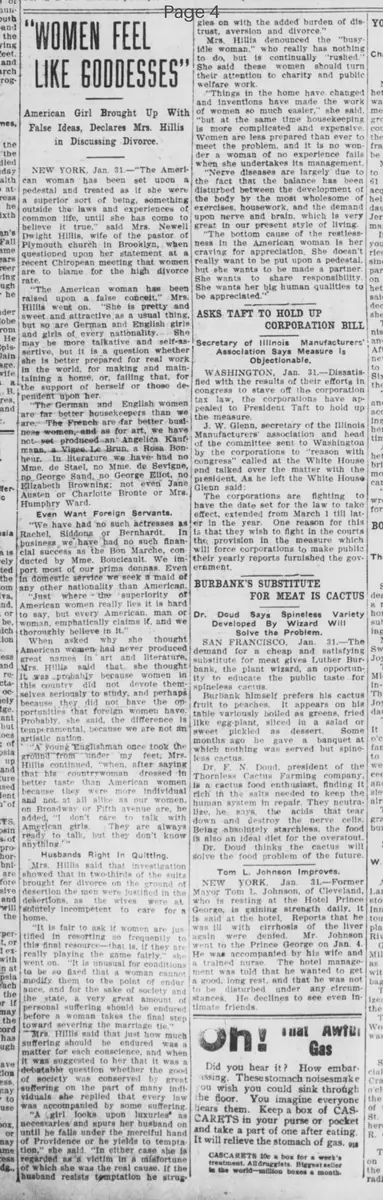
LIKE GODDESSES"
American
Girl
Brought
Up
With
False Ideas, Declares Mrs. Hillis
in Discussing Divorce.
NEW YORK, Jan. 31.—"The American woman has been set upon a pedestal and treated as if she were a superior sort of being, something outside the laws and experiences of common life, until she has come to believe it true," said Mrs. Newell Dwight Hillis, wife of the pastor of Plymouth church in Brooklyn, when questioned upon her statement at a recent Chautauquan meeting that women are to blame for the high divorce rate.
"The American woman has been raised upon a false conceit," Mrs. Hillis went on. "She is pretty and sweet and attractive as a usual thing, but so are German and English girls and girls of every nationality. She may be more talkative and self-assertive, but it is a question whether she is better prepared for real work in the world, for making and maintaining a home, or, failing that, for the support of herself or those dependent upon her.
"The German and English women are far better housekeepers than we are. The French are far better business women, and as for art, we have not yet produced an Angelica Kauffmann, a Vigée-Le Brun, a Rosa Bonheur. In literature we have had no Mme. de Staël, no Mme. de Sévigné, no George Sand, no George Eliot, no Elizabeth Browning; not even Jane Austen or Charlotte Brontë or Mrs. Humphry Ward.
Even Want Foreign Servants.
"We have had no such actresses as Rachel, Siddons or Bernhardt. In business we have had no such financial success as the Bon Marché, conducted by Mme. Boucicault. We import most of our prima donnas. Even in domestic service we seek a maid of any other nationality than American.
"Just where the superiority of American women really lies it is hard to say, but every American, man or woman, emphatically claims it, and we thoroughly believe in it."
When asked why she thought American women had never produced great names in art and literature, Mrs. Hillis said that she thought it was probably because women in this country did not devote themselves seriously to study, and perhaps because they did not have the opportunities that foreign women have. Probably, she said, the difference is temperamental, because we are not an artistic nation.
"A young Englishman once took the ground from under my feet," Mrs. Hillis continued, "when, after saying that his countrywomen dressed in better taste than American women because they were more individual and not at all alike as our women on Broadway or Fifth avenue are, he added, 'I don't care to talk with American girls. They are always ready to talk, but they don't know anything.'"
Husbands Right In Quitting.
Mrs. Hillis said that investigation showed that in two-thirds of the suits brought for divorce on the ground of desertion the men were justified in the desertions, as the wives were absolutely incompetent to care for a home.
"It is fair to ask if women are justified in resorting so frequently to this final resource—that is, if they are really playing the game fairly," she went on. "It is unusual for conditions to be so fixed that a woman cannot modify them to the point of endurance, and for the sake of society and the state, a very great amount of personal suffering should be endured before a woman takes the final step toward severing the marriage tie."
Mrs. Hillis said that just how much suffering should be endured was a matter for each conscience, and when it was suggested to her that it was a debatable question whether the good of society was conserved by great suffering on the part of many individuals she replied that every law was accompanied by some suffering.
"A girl looks upon luxuries as necessaries, and spurs her husband on until he falls under the merciful hand of Providence or he yields to temptation," she said. "In either case she is regarded as a victim in a misfortune of which she was the real cause. If the husband resists temptation he struggles on with the added burden of distrust, aversion and divorce."
Mrs. Hillis denounced the "busy idle woman," who really has nothing to do, but is continually "rushed." She said these women should turn their attention to charity and public welfare work.
"Things in the home have changed and inventions have made the work of women so much easier," she said. "But at the same time housekeeping is more complicated and expensive. Women are less prepared than ever to meet the problem, and it is no wonder a woman of no experience fails when she undertakes its management.
"Nerve diseases are largely due to the fact that the balance has been disturbed between the development of the body by the most wholesome of exercises, housework, and the demand upon nerve and brain, which is very great in our present style of living.
"The bottom cause of the restlessness in the American woman is her craving for appreciation. She doesn't really want to be put upon a pedestal, but she wants to be made a partner. She wants to share responsibility. She wants her big human qualities to be appreciated."
What sub-type of article is it?
What themes does it cover?
What keywords are associated?
What entities or persons were involved?
Where did it happen?
Story Details
Key Persons
Location
New York
Event Date
Jan. 31
Story Details
Mrs. Hillis argues that American women, raised with inflated self-importance, contribute to high divorce rates through incompetence in homemaking and unrealistic expectations, contrasting them with superior European women in various fields and advocating endurance in marriage for societal good.